Palestine Foundation Information Center
By: Dr. Sabir Abu Maryam
Secretary General, Palestine Foundation Pakistan
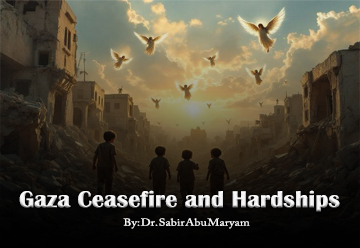
The Palestinian region of the Gaza Strip has been suffering under a continuous, inhuman blockade for the past twenty years. On the global level, human rights activists often refer to Gaza as an open prison. The very mention of Gaza recalls stories of pain and suffering. Two years ago, at American insistence and with constant military support, the occupying Zionist army launched a brutal assault on Gaza which still continues today.
After this attack and ongoing genocide, two months ago U.S. President Donald Trump presented a dramatic ceasefire agreement, and some Muslim governments signed it in hopes of stopping the genocide in Gaza.
Although a ceasefire has been declared on the surface, in reality the occupying Israeli forces continue their aggression in Gaza. Under such circumstances, global observers have termed this ceasefire agreement a fake ceasefire.
Gaza, the most heavily besieged region in the world, has faced famine and genocide. After the ceasefire, it was hoped that life in Gaza might begin to recover, but although hope has emerged, many obstacles still remain, most significantly Israel’s obstinacy and its protection under American patronage.
Winter has now begun in Gaza. With every year’s arrival of cold weather, Gaza faces a new test. Last year, during the brutal genocide, the people of Gaza did not even have proper tents to shield themselves from the cold, and the world witnessed the unimaginable sight of innocent children forced to live in freezing rainwater and mud. President Trump may have presented a ceasefire agreement for his own political gain, but this year’s winter, amid the lingering consequences of war, is no less difficult than previous years; in fact, it is even more troubling.
The Gaza Strip, where bombardment, displacement, and a severe humanitarian crisis have paralyzed life, now faces an intensity of cold that has made survival almost impossible. Destroyed houses, a shortage of shelters, a scarcity of fuel, a collapsing health system, and limited access to food and water have all turned Gaza’s winter into a deadly season. The war has displaced hundreds of thousands of people. Entire families are forced to live under the open sky or inside temporary tents. Cold winds, rains, and the falling temperature have become serious threats for them. Damaged buildings with broken doors and windows, and piles of rubble everywhere, cannot protect anyone during winter. The combination of war and winter has pushed the humanitarian crisis to an extreme.
Meanwhile, the number of tent camps across Gaza continues to increase, but the condition of these tents is extremely poor. Most of them cannot withstand rain and tear apart in strong winds. Many tents lack warm clothing, blankets, or proper bedding even in the freezing cold. Several families are forced to live inside small tents, increasing the spread of disease and destroying any sense of privacy and human dignity.
In Gaza today, it has become normal for tents to flood with rainwater, for mud to accumulate everywhere, and for children to fall ill. In such conditions, winter becomes not just a hardship but a battle for survival.
Fuel, electricity, and heating resources are in severe shortage. Because of the Israeli blockade, bringing fuel into Gaza is nearly impossible, leaving people without any means of warming themselves. Power outages, a lack of gas cylinders, and shortages of wood and coal have made winter life extremely dangerous. Many families are forced to burn pieces of wood from the seashore, scraps of fabric, or even waste material. This is not only insufficient but also dangerous for health. Due to lack of warmth, pneumonia, respiratory diseases, fevers, and infections are spreading rapidly among children, the elderly, and the sick.
During the war, Gaza’s health system collapsed completely. The occupying Zionist forces destroyed almost all hospitals in Gaza. Most health facilities have been reduced to rubble, and those still functioning are under intense strain. In winter:
Pneumonia cases are rising
Respiratory infections are spreading rapidly
Stomach illnesses are increasing due to lack of clean water
Untreated wounds and infections are causing deaths
There is a severe shortage of medicines, syringes, oxygen cylinders, vaccines, and warm blankets
According to the World Health Organization, this crisis of cold and disease is intensifying the devastation caused by war.
During winter, the human body needs more energy and nutrition, yet access to food in Gaza is already limited. Many families cannot find even one proper meal a day, and warm food has become a rarity. Water shortages have made the situation worse. Collecting rainwater in tent camps is not easy, and in the cold season drinking contaminated water leads to further sickness. Malnutrition among children is increasing rapidly.
The groups most affected by the cold are:
Children: lack of clothing, wet tents, dangerous winter illnesses, psychological trauma, hygiene issues
Pregnant women and mothers: health risks and difficulty caring for children
Elderly: weakened bodies unable to bear freezing temperatures
All these groups are in desperate need of humanitarian assistance.
In such circumstances, the people of Gaza need uninterrupted aid. According to the United Nations and relief organizations, despite the severe winter, aid delivery remains extremely limited. Every hour of delay costs lives. The major barriers include the blockade, bombardment, destroyed roads, and political obstacles. Despite the agreement, Israel has not allowed the Rafah crossing to operate fully for humanitarian activities. In these conditions, winter has become a silent killer for the defenseless people of Gaza.
Despite all these hardships, the Palestinian people continue to set an example of courage, resilience, and unity. Helping one another, sharing limited resources, and standing firm in the face of adversity reflect their collective spirit. It is this resilience that keeps them standing against both winter and war.
In conclusion, winter in Gaza is not just a seasonal change—it is a humanitarian tragedy intertwined with war, blockade, and poverty. The situation demands an urgent awakening of global conscience and immediate practical steps. Without proper shelters, heating, food, medicine, blankets, clean water, and safety, surviving winter in Gaza is impossible.
The people of Gaza are enduring not only the bitter weather but also the cold indifference of the world. Humanity requires that the international community and the Muslim world unite urgently to assist the people of Gaza and reduce the severity of this crisis. It is our collective human, moral, religious, and political responsibility to ensure large-scale aid for Gaza so that this tragedy can be confronted and lives can be saved.