By: Dr. Sabir Abu Maryam
Secretary General Palestine Foundation Pakistan
(Palestine Foundation Information Center), The “Gaza Board of Peace” is essentially a continuation of the ceasefire framework announced in September last year regarding the Gaza war. That ceasefire, however, has never materialized on the ground, as the occupying Zionist regime of Israel continues its aggression against Gaza. More than one hundred days have passed since the so-called agreement was announced, yet not a single day has gone by in which the brutal Israeli occupation forces have not killed Palestinian civilians and loved ones.
In September, the U.S. President gathered a number of Muslim and Western states and declared a ceasefire in Gaza, claiming that eight Muslim governments would serve as guarantors. Yet today, even those guarantors appear helpless in the face of ongoing Israeli aggression and acts of terrorism.
Under Trump’s twenty-point so-called peace framework, the first phase involved a mutual prisoner exchange between the Palestinians and Israelis, which was executed. The second phase was to deal with Gaza’s reconstruction, administrative supervision and other governance-related affairs.
In reality, the Gaza Board of Peace can be understood as the second phase of that ceasefire arrangement. Its central claim is that a neutral security, administrative and reconstruction authority would govern Gaza after the war to ensure future stability. On the surface, this sounds like a blueprint for peace, reconstruction and economic recovery, but within Palestinian society it has triggered deep suspicion and concern. Many Palestinians view the plan as a new form of colonial management.
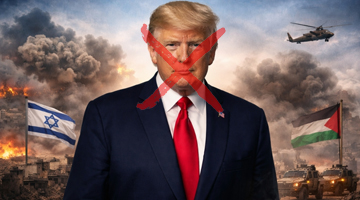
Their apprehension is justified, especially because the chairman of the Board is none other than U.S. President Trump, a figure widely seen as fueling conflict worldwide, destabilizing sovereign governments and fostering chaos. Recent examples include Venezuela and Iran, where Trump’s aggressive foreign policy has been visible to the world.
Trump has also included former British Prime Minister Tony Blair in the Board, a man whose hands are stained with the blood of thousands of Iraqis. Trump’s notorious son-in-law Jared Kushner, U.S. Secretary of State Marco Rubio, Washington’s special envoy to West Asia Steve Witkoff, and even World Bank President Ajay Banga (an Indian national) are part of the Board.
Palestinians argue, rightfully, that non-Palestinians are being imposed to decide the fate of Palestine. The plan sidelines Palestinians from any central role in political decision-making, raising fundamental questions:
By what authority do external powers decide Gaza’s future?, Where do local political actors, elected representatives and resistance groups fit in?, Is Gaza being converted into an international protectorate or trusteeship?
The deeper fear is that this arrangement will erode the Palestinian right to self-determination. A large segment of Palestinians already believes that global powers are transforming the Palestinian question from a political conflict into a mere administrative crisis. At the same time, the occupying Israeli regime has recognized Somaliland and is preparing plans to forcibly resettle Palestinian refugees there, another alarming signal.
In truth, the purpose of the plan is to dismantle Gaza militarily and keep it politically ineffective so the resistance cannot re-organize. Under the operational structure of the Board, Muslim military forces would be deployed to Gaza under the label of “international stabilization forces.” Under the guise of peace, the rights of Palestinians are being undermined, while Washington seeks to limit Palestinian strategic capacity and guarantee Israel low-cost security benefits. This is, in essence, a U.S. security architecture designed for Israel’s defense.
This is a new form of security colonialism, where “peace” means comfort for the occupier and control for the occupied population.
Although American officials promise a reconstruction fund for Gaza, the attached conditions are deeply troubling. One of the stipulations ties reconstruction to the absence of Palestinian rocket fire, meaning that Israel could violate the ceasefire at will, as it has since the agreement, yet expect no retaliation. Is this justice? The framework effectively grants protection to the killers.
Even reconstruction would not be directed by Palestinians themselves; rather, the Board would decide where and what is to be rebuilt, outsiders determining what is “good” or “bad” for Gaza. It is an openly unjust and coercive arrangement. This is the same model the U.S. imposed in Iraq, Libya and Bosnia, where post-war economies pushed populations into deeper dependency. Gaza’s weakening is the goal, not its recovery.
Resistance movements also view the Gaza Board of Peace as a softer form of warfare aimed at neutralizing Palestinian resistance. Hamas has openly rejected any arrangement where command lies with foreign entities. The Palestinian public refuses to accept an administration dominated by outsiders. Having failed to defeat Gaza militarily, the U.S. and Israel now seek to deceive Gaza politically in the name of peace, rendering Palestinians administratively irrelevant while discrediting the resistance.
Resistance in Palestine is not merely an organization, it is a historical and national consciousness shaped after 1948 through exile camps and internal social structures. Today, it exists in the mind and heart of every Palestinian child. The United States can never eliminate this idea.
In summary, the Palestinian position is simple:They want not peace without freedom, but freedom first, liberation, sovereignty and the end of occupation.
If peace initiatives aim to suppress freedom, Palestinians will see them only as neo-colonial arrangements. And that is the American conspiracy unfolding in Gaza under the label of peace. The Gaza Board of Peace may appear administrative, but for Palestinians it is a denial of sovereignty, an insult to resistance, a division of national unity, a protection of Israeli interests and a soft form of colonial control.
A real solution demands that peace be felt not by the occupier but by the occupied, and that is possible only when Palestinians become masters of their own future. Palestine is the homeland of Palestinians, and only they have the right to decide its destiny. An American government waging wars globally cannot exploit the slogan of peace to oppress Palestinians.
This conspiracy will never be accepted by the people of Gaza and Palestine.