By: Dr. Sabir Abu Maryam
Secretary General – Palestine Foundation Pakistan (PLF)
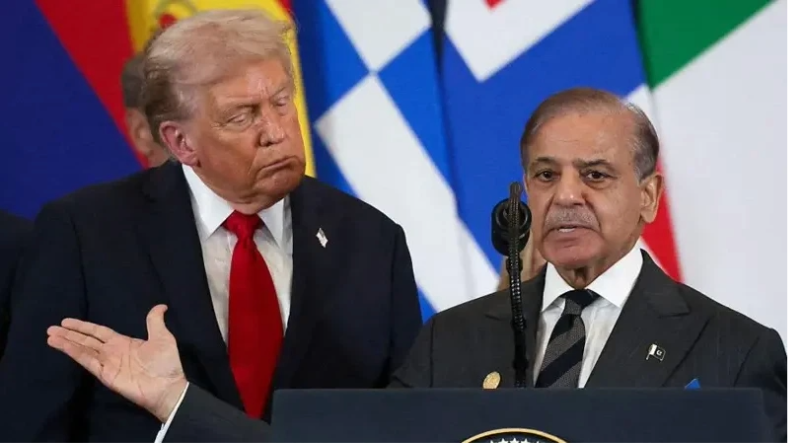
(Palestine Foundation Information Center), U.S. President Donald Trump has announced the second phase of the Gaza ceasefire initiative under the title “Gaza Board of Peace.” Pakistan, along with seven other countries, has joined this Board.
Prime Minister Shehbaz Sharif was personally invited by President Trump to join, and Pakistan has formally agreed. Other Muslim participants included Egypt, Saudi Arabia, Indonesia, the United Arab Emirates, Morocco, Jordan, and Türkiye also accepted the invitation.
Following this development, Western political analysts believe Trump aims to use the Gaza Board of Peace as a cover to introduce a new global system parallel to the United Nations, a system through which Washington can enforce unilateral decisions in world affairs.
Pakistan’s decision to join was taken solely to please the Trump administration. Neither house of Parliament debated the matter, nor was any national consultation held. The decision was taken unilaterally, without public or institutional consensus.
Meanwhile, across Pakistan, the decision has faced rejection from citizens, journalists, lawyers, political activists, and intellectuals. For the Pakistani public, participating in a U.S.-led forum on Palestine is viewed as a betrayal of the Palestinian people. Only a few government-aligned commentators are attempting to defend the decision.
The Gaza Board of Peace uses the language of peace, but it envisions a peace without Palestinians. Although described as the continuation of last year’s ceasefire agreement, in reality, no ceasefire ever materialized. Israel has continued to violate terms, bombard Gaza, escalate killings, and worsen the humanitarian crisis. The next agenda is now to forcibly disarm Palestinian resistance factions, especially Hamas, effectively ending resistance in the name of peace.
On January 21, Trump openly declared that 59 countries have joined the Gaza Peace Board and are prepared to eliminate Hamas in Gaza and fight Hezbollah in Lebanon. Trump claims to speak on behalf of Muslim armies, stating that forces from Muslim countries will be deployed to Gaza and Lebanon to dismantle resistance movements.
In Pakistan, Finance Minister Ishaq Dar continues to assure the public that Pakistan will not act against Hamas, yet Pakistan has already joined and is preparing to send 4,000 troops as part of the initiative.
Pakistan’s participation has sparked public alarm: will Prime Minister Shehbaz Sharif now sit at the same table with Israeli Prime Minister Benjamin Netanyahu, the man responsible for the massacre of Palestinians? Netanyahu has already declared that all members of the Gaza Peace Board will have to follow his terms.
Another concern: Netanyahu rejects the deployment of Turkish forces in Gaza but raises no objection to Pakistani troops. This discrepancy has caused discomfort and unease within Pakistan’s political, religious, and academic circles.
To calm public anger, Islamabad is now claiming that Pakistan is participating under UN Security Council Resolution 2803. But the public is no longer naïve. If the government genuinely respects UN decisions, then what about the International Criminal Court (ICC), which has already issued warrants for Netanyahu’s arrest? Will Pakistan’s prime minister sit beside a man wanted by an international court for war crimes and the killing of thousands of Palestinians?
If UNSC resolutions are sacred, why is ICC enforcement selectively ignored?
If a Pakistani prime minister shares a negotiation table with Netanyahu, then serious ideological questions emerge, What happens to the ideology of Pakistan?, Will we erase Quaid-e-Azam Muhammad Ali Jinnah’s statements declaring Israel an illegitimate state?, Will Pakistan abandon its principled stance on Palestine?, Will Pakistan’s support for Kashmir’s right to self-determination also be reconsidered?
These questions arise because Pakistan has made a historically flawed decision under U.S. pressure. The Pakistani public stands firmly against it.
Pakistan and seven Muslim states have joined the Board, but they have been assigned a subordinate role. The Executive Committee will make all decisions, and member states must implement them. Trump himself has assumed the role of Chair, and has appointed a circle of controversial figures including former British PM Tony Blair, Jared Kushner, U.S. Foreign Secretary Marco Rubio, Envoy Steve Witkoff, Ajay Banga, and others, none of whom represent Palestinian interests.
Decisions regarding the future of Palestine will thus be made by a non-Palestinian, Western-led committee.
Russian President Vladimir Putin rejected the invitation to join, stating that Russia seeks to defend Palestinian rights, not endorse decisions against them, a stance one would have expected from Muslim states.
Türkiye’s position has also raised questions: it accepted the American invitation while simultaneously facing Israeli pressure not to deploy Turkish troops. European states likewise declined Trump’s invitation. French President Macron openly criticized the Board.
Trump does not intend to confine the Gaza Board of Peace to Gaza alone. His vision is to use it as a global conflict-management tool outside the UN, with total decision-making power in U.S. hands. This is not peace, it is a continuation of power politics aimed at imposing U.S. dominance on weaker states.
The Final Question is that, will Pakistan discuss Gaza under a forum where the killer of Palestinians sits as a decision-maker? Will the murderers decide the fate of their victims, while Palestinians themselves remain absent from the picture?
History remembers those who choose the right side, and those who don’t. It is now for the Government of Pakistan to decide whether it stands with justice or aligns with a violent political bloc. If it sides with the latter, Pakistan’s emerging global reputation, which has recently seen improvement, will suffer serious damage.