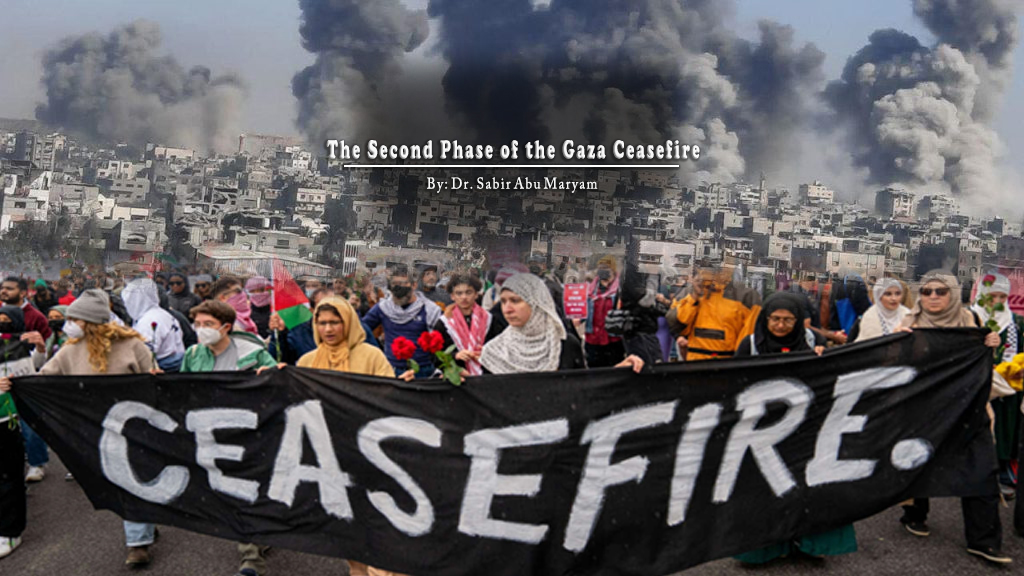
By: Dr. Sabir Abu Maryam
Secretary General, Palestine Foundation Pakistan(Palestine Foundation Information Center) Global media outlets are reporting that the first phase of the Gaza ceasefire agreement has been completed. However, according to Israeli media, one Zionist prisoner is still allegedly in Hamas custody. Hamas has already denied this claim, stating that the Zionist prisoner،who was affiliated with the Israeli police, was killed as a result of Israeli bombardment in Gaza. Due to the intense and continuous airstrikes on Gaza, Hamas maintains that it has become impossible even to recover the remains.
During the first phase of the Gaza ceasefire, Hamas had agreed to hand over all 30 Zionist prisoners to the occupying Israeli regime. In return, it was agreed that approximately 1,700 to 2,000 Palestinian prisoners would be released. These Palestinian prisoners included a large number of women, children, and young men. In any case, while the first phase has formally concluded, from its very beginning to its end the occupying Zionist forces repeatedly violated the agreement. Israeli forces continued bombing Gaza and even carried out a targeted killing of a Hamas leader. In essence, Israel does not adhere to any ceasefire agreement; rather, it has a consistent history of openly violating international laws, agreements, and resolutions.
Now that the first phase of the Gaza ceasefire is said to be complete, discussions have shifted to the second phase. According to the conditions and points presented by US President Donald Trump, the second phase would involve the withdrawal of Israeli forces from areas of Gaza they currently control, in exchange for the disarmament of Hamas. It is important to note that from the very first day of the agreement, Hamas and all Palestinian factions categorically rejected the condition of disarmament. However, some statements from Hamas leadership did appear in the media indicating that if Hamas were ever to lay down its arms, it would do so only before the army of an independent Palestinian state. On the other hand, American and Israeli political analysts themselves have repeatedly acknowledged that disarming Hamas is not as simple as President Trump seems to believe, because Hamas will never surrender its weapons to either the United States or Israel.
In recent days, this debate has intensified further, because another crucial condition is linked to the second phase alongside the withdrawal of Israeli forces and the issue of Hamas’s disarmament. This condition involves the deployment of troops from Muslim countries in Gaza under the banner of an “international stability force,” at the behest of US President Trump. Israeli Prime Minister Benjamin Netanyahu has reportedly agreed to this proposal on the condition that Turkish forces are not deployed in Gaza, while troops from other Muslim countries would be acceptable including Pakistan. In this context, the deployment of forces from Indonesia, Saudi Arabia, Egypt, Jordan, Turkey, and Azerbaijan has been discussed, and Pakistan’s armed forces have also been mentioned as a possible participant in Gaza.
In Pakistan, this issue has sparked an ongoing debate. Government ministers have issued clarifications on several occasions, yet these explanations remain incomplete because the decision to send troops cannot be made by a single institution or the government alone. Parliament has not been consulted, and as a result, the people of Pakistan are deeply aggrieved over the matter. Meanwhile, just as Israel rejected the presence of Turkish forces, Egypt and Indonesia have also adopted a cautious and apologetic stance, declining to deploy troops in Gaza. According to the latest reports, Azerbaijan, despite having relations with Israel,has also declined to deploy forces in Gaza, citing a shortage of troops. This leaves only Pakistan, Jordan, and Saudi Arabia under discussion for potential deployment.
It is worth recalling that in November, the United Nations Security Council passed a resolution in favor of US President Donald Trump’s 20-point plan for peace in Gaza, which included a clause calling for the deployment of an international peace force in Gaza. Pakistan also supported this resolution.
During a press briefing, US official Marco Rubio stated that Pakistan had already made an offer in this regard, which has led to significant criticism of the Pakistani government domestically. In response to this criticism, Deputy Prime Minister and Foreign Minister Ishaq Dar stated that if Pakistan were asked to go there to fight, to disarm Hamas, or to dismantle their tunnels, “that is not our job.” He added that such an action would amount to pitting one Muslim against another. Pakistan, he emphasized, would only be willing to go for peacekeeping and social work. This clarification was given by Ishaq Dar during a Friday news briefing in response to questions about media reports claiming that 3,500 Pakistani troops might be sent to Gaza. This is not the first time that Pakistan’s Foreign Office or the Foreign Minister himself has had to clarify Pakistan’s position on sending troops as part of an “international force” to Gaza.
UK-based Pakistani author Ayesha Siddiqa, in an article written for the Israeli newspaper Haaretz, claimed that President Trump might ask Field Marshal Asim Munir to send Pakistani troops to Gaza, describing such a decision as a very high-stakes gamble. During the same Friday briefing, Ishaq Dar further stated that there is complete harmony between Pakistan’s civilian and military leadership on this issue, emphasizing that “we will go to Gaza only to establish peace.”
This raises a fundamental question: what kind of peace would be established by sending Pakistani troops to Gaza? The entire world has witnessed that over the past two and a half years Israel has carried out genocide against the Palestinians, yet no Muslim army has gone to Gaza to establish peace. So what kind of peace is being envisaged now? Similarly, the Palestinian people and Palestinian factions have declared the deployment of any foreign troops in Gaza to be illegal and have likened it to an occupying force on Palestinian land. Palestinians have urged that the armed forces of Muslim countries should not become part of a plan driven by President Trump’s wishes to ensure Netanyahu’s political survival.
In principle, any decision on this matter should reflect the will of the Palestinian people and the desires of Palestinian political and resistance factions, rather than using the armies of Muslim countries as fuel to fulfill the ambitions of the US president. In any case, this is the second phase of the ceasefire, whose completion appears unlikely. The third phase envisions the establishment of a technocratic government in Gaza, followed by the fourth phase, which would focus on Gaza’s reconstruction. Recently, Pakistani religious scholars and spiritual leaders have also strongly criticized the prospect of sending Pakistani troops to Gaza. At a conference organized by the Majlis Ittehad-e-Ummat Pakistan in Karachi, prominent scholars from various schools of thought including Mufti Taqi Usmani, Maulana Fazlur Rehman, and Mufti Muneeb-ur-Rehman, participated and voiced their opposition.
In conclusion, the United States, which sought to impose a so-called peace agreement on the Palestinian people to safeguard Israel and to claim credit for ending the war, has failed miserably. Political analysts worldwide agree that any agreement imposed without the consent of the Palestinian people will not be workable and will lead to further negative consequences in the future. These analyses make it clear that the United States and Israel are not only losing on the battlefield but are also facing defeat at the negotiating table.