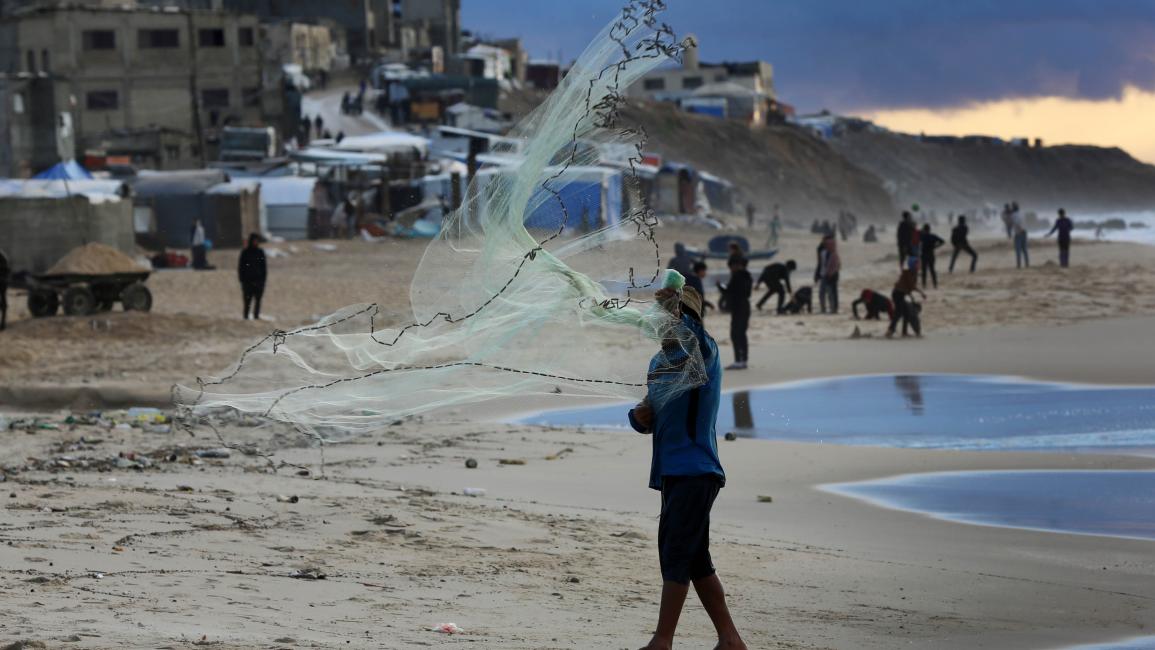
GAZA, (Palestine Foundation Information Center), Official figures revealed a complete collapse of the maritime fishing sector in the Gaza Strip by 100%, as a result of the ongoing Israeli attacks and the imposed naval blockade, at a time when the sea has turned from a source of livelihood for thousands of families into an open killing zone for fishermen.
According to the Government Media Office, around 4,000 fishermen supported approximately 50,000 people before the war, however the profession turned into a daily risk, resulting in the killing of 238 fishermen, and the injury or arrest of about 450 others, in addition to widespread destruction of boats and fishing facilities.
Footage broadcast by Al Jazeera shows the scale of destruction that hit boats, fishing facilities, and fish farms, while Israeli occupation forces continue to open fire on fishermen when they approach to a distance of just one mile from the shore, in addition to confiscating boats and damaging nets and equipment.
The current collapse is not limited to the consequences of the latest war, as the naval blockade imposed on Gaza has continued for more than 18 years, however the two years of war witnessed an almost complete halt in fish production, within direct losses in the agricultural and fishing fields estimated at about 2.8 billion dollars.
In the markets of Deir al Balah city in the central Strip, the effects of this decline appeared, as frozen and chilled fish are offered as a substitute for the catch of the Gaza sea, some of which are allowed to enter after special coordination and additional financial costs, and are limited to specific types.
The deterioration of the purchasing power of hundreds of thousands of Palestinians prevents them from being able to buy fish, even during periods when it is available in limited quantities.
In the same context, an interactive map presented by journalist Salam Khader showed a sharp contraction of the maritime area available for fishing, as the Oslo Agreement provides for the extension of Gaza’s maritime zone to 20 nautical miles, however this distance has shrunk since 2006 to 6 miles, then to less than that after October 2023, reaching in some periods a depth not exceeding 3 kilometers, before the currently permitted distance was set at about 800 meters only from the shore.
According to UN reports, fishing within these narrow areas directly affects the size of fish and their availability, at a time when Gaza Port was subjected to repeated attacks that led to its near complete destruction.
For his part, the head of the Fishermen Committees, Zakaria Bakr, confirmed that the fishing area is zero mile, and that the sea has become practically closed, pointing out that some fishermen risk using small boats at a distance not exceeding 800 meters, where more than 67 fishermen were killed in this area alone.
Bakr added in his remarks to Al Jazeera that the fishermen’s file is absent from any agreement or official committee, amid the absence of serious initiatives to rescue this sector, warning that the continued targeting of boats and the lack of support will lead to the complete erasure of the fishing profession from Gaza.
These developments come amid an ongoing Israeli war on the Strip since October 2023, which left more than 72,000 Palestinian martyrs, and more than 171,000 wounded, in addition to destruction affecting about 90% of civilian infrastructure.