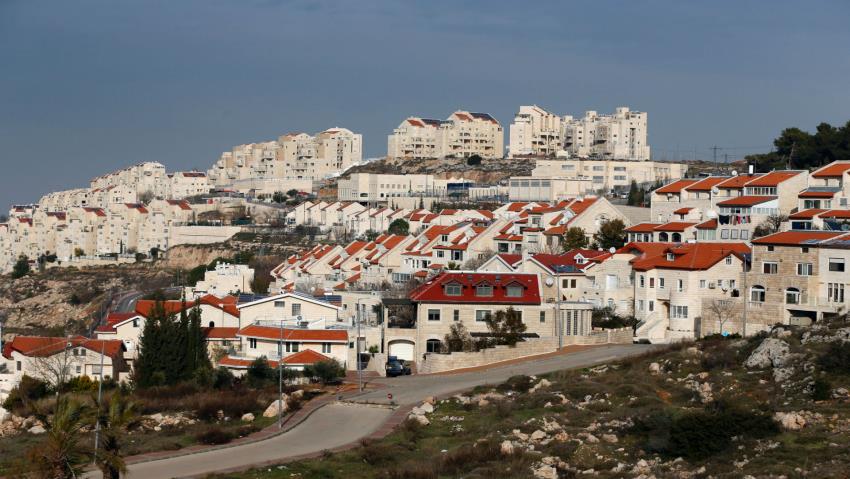
WEST BANK, (Palestine Foundation Information Center), The Israeli occupation government approved on Sunday the establishment of 19 new settlements in the West Bank, a move that further accelerates settlement expansion. Far-right Finance Minister Bezalel Smotrich described the decision as “historic,” raising the total number of settlements approved over the past three years to 69.
In a statement, Smotrich’s office said the ministerial security cabinet approved a proposal submitted by Smotrich and Armhy Minister Yisrael Katz to “approve and regulate” 19 new settlements, deeming these sites to be of “high strategic importance,” particularly in the northern West Bank. The decision includes the re-establishment of the settlements of Ganim and Kadim, which had previously been dismantled.
The decision comes days after Smotrich approved, last Thursday, a plan to establish a new settlement city east of occupied Jerusalem, comprising around 3,380 housing units. Israel’s Channel 7 reported that the new city will be named “Mishmar Yehuda,” as part of what Smotrich described in a post on the X platform as “strengthening control over the area and protecting Jerusalem from the eastern side.”
These steps fall within the policy of Israel’s far-right government, which continues to expand settlement activity in the occupied Palestinian territories, disregarding international resolutions that consider settlements built on land occupied in 1967 to be illegal. The UN Security Council has repeatedly called on Israel to halt all settlement activities.
The rapid settlement expansion has led to the fragmentation of Palestinian geography in the West Bank, isolating Palestinian cities and towns from one another, in addition to the establishment of a number of settlements in earlier stages without official authorization. About 2.7 million Palestinians live in the West Bank, which is considered a central pillar of Palestinian plans to establish an independent state.
Since the implementation of the “disengagement” plan, dozens of settlement outposts have been established in the northern West Bank, as well as in other areas. This trend has accelerated markedly since October 7, 2023, under the cover of the genocidal war on the Gaza Strip.
Despite the restrictions imposed by the “Disengagement” Law, these outposts have formed what resembles a “pincer” encircling the northern West Bank from several directions. In May 2023, an amendment was introduced to the Disengagement Law, and a military order was issued canceling its application in the northern West Bank.
In May 2024, based on directives from then–Army Minister Yoav Gallant, the application of the Disengagement Law was canceled in the remaining areas of the northern West Bank. The occupation army later declared the area a “closed military zone.”
Although the “full legal regularization” of these settlements may take years, the latest political decision has laid the groundwork for a gradual return of settlers under army protection, with “legalization” procedures to be completed later, as has been customary in the West Bank.
Data show that since the formation of the current government, the Israeli cabinet has approved the regularization of settlement outposts three times: in February 2023, nine outposts were regularized; in June 2024, five additional outposts; and in May 2025, the regularization of 22 outposts was approved.