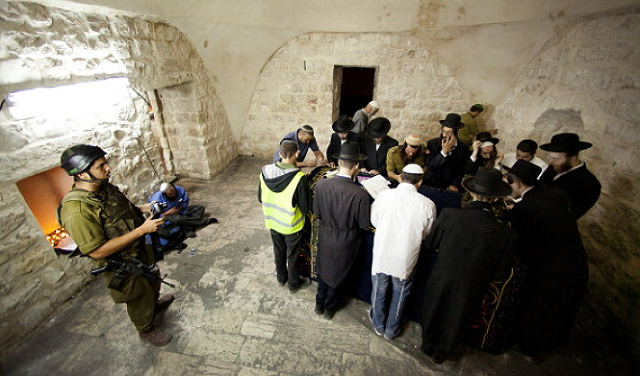
NABLUS, (Palestine Foundation Information Center)، Israeli occupation authorities are set to allow settlers to storm Joseph’s Tomb in the West Bank city of Nablus during daylight hours for the first time in 25 years, marking a significant escalation at one of the most sensitive flashpoints in the city.
The Israeli newspaper Yedioth Ahronoth reported on Monday that Israeli war minister Israel Katz, Knesset member Zvi Sukkot, and Yishai Merling, head of the settlement division at Israeli national institutions, agreed to extend visiting hours at the site from night-time only to daytime access.
Under the agreement, settlers will be permitted to enter the compound in the heart of Nablus during the day for the first time since the evacuation of the Jewish religious school (yeshiva) that had been established at the site 25 years ago. The report did not specify when the new arrangement would take effect.
Joseph’s Tomb is located on the eastern edge of Nablus, an area under Palestinian Authority control. Jewish settlers have claimed the site as a holy shrine since Israel’s occupation of the West Bank in 1967, alleging it contains the remains of the biblical figure Joseph, son of Jacob.
Palestinian and international archaeologists, however, have rejected this claim, stating that the structure dates back only a few centuries and is in fact the shrine of a Muslim cleric known as Sheikh Yusuf Dweikat.
Since 1967, the site has become a focal point for settler incursions and Talmudic rituals under protection from Israeli occupation forces (IOF). In 1986, Israel established a yeshiva at the location, before turning the site into a fortified military position in 1990. That same year, Israel’s so-called Ministry of Religious Affairs designated the shrine as a Jewish religious endowment.
The area surrounding Joseph’s Tomb has witnessed repeated deadly confrontations over the years, most notably in 1996 during the so-called Tunnel Uprising, when clashes erupted between Palestinian security forces and Israeli soldiers, resulting in fatalities on both sides. Similar clashes broke out at the start of the second Palestinian Intifada in 2000.
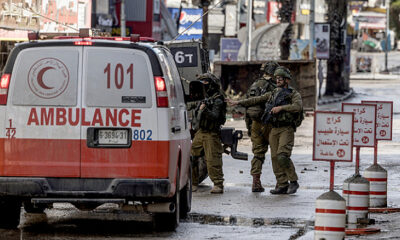
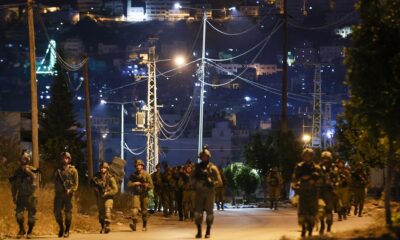
Since then, the site has formally remained under Palestinian administration, but has continued to be a point of friction, with hundreds of settlers entering the compound weekly under heavy IOF protection, usually during night-time raids.
An estimated 750,000 Israeli settlers now live in hundreds of settlements built on occupied West Bank land, including around 250,000 in occupied East Jerusalem. Settlers regularly carry out attacks against Palestinian civilians as part of efforts to forcibly displace them.