By Dr. Sabir Abu Maryam
Secretary General, Palestine Foundation Pakistan (PLF)
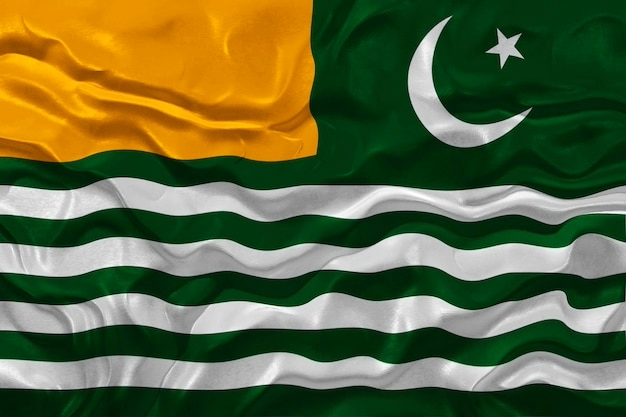
(Palestine Foundation Information Center), The Kashmir issue is a long-standing, complex, and sensitive dispute of the subcontinent that has not only affected peace and stability in South Asia but has also remained significant in global politics. This issue is not merely a geographical or border dispute; rather, it represents a humanitarian, political, and moral struggle directly linked to the right to self-determination, freedom, and fundamental human rights.
With the end of British colonial rule in 1947, the subcontinent was divided into two independent states, Pakistan and India. The principle of this partition was that Muslim-majority areas would join Pakistan, while Hindu-majority areas would become part of India. The State of Jammu and Kashmir, despite having an overwhelming Muslim majority, was a princely state ruled by a Hindu ruler, Maharaja Hari Singh. Contrary to the wishes of the people, the Maharaja adopted delaying and controversial decisions, which eventually led to Indian military intervention, turning Kashmir into a permanent and unresolved dispute.
If we examine the partition of the subcontinent alongside the division of the Middle East, a clear similarity emerges. In 1916, under the secret Sykes–Picot Agreement, Britain and France divided the Middle East according to their colonial interests. Artificial borders were drawn in Palestine, Iraq, Syria, and other regions, giving rise to perpetual conflicts. In a similar manner, when the British were forced to leave the subcontinent, they deliberately created disputes, particularly in South Asia that continue to undermine peace, security, and stability in the region to this day.
The British were well aware that the freedom movement in the subcontinent would eventually succeed and that Muslims and Hindus would establish separate homelands. At that time, nearly 562 princely states existed, ruled by Nawabs, Rajas, and Maharajas. According to colonial planning, these states were to be maintained as separate entities so that the region would remain fragmented and internally conflicted, allowing colonial powers to exert influence even after their departure. The same strategy was applied in the Middle East under the Sykes–Picot framework, which later led to the creation of the illegitimate state of Israel, still the greatest obstacle to peace and stability in the Middle East.
Just as British colonialism ignored the will of the people in Palestine, it also suppressed the right to self-determination of the Kashmiri people through force. Although the United Nations passed resolutions calling for a plebiscite in Kashmir, these resolutions have yet to be implemented.
For more than seven decades, the people of Kashmir have been struggling for their identity, freedom, and right to self-determination. This struggle has passed through various phases, from political movements to public protests and resistance. The Kashmiri people have consistently maintained that they want to decide their own future, but their voices have been silenced through force, oppressive laws, and the use of arms.
Today, the people of Palestine demand the same right: that Palestinians be allowed to decide their own destiny. However, so-called peace boards are being imposed to restrict the Palestinian people’s right to self-determination, just as similar tactics are used in Kashmir.
Kashmir has been the root cause of three major wars and countless border clashes between Pakistan and India. Both countries are nuclear powers, making this dispute a persistent threat to global peace. Pakistan has consistently supported the Kashmiri people’s right to self-determination at diplomatic, political, and moral levels, while India attempts to label Kashmir as its internal matter in order to evade international pressure.
In Indian-occupied Kashmir, the local population faces severe human rights violations. Extrajudicial killings, enforced disappearances, mass graves, prolonged curfews, internet shutdowns, arrests of political leadership, and restrictions on freedom of expression have become routine.
Under special laws, Indian security forces enjoy unchecked powers, forcing ordinary citizens to live in an atmosphere of fear and insecurity. Women, children, and the elderly are all victims of this systematic oppression.
A few years ago, the Indian government revoked Articles 370 and 35A, following which deliberate efforts have been made to alter the demographic composition of Kashmir and change its special status. This is despite the fact that Kashmir is a disputed territory under United Nations resolutions, a reality acknowledged by both Pakistan and India. Nevertheless, Indian intransigence and coercion continue, as New Delhi has amended its own constitution to impose its will on Kashmir.
The Kashmir issue is not merely a regional dispute; it is a test of the global conscience. Until the Kashmiri people are granted their right to self-determination in accordance with United Nations resolutions, this conflict will continue to threaten regional and international peace. History bears witness that the voice of a nation cannot be silenced forever through force.
The future of Kashmir must rest in the hands of its people—this alone forms the basis of a just, sustainable, and lasting solution. United Nations Security Council resolutions dated 13 August 1948 and 5 January 1949 clearly state that the people of Kashmir must be allowed to decide, through a free and impartial plebiscite, whether they wish to accede to Pakistan or India. However, the Indian government’s obstinacy is evident in the deployment of over 700,000 troops in Kashmir to prevent the Kashmiri people from exercising their right to self-determination.
Across Pakistan, 5 February is observed as Kashmir Solidarity Day with the aim of educating the new generation about the Kashmir issue and keeping the struggle alive among the youth. This day symbolizes support for the Kashmiri people’s right to self-determination, an expression of solidarity with them, and a call to awaken the global conscience against Indian oppression.
It is a reaffirmation of Pakistan’s commitment to stand with the Kashmiri people in their just struggle. Kashmir Solidarity Day serves as a platform to amplify the voices of the oppressed Kashmiris at international forums and to remind the world of the unimplemented United Nations resolutions.
This day reminds us that the Kashmir issue is not merely territorial—it is a global issue of human rights and justice. The sacrifices of the Kashmiri people testify to the fact that a struggle for freedom cannot be crushed by force.