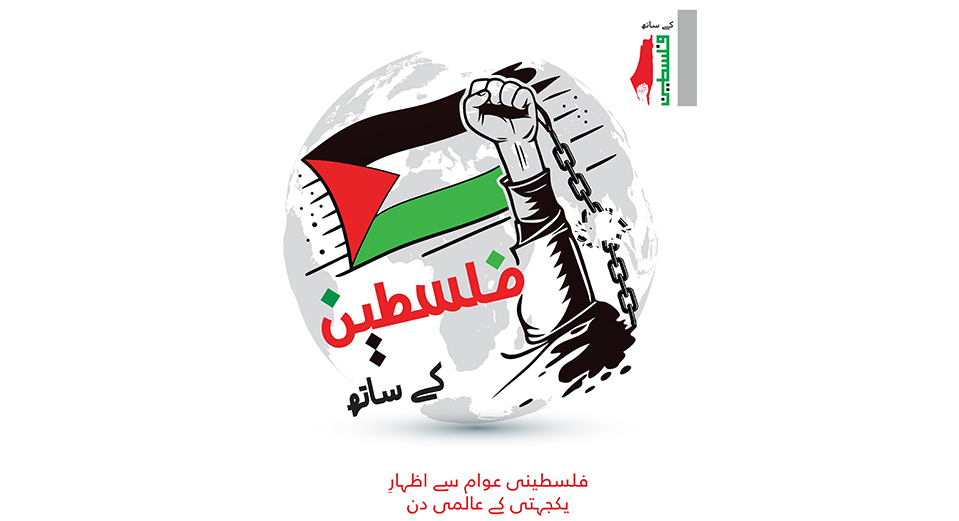
The Palestine Foundation Pakistan
By: Dr. Sabir Abu Maryam
Secretary General, Palestine Foundation Pakistan
November 29 is observed every year as an International day of solidarity with the Palestinian people, and even the United Nations marks this day. However, the irony is that this day is also the day when the United Nations itself committed a historical betrayal with Palestine. While it is called the “Day of Solidarity with Palestine,” historical facts and research suggest that it should, in reality, be recognized as a Global Day of Betrayal by the UN with Palestine.
This date commemorates UN Resolution 181 of 1947, which forcibly divided the land of Palestine into two parts. This division caused immense harm and displacement to the Palestinian people. On the surface, Resolution 181 appeared to be a plan for partition, but in reality, it was a betrayal whose consequences are still being felt today, not only in Palestine but across West Asia and the wider world. This resolution directly led to the establishment of the illegitimate Zionist state of Israel in 1948.
At the time of the resolution in 1947, the Palestinian population was 67%, while the Jewish population was approximately 33%. Nevertheless, 55% of the land was allotted to the Zionists, and only 45% remained for the local Palestinians. This was an extreme injustice, officially sanctioned by the United Nations. The Palestinian people completely rejected this partition, but global powers particularly the United States and Britain applied extraordinary pressure to ensure its approval.
The vote in favor of Resolution 181 consisted of only 33 votes, with 13 countries voting against it and 10 abstaining. Most of the countries that voted in favor had no historical or regional connection to West Asia, yet they were influenced by U.S. and British pressure.
Historically, even before UN Resolution 181, Britain had already laid the groundwork for betrayal. Following World War I, in 1917, Britain issued the Balfour Declaration, promising the establishment of a Jewish homeland in Palestine. This act ignored the Palestinians’ right to self-determination and disrupted the demographic balance of the region. Subsequently, Britain facilitated the migration of Jews from around the world to Palestine and ultimately, in 1947, executed the betrayal of partition through UN Resolution 181. Britain provided political and military support to Jewish settlers, resulting in the establishment of the illegitimate state of Israel in 1948.
During its mandate, Britain ignored the political aspirations of the Palestinian people while providing full support to the Zionists. It allowed Zionist militias to seize land, stockpile weapons, and consolidate political power, while attempting to suppress Palestinian resistance. This clearly demonstrates a global betrayal of Palestine, given the United Nations’ endorsement.
The United States also played a key role in supporting Zionist control over Palestine. It exerted diplomatic pressure and economic threats on several countries to vote in favor of Resolution 181. Many nations, therefore, did not exercise independent judgment but voted according to U.S. interests, highlighting that global powers often prioritize their own agendas over justice.
After Resolution 181, the United Nations failed to take any practical measures to prevent atrocities. During the wars of 1948 and 1967, 1973, 1982, 2006, 2007, 2014 and 2023 as well as subsequent Israeli settlements, blockades, and acts of ethnic cleansing, the UN remained largely inactive. Its resolutions were often limited to words, leaving the voices of oppressed Palestinians unheard.
Another critical point is that UN General Assembly resolutions do not carry binding obligations like those of the Security Council. Yet, for the first time in history, colonial powers implemented the Assembly’s unjust decision to protect their own interests, creating an illegitimate state in West Asia that has fueled terrorism and conflict in the region for 78 years.
As a result of this same UN resolution, over 1.5 million Palestinians were forcibly expelled from their homes and homeland on Nakba Day, living as refugees to this day. Historical evidence indicates that Zionist forces attacked and destroyed over 500 Palestinian villages and towns on Nakba Day. All of this occurred under British colonial supervision, giving Zionists unchecked authority. Systematic massacres were carried out, and ethnic cleansing continues. The seizure of Palestinian lands that began in 1948 persists today, denying Palestinians access to their homes and lands. Efforts have been made to obliterate Palestinian culture, which is why Palestinians commemorate this event as the Nakba, a day of devastation and catastrophe.
Despite these betrayals, the Palestinian people have resisted the conspiracies of global colonial powers, whether the 1917 Balfour Declaration or the 1947 UN partition plan, and their continuation in the Nakba. Palestinians have never given up and have consistently raised their voices for their rights, struggling for Palestine’s freedom,a struggle that continues to this day. The Palestinian resistance has highlighted their plight on the international stage, and their efforts continue to awaken the global conscience. The Al-Aqsa Storm movement is part of this ongoing century-long struggle.
In summary, November 29 is not merely a historical day; it is a reminder that global powers often prioritize their interests over justice. The United Nations has historically failed to protect the rights of the oppressed and continues to do so. Palestinians have sacrificed for decades for their land and freedom, and this struggle continues. The commemoration of this day as the “Day of Solidarity with Palestine” cannot erase the historical betrayal and injustice committed by the UN. Not only Palestinians, but people across the world recognize this injustice, and every year this day reopens those wounds, reminding humanity that the UN, in reality, has become a servant of the U.S., Britain, and other Western powers.
However, this day holds great significance for Palestinians and their supporters worldwide: it is an occasion to raise their voices for Palestine and show the world that Palestine is not alone, and we stand with Palestine.