By Dr. Sabir Abu Maryam
Secretary General, Palestine Foundation Pakistan
(Palestine Foundation Information Center), West Asia, South Asia, and the Mediterranean region have remained arenas of confrontation for nearly a century, where colonial powers continue to weaken regional governments through conflicts in pursuit of their political and economic interests. Since the creation of Israel in 1948, the region has been pushed into even greater instability. Israel’s occupation of Palestine has never remained confined to Palestinian land alone; rather, its expansionist ambitions under the concept of “Greater Israel” have consistently threatened the wider region.
To advance this objective, Israel has developed and implemented a strategic doctrine known as its National Security Concept, commonly referred to as the Parametric Security Doctrine. Under this doctrine, Israel seeks to weaken, distract, or contain its ideological and geopolitical adversaries from a distance.
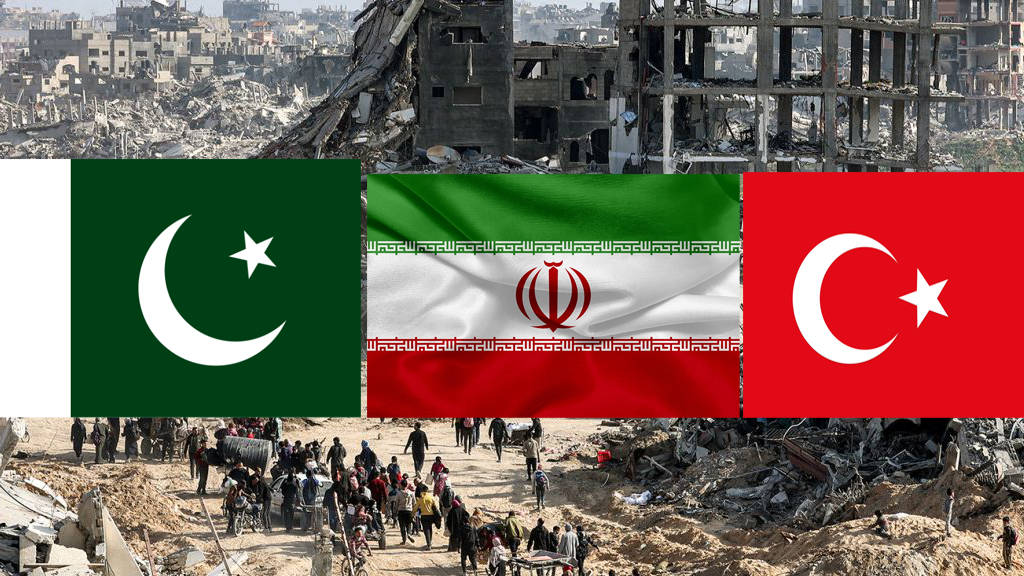
According to many analysts, Israel has repeatedly attempted to limit the geopolitical influence of Pakistan, Iran, and Türkiye through proxy states, allied blocs, and diplomatic coalitions, directly impacting South Asia, West Asia, and the Mediterranean basin.
What is the Parametric Security Doctrine? The doctrine is based on four core principles: Deterrence, Pre-emptive Defense, Forward Defense against External Threats and Maintaining a Favorable Balance of Power.
Through these principles, Israel aims to prevent the emergence of strong Muslim military powers in the region, keep adversarial states politically and militarily entangled, and isolate them diplomatically.
Why Pakistan, Iran, and Türkiye? Israel’s hostility toward Pakistan stems from several factors: Pakistan is a nuclear power with a strong military, and its ideological foundations firmly support the Palestinian cause while rejecting Israel as an illegitimate occupying entity.
Iran, on the other hand, is regarded by Israel as a direct strategic rival. Tehran’s support for Hezbollah in Lebanon, Hamas and Islamic Jihad in Palestine, and its anti-Israel stance in Syria is unacceptable to Tel Aviv. Like Pakistan, Iran has never recognized Israel and continues to expand its military, missile, and nuclear capabilities, developments Israel views as existential threats.
Türkiye has reasserted its support for the Palestinian narrative since 2002. Its growing influence in the Eastern Mediterranean, particularly in energy and naval affairs, has created new strategic challenges for Israel. Despite diplomatic ties between Ankara and Tel Aviv, Türkiye’s support for the Muslim Brotherhood and its regional assertiveness have placed it in a state of strategic rivalry with Israel.
Israel does not prefer direct military confrontation with Pakistan, Iran, or Türkiye. Instead, it relies on proxy alliances and regional blocs to contain them.
Against Pakistan, Israel leverages India, the United States, the European Union, Afghanistan, and Saudi Arabia to keep Islamabad strategically entangled.
Against Iran, Israel operates through the US, EU, Saudi Arabia, Bahrain, and the UAE.
Against Türkiye, Israel relies on Greece, Cyprus, and Egypt as strategic counterweights.
Israel prioritizes proxy warfare over direct conflict, allowing it to preserve its military and economic resources while maintaining regional pressure.
Israel has effectively used powerful think tanks such as the Foundation for Defense of Democracies (FDD) to influence US policy making, shaping the narrative that military action against Iran is the only viable solution. This lobbying effort contributed to Washington’s adoption of the “Maximum Pressure” policy against Tehran.
Tel Aviv continuously supplies intelligence portraying Iran’s nuclear program as an immediate global threat, while ensuring that any potential military operation would be carried out by US naval and air forces, shielding Israel from the costs of a prolonged regional war.
Israel has transformed its relationship with India into a strategic platform against Pakistan. Israeli military technology supplied to India is not merely defensive, it provides offensive superiority. Barak‑8 missile system (jointly developed), Phalcon AWACS surveillance aircraft, Heron TP armed drones,
Spice‑2000 smart munitions (used in Balakot and 2025 skirmishes) and Pegasus cyber‑espionage software have been delivered to India by Israel.
This intelligence and cyber cooperation is designed to keep Pakistan in a state of continuous defensive engagement and maintain strategic pressure on its eastern front.
To counter Türkiye’s growing influence, Israel has built a security architecture with Greece and Cyprus. A $1.65 billion defense agreement with Greece includes the establishment of an international flight training center where Israeli combat tactics are taught to Greek pilots.Greece has received Spike NLOS missile systems, capable of precision strikes on naval and land targets.
Cyprus has been offered advanced radar, aerial surveillance, and Iron Dome‑style defense systems. A trilateral intelligence-sharing mechanism between Israel, Greece, and Cyprus now monitors Turkish activities across the Eastern Mediterranean, forcing Ankara to adopt cautious strategic calculations.
Israel does not possess the capacity to directly confront Pakistan, Iran, and Türkiye simultaneously. Instead, it seeks to weaken them through proxy states and strategic alliances while advancing its expansionist agenda in West Asia.
The urgent need of the time is for Pakistan, Iran, and Türkiye to forge a strong strategic alliance capable of confronting Israel’s direct and indirect aggression and safeguarding regional sovereignty, stability, and justice.
Only through unity can these three nations counter Israel’s parametric security doctrine and reshape the balance of power in the Muslim world specially in West Asia, South Asia and Mediterranean.