(Palestine Foundation Information Center), By: Dr. Sabir Abu Maryam
Secretary General, Palestine Foundation Pakistan
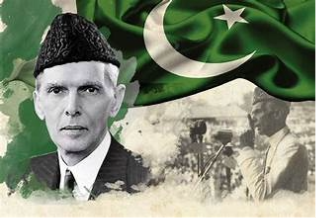
December 25 is an important day in Pakistan’s history, when the nation commemorates the birth anniversary of the Founder of Pakistan, Quaid-e-Azam Muhammad Ali Jinnah. Across the country, ceremonies, seminars, speeches, and special newspaper supplements are dedicated to Quaid-e-Azam. However, the bitter reality is that while we celebrate Quaid-e-Azam Day, we tend to forget to practice his ideas and principles.
What is even more astonishing is that some time ago, Pakistan’s caretaker Prime Minister Anwar-ul-Haq Kakar, during a conversation with a TV channel on the issue of Palestine and the occupying Zionist state of Israel, went so far as to say that Quaid-e-Azam’s words are not verses of the Qur’an that cannot be changed. A caretaker prime minister who today considers the ideas of the Founder of Pakistan so lightly,who knows, tomorrow, for the sake of personal interests, he may even raise questions about the verses of the Qur’an.
Pakistan has always faced individuals and families whose forefathers were servants of British colonial rule and enjoyed privileges from the colonial government. This legacy has continued from generation to generation and has now reached the third generation. Such individuals have never hesitated to undermine Pakistan’s national and collective interests. Therefore, the former caretaker prime minister’s statement regarding Israel also falls into the same category of people who feel compelled to please the United States and Britain first, and consider Pakistan’s interests later.
Quaid-e-Azam Muhammad Ali Jinnah secured Pakistan on the basis of a clear ideology, strong principles, and lofty objectives. His message was simple yet comprehensive: Faith, Unity, and Discipline. He considered the rule of law, honesty, justice, tolerance, and education as the foundations of a strong state. However, today our national attitudes appear to be contrary to these principles.
The real issue is that we remember Quaid-e-Azam as a symbol rather than as a guide. Instead of making his ideas a part of our curriculum, governance, society, and national policy, we have confined them to ceremonies and public holidays.
Today, we are celebrating the day of Quaid-e-Azam Muhammad Ali Jinnah, but there is a pressing need to make his ideas an integral part of Pakistan’s soul,a soul that we are gradually stripping away.
Quaid-e-Azam Muhammad Ali Jinnah always regarded education, honesty, tolerance, justice, and the supremacy of law as the foundations of the state. It was due to these principles that he paid special attention to the issues of the Muslim world. Before and after the creation of Pakistan, Quaid-e-Azam consistently adopted a principled stance on Palestine. He stated that Pakistan would stand with the oppressed across the world. Regarding Palestine, he declared British colonial decisions unjust toward the Palestinians and, on the other hand, also wrote a letter to U.S. President Truman. Quaid-e-Azam is the originator of the position that Palestine should belong to the Palestinians and that Zionists settled there from outside have no right to that land.
Alongside leading the Pakistan Movement, Quaid-e-Azam consistently continued efforts to support the Palestinian people. He informed the world that global powers were committing injustice against the Palestinians and demanded justice for them. Quaid-e-Azam was a principled leader who organized strikes in the Subcontinent in support of the Palestinians, established the Palestine Fund, and provided every possible assistance to them. He remained in constant contact through correspondence with the Grand Mufti of Palestine, Haj Amin al-Husseini.
After the creation of Pakistan, he adopted an unequivocal stance and refused to recognize Israel. He clearly maintained that Palestine belongs solely to the Palestinians and that Israel is an illegitimate state. He categorically stated that Pakistan would never recognize Israel. Sadly, today it must be said that deviation from Quaid-e-Azam’s ideology and principles has increased to such an extent that voices are heard within government circles suggesting that Israel could be recognized if an independent Palestinian state were established,whereas Quaid-e-Azam’s position contains no such condition. This means that Pakistan has set aside the teachings of Quaid-e-Azam Muhammad Ali Jinnah, the consequences of which could be extremely grave.
In conclusion, Quaid-e-Azam Muhammad Ali Jinnah’s stance on Palestine remains highly relevant today because it exemplifies principles, justice, and standing with the oppressed. This stance reminds us that foreign policy should not be based solely on interests but also on moral values,something that those currently seated in the Foreign Office have forgotten. Today, those in the Foreign Office need to pay more attention to the teachings of Quaid-e-Azam Muhammad Ali Jinnah than to political science and other books. Not merely by celebrating a day or observing a holiday, but by acting upon Quaid-e-Azam’s teachings, we must prove that this is Quaid-e-Azam’s Pakistan. Quaid-e-Azam Muhammad Ali Jinnah’s solidarity with Palestine is proof that he was a principled leader. His thinking on the Palestine issue continues to provide guidance today,that raising one’s voice against oppression and supporting the truth is the responsibility of every free nation.