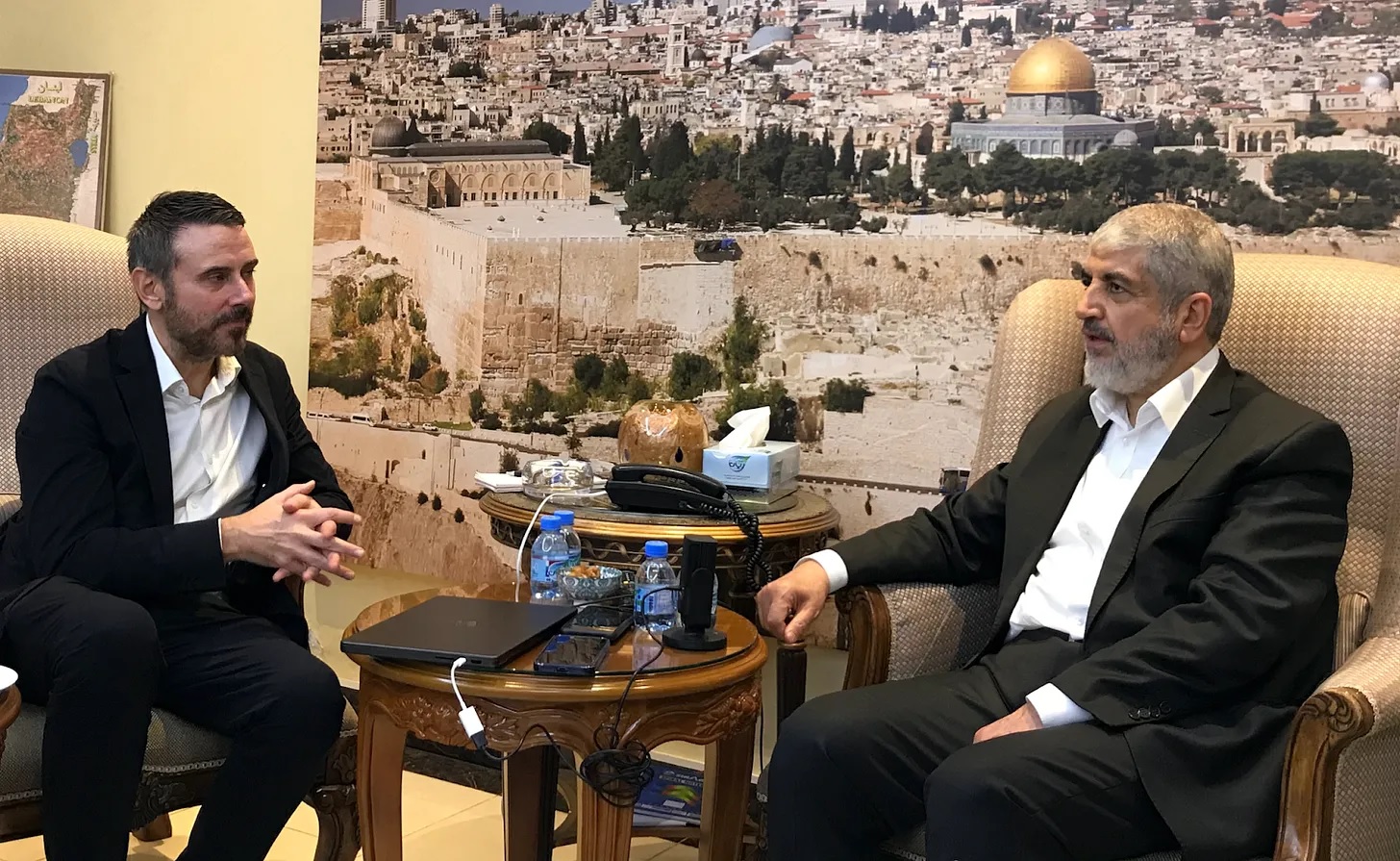
DOHA, (Palestine Foundation Information Center), Senior Hamas leader Khaled Mishaal told a Washington-based news outlet that the US administration must end Israeli influence over its Middle East policy and engage directly with Palestinian factions if it seeks regional stability.
In a December 11, 2025 interview with “Drop Site” in Doha, Mishaal said Hamas is prepared to enter a long-term ceasefire with Israel under international guarantees, while warning against foreign-imposed authority in Gaza.
Mishaal argued that Washington’s prioritization of Israeli interests undermines America’s own. He urged US leaders and the American public to judge the conflict through the lens of US national interests rather than Israel’s.
“If they look at us even for a moment in a fair and impartial way, they will see that the Palestinian people are oppressed under occupation, and they have the right to resist—unless America steps in and forces Israel to withdraw, in which case we would thank America. But if they do not do so, then they should leave us to resist,” Mishaal said.
The Hamas leader reiterated that his Movement is ready to commit to a ceasefire, store its weapons, and halt military operations against Israel if a framework is established to rebuild Gaza, hold democratic elections, and negotiate the future of a Palestinian state. He stressed that Hamas offers “real guarantees and a record of commitment” to stability, but warned that attempts to exclude Hamas from reconstruction or impose foreign governance would be “doomed to fail.”
Mishaal rejected any plan to deploy foreign forces in Gaza, saying Palestinians would view them as occupiers. He emphasized that Hamas is open to dialogue with the US and Europe, but not to “occupation, guardianship, or support for an occupier.”
He also compared the Palestinian struggle to South Africa’s anti-apartheid movement, urging the West to recognize the legitimacy of Palestinian resistance.
On disarmament, Mishaal said Hamas would only agree in the context of forming a Palestinian security force capable of defending against Israeli aggression. He cautioned that Israel’s violations of agreements must be addressed before advancing to new phases of negotiations. “As Hamas committed to the first phase requirements, Hamas, along with all Palestinian forces, is committed to the requirements of the second phase through this serious dialogue with the mediators,” he stressed.
Mishaal also addressed Palestinian politics, replying to a question about his position as the second most popular hypothetical candidate for president after Marwan Barghouthi, who remains imprisoned in Israel. He said Hamas reserves the right to nominate its own candidates and criticized regional practices of canceling elections when results are unfavorable.
“The democracy desired in Palestine, as is unfortunately practiced in some countries in the region and the world, is that elections should produce predetermined results acceptable to those holding them. If they do not, they are canceled. That is not democracy,” Mishaal explained.
“If you respect the will of the people, allow them to express it freely at the ballot box. Today, everyone knows—even after the destruction in Gaza following two long years of the crime of genocide committed by Israel—that the Palestinian conscience, awareness, and, I believe, the Palestinian voter, if given the opportunity, would vote for the resistance,” he added.
Turning to US policy, Mishaal voiced objections to president Trump’s Gaza stabilization plan, warning that efforts to impose foreign rule or disarm Hamas would sabotage peace. He said Hamas negotiators had only agreed to discuss ceasefire and prisoner exchanges, not disarmament. “We will not accept being forcibly disarmed,” he said, adding that Palestinian weapons are limited and defensive in nature.
Mishaal acknowledged Arab and Islamic states’ reluctance to confront Israel directly, but insisted that only the US has the leverage to compel Israel to honor agreements.
“President Trump and the American administration alone are capable of compelling Israel and Netanyahu to respect the agreements,” he underscored.
Below is the link to the full transcript of Drop Site’s wide-ranging interview with Mishaal on December 11, 2025 in Doha, Qatar. The interview was conducted in Arabic and translated into English by Drop Site.