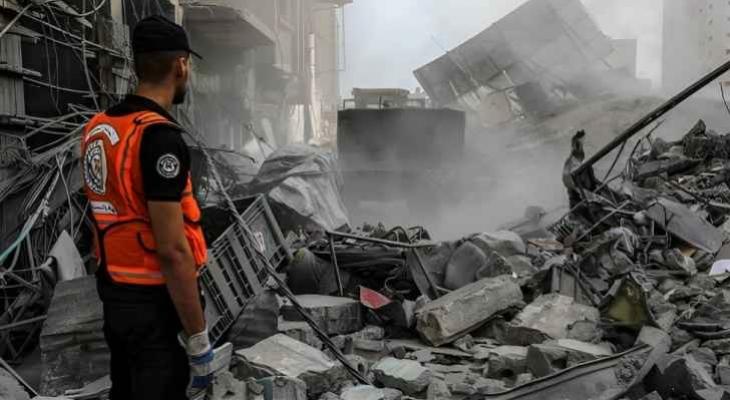
GAZA, (Palestine Foundation Information Center), Senior United Nations officials have warned that the Gaza Strip is facing a monumental reconstruction challenge, with more than 60 million tons of rubble left by Israel’s genocide, a volume that could take over seven years to clear under current conditions.
Jorge Moreira da Silva, executive director of the United Nations Office for Project Services (UNOPS), said that the amount of debris in Gaza is equivalent to the load of around 3,000 container ships. Speaking after a visit to Gaza and the region, he noted that each resident is now surrounded by an average of 30 tons of rubble.
Da Silva warned that the humanitarian crisis is deepening as residents suffer from extreme exhaustion, psychological trauma, and mounting pressures, compounded by harsh winter conditions and heavy rainfall.
He said children’s lives in Gaza have come to be defined by loss and trauma, after being out of school for a third consecutive year, raising the risk of an entire “lost generation” struggling with lasting physical and psychological wounds.
He elaborated on his meetings with families who have been displaced multiple times, as well as UNOPS staff and partners continuing to work under severe insecurity and pressure. Their determination to restore access to basic services despite limited resources and serious personal risks, he said, was “deeply humbling.”

Da Silva stressed that UNOPS, working with partners, is ready to support large-scale rubble removal, power restoration, waste management, and the provision of shelter. He added that the agency continues to facilitate the entry of fuel for humanitarian purposes and is coordinating with UN mine action teams to help communities threatened by widespread unexploded ordnance.
He said that the announcement of the second phase of the ceasefire plan represents a real starting point for reconstruction, but emphasized the urgent need to begin early recovery immediately, including restoring access to essential services. He called for improved humanitarian access and the opening of all crossings and corridors, including the resumption of direct aid delivery to Gaza through the “Jordan Corridor.”
In a related statement, UN Secretary-General António Guterres underscored Gaza’s urgent need for heavy machinery to remove rubble, calling for the unhindered flow of humanitarian assistance.
Guterres’ spokesperson told a press briefing on Thursday that heavy equipment and tools currently barred from entering Gaza are critically needed, particularly as thousands of residents are still suffering from the impact of recent winter storms.
The UN chief welcomed the start of the second phase of the ceasefire and stressed that humanitarian aid must be allowed to flow without obstruction. He also reiterated the need for the ceasefire to be fully implemented in a way that opens an irreversible path toward a two-state solution, in line with international law.
Both officials emphasized that increasing the flow of essential supplies and easing restrictions are vital to sustaining humanitarian operations and enabling early recovery, including allowing the entry of so-called “dual-use” materials necessary to repair and restore water systems, primary healthcare, and education for Gaza’s children.