
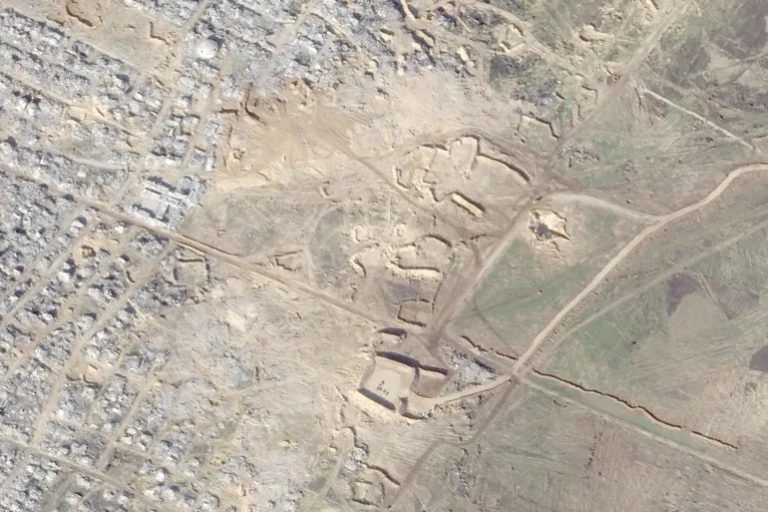
GAZA, (Palestine Foundation Information Center), An analysis conducted by Al Jazeera of satellite images has revealed that the Israeli occupation army has carried out large-scale operations to remove the rubble of destroyed homes in the city of Beit Hanun, in the northern Gaza Strip, raising fundamental questions about the objectives of these actions and whether they are limited to security considerations or extend to broader plans.
The analysis relied on high-resolution satellite images captured between October 8, 2025, two days before the start of the ceasefire in Gaza, and the most recent images dated January 10 of the current year. These images show the continued bulldozing and removal of rubble in devastated neighborhoods, particularly in the Al-Boura area and along the outskirts of Al-Masriyin and Al-Na’ayma streets in northeastern Beit Hanun.

Geographic measurements indicate that the area from which home rubble was removed, along with land that was leveled, amounts to approximately 408,000 square meters, roughly 100 acres. The number of homes whose rubble was cleared is estimated at around 329, in addition to agricultural structures, rooms, and property belonging to farmers in an area considered one of the city’s agricultural zones.
The images also show bulldozers operating among the destroyed homes undergoing debris removal, within a zone that includes several active and inactive Israeli military positions.
The data suggest that the rubble-removal operations began at the start of Beit Hanun’s urban boundary, adjacent to the security fence separating it from nearby Israeli settlements close to the northern border, including the settlement of Sderot.

These scenes contradict recent statements by the Israeli army reported by the newspaper Yedioth Ahronoth regarding the purpose of “recruiting” civilian tractors belonging to settlers in the Gaza envelope for use inside the Strip, including in Beit Hanun.
According to the newspaper, the army explained that it had borrowed these tractors for a military unit to carry out tasks behind the border aimed at improving visibility by removing dense vegetation, clearing shrubs, and leveling the ground, without mentioning the removal of rubble from hundreds of homes.
The Israeli army also denied that the purpose of these works was to prepare Palestinian land for Israeli agricultural needs.
The use of agricultural equipment belonging to settlers inside the Gaza Strip is considered unprecedented since 2005. The newspaper noted that the Israeli army’s Southern Command had previously expressed reservations about such a step.

Beit Hanun lies at the extreme northern edge of the Gaza Strip within what are known as the “zero zones,” areas under full Israeli military control. The city has suffered unprecedented levels of destruction due to continuous bombardment and bulldozing over two years of war, including during the ceasefire period, and its residents have only been able to return for short, partial periods.
In the same context, Israel has not concealed its settlement intentions in the Gaza Strip. References to Beit Hanun have repeatedly appeared in speeches and slogans by leaders of the far-right within Prime Minister Benjamin Netanyahu’s government.
In January 2024, ministers and Knesset members from the ruling coalition signed what was termed the “Charter of Victory and the Renewal of Settlement in the Gaza Strip and Northern Samaria” during a conference held in Jerusalem, where a map was displayed showing planned settlement points, including a settlement nucleus on the outskirts of Beit Hanun.
In December of the same year, ministers and Knesset members visited a site overlooking the Gaza Strip from the settlement of Sderot and discussed establishing settlements inside it. Meanwhile, Hadar Bar-Hai, director of a settlement group, stated that Beit Hanun and Beit Lahiya are uninhabited areas, affirming that more than 800 Jewish families are ready to settle immediately once permitted.

Last December, Israeli Army Minister Israel Katz made statements about the future of the Gaza Strip, revealing during a conference at the settlement of Beit El a plan to establish military-agricultural “Nahal nuclei” in northern Gaza, asserting that Israel “will never withdraw and will never leave Gaza.”
Katz described these bases as an alternative to the settlements evacuated in 2005, prompting discontent within the US administration, which demanded clarifications, viewing the plan as contradictory to US President Donald Trump’s plan to end the war.
Meanwhile, the Israeli army continues, in parallel, to demolish homes and expand its areas of control within what is known as the “Yellow Line” in the Gaza Strip, including leveling thousands of dunams of land and residential buildings.
The ceasefire agreement ended a genocidal war launched by Israel against Gaza Strip on October 8, 2023, which lasted two years and resulted in more than 71,000 Palestinian martyrs and over 171,000 wounded, in addition to widespread destruction affecting nearly 90% of civilian infrastructure. The United Nations has estimated the cost of reconstruction at approximately $70 billion.