
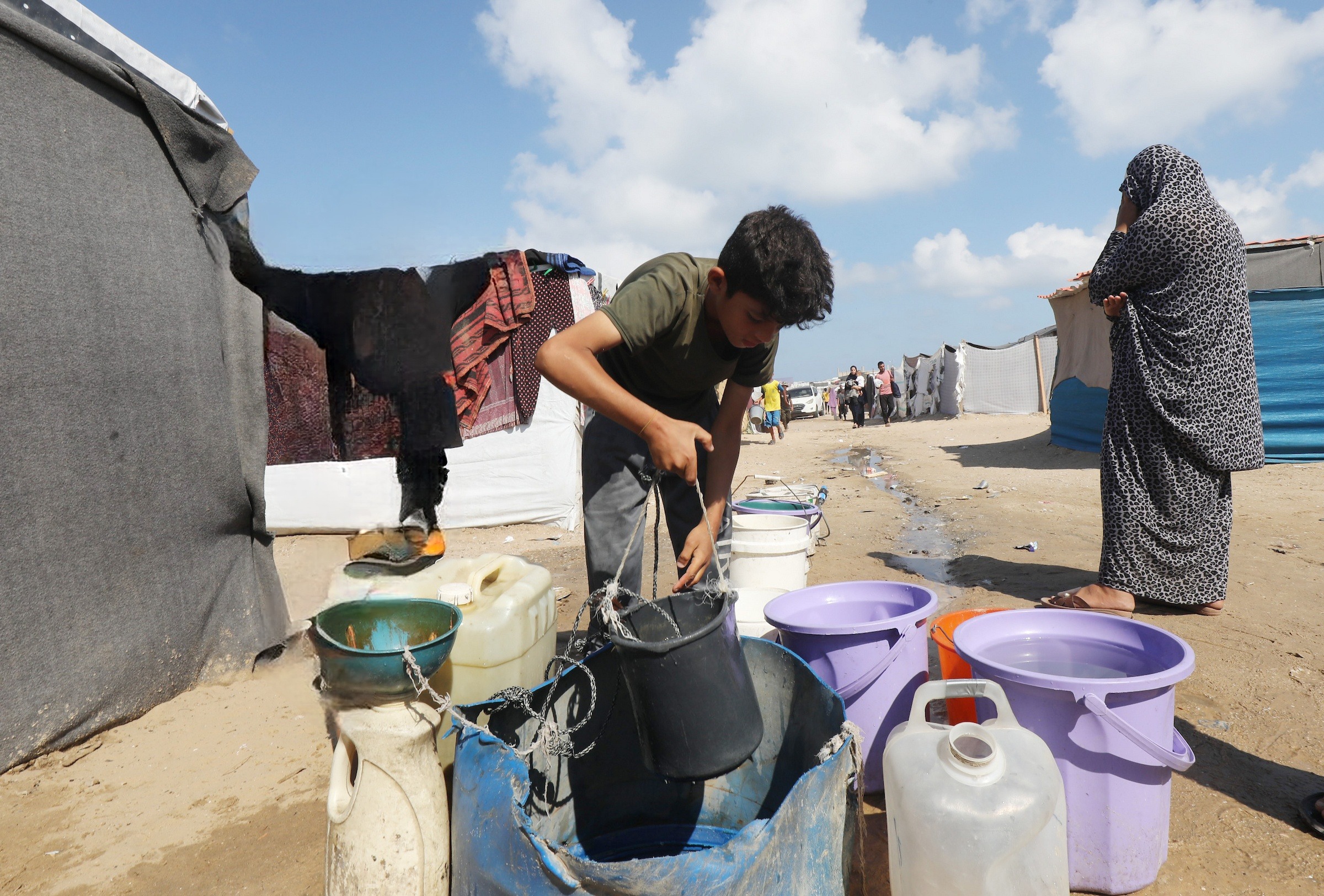
GAZA, (Palestine Foundation Information Center), UN Special Rapporteur on the human rights to safe drinking water, Pedro Arrojo-Agudo, has warned that the Gaza Strip is facing an unprecedented humanitarian catastrophe due to the widespread destruction of water infrastructure, stressing that the crisis has moved beyond scarcity to a near-total lack of safe drinking water.
In an interview with Al Jazeera Mubasher, Arrojo-Agudo said that Israeli forces are using water as a weapon of war, in clear violation of international humanitarian law. He noted that approximately 90% of Gaza’s water desalination and treatment facilities have been destroyed or directly targeted during the conflict.
He added that, even four months after the ceasefire, adequate water supply to the Strip has not resumed, and severe shortages of potable water persist. International institutions and NGOs continue to face significant restrictions that hinder their ability to provide even minimal levels of water and food, particularly amid the destruction of wells and water storage facilities, leaving what remains sufficient only for a few thousand residents.
According to Arrojo-Agudo, access to safe drinking water has dropped to just 10% of pre-war levels. He also highlighted that damaged water treatment plants have not yet been repaired, leading to the spread of contaminated water and serious health consequences, especially for children and the elderly.
He emphasized that the issue is not merely water scarcity but the absence of safe drinking water, warning of the spread of disease and describing the situation as a systematic use of water as a weapon against Palestinian civilians.
The UN expert said his findings align with reports from human rights organizations, including Human Rights Watch and Oxfam, which have similarly concluded that Israel is using water as a weapon of war in Gaza, an act prohibited under international humanitarian law.
Arrojo-Agudo also noted his participation, alongside the UN Special Rapporteur on the occupied Palestinian territory, in preparing a report on Gaza’s reconstruction, which found that 92% of infrastructure requires rebuilding, including water and sanitation systems. He described the scale of destruction as exceeding that seen in other conflicts.
He stressed that any reconstruction efforts must be grounded in international law and humanitarian principles, rather than investment or commercial interests, referencing a July 2024 International Court of Justice ruling calling for an end to the Israeli occupation, later reaffirmed by the UN General Assembly in September.
The rapporteur called for the immediate implementation of humanitarian agreements signed in Sharm El-Sheikh, including the entry of aid and essential services through all crossings, particularly Rafah, and the full restoration of desalination and water treatment plants, with guarantees against future targeting. He emphasized that restoring access to safe drinking water is a fundamental first step toward restoring life and dignity in Gaza after months of suffering.
Separately, Gaza’s Petroleum Authority confirmed on Thursday that no cooking gas shipments entered the Strip that day, further deepening an already severe fuel crisis. The authority said that Israeli authorities did not permit the entry of any gas trucks, worsening supply shortages for residents.
Current levels of cooking gas entering Gaza meet only about 20% of monthly needs, according to official data, exacerbating daily hardships for the population.
Since the ceasefire took effect in October 2025, Israeli forces have killed 648 Palestinians, including 198 children and 85 women, and injured 1,662 others in repeated violations.
Since October 7, 2023, more than 72,000 Palestinians have been killed, around 172,000 injured, and over 8,000 reported missing. Approximately 90% of civilian infrastructure has been destroyed, with reconstruction costs estimated by the United Nations at around $70 billion.


