Palestine Foundation Information Center
By Dr. Sabir Abu Maryam
Secretary General, Palestine Foundation Pakistan
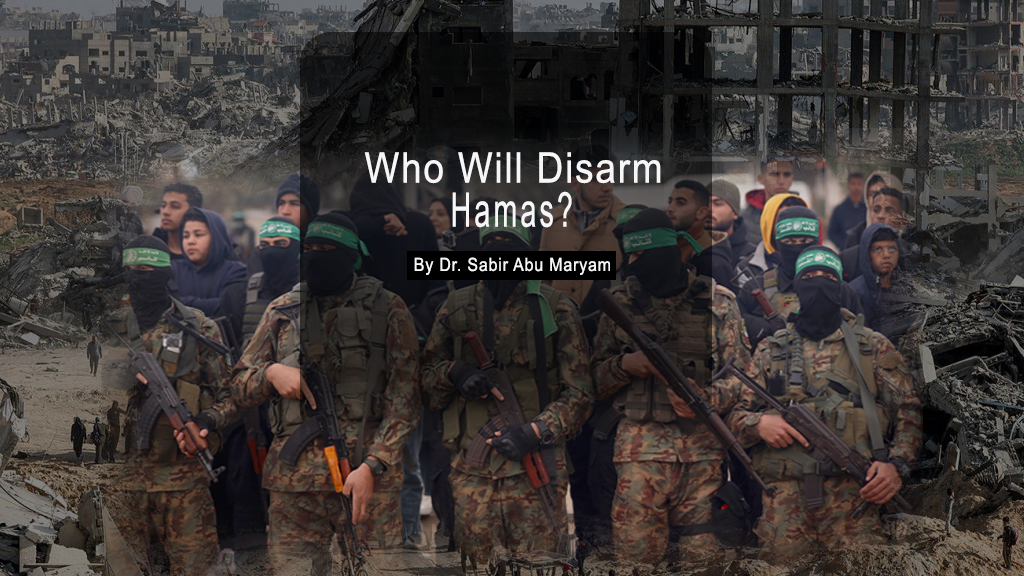
Israel’s continuous aggression against Gaza and the genocide of the Palestinian people are ongoing. Although, to some extent, the parties have acted on the dramatic “peace agreement” presented by U.S. President Trump, many questions still remain. Eight Muslim countries were included in the so-called peace agreement proposed by President Trump, and Pakistan is one of them. In the agreement, the U.S. president stated that Hamas must be disarmed, and in return Israeli forces would be withdrawn from Gaza. This was described as the second phase of the ceasefire.
In the first phase, there was discussion of a bilateral exchange of prisoners, for which Hamas released all Israeli captives. Those captives who had been killed during Israeli bombardment were also searched for, and their remains were handed over to Israel. However, sources say that one Israeli captive is still in Hamas’s custody. Some sources claim there are two captives, but one has been confirmed, who was affiliated with the Israeli police.
Ronen Givli, who was associated with the Israeli police, had been in Hamas’s custody in Gaza. According to Hamas’s confirmation, it was stated that Ronen Givli was killed in Israel’s brutal attacks, and now it has become impossible to locate his remains amid the rubble. On the other hand, Givli’s family says that he is still in Hamas’s custody and that Hamas is not releasing him in order to impose its conditions. Hamas has rejected these allegations.
In any case, the exchange of prisoners has now almost been completed, and the next part of this so-called ceasefire agreement concerns the disarmament of Hamas, which is linked with the withdrawal of Israeli forces from Gaza. However, even in the first phase, the occupying Zionist government of Israel did not adhere to any agreement and continued bombardment and attacks in Gaza, even to the extent that a Hamas leader was martyred. After all these violations, it is unlikely that Israel will withdraw its forces from Gaza, because if Israel does withdraw, it would mean that Israel’s retreat would become more certain,something Netanyahu will never accept.
In the next stages of Trump’s ceasefire plan, an interim government would be established in Gaza, while in the fourth stage the reconstruction of Gaza would be completed.
At present, the second phase is extremely important, in which Hamas is to be disarmed and Israeli forces are to be withdrawn from Gaza. After that, an international stabilization force would be deployed in Gaza, and Muslim countries are being invited to contribute their troops and deploy them in the area. This raises a critical question: if Israeli forces violate the agreement afterward, who will be held responsible? The agreement does not address this issue at all. After the violations of the first phase, the entire world has become cautious, if Israeli forces re-enter Gaza and Hamas has already been disarmed, then whom will the so-called international stabilization force support? Will it protect Palestinians from Israeli aggression, or will it merely stand by as a spectator? These questions have raised serious doubts and concerns about the plan known as the international stabilization force.
According to a BBC report, citing the Hebrew-language Israeli newspaper Israel Hayom, Turkey has been persistently pressuring to become part of the International Stabilization Force (ISF). According to the newspaper, the mandate of this force would also include disarming Hamas. An article published last week in the newspaper stated that Netanyahu has taken a firm stance that Turkey will not be allowed to join this force, and that the United States also supports Israel’s position.
On the other hand, U.S. officials have told the media that Pakistan has accepted an offer to become part of this force. However, so far no Muslim country has formally announced that it will join the force. A senior Israeli official, Gershon Baskin, says that Hamas might agree to freeze or store its weapons and possibly hand them over to the Palestinian Authority or a third party, but it will never hand over its weapons to the United States or Israel. He said that the U.S. also realizes that disarming Hamas is linked to the complete withdrawal of Israeli forces from Gaza, which is currently very difficult because Israeli troops are still present inside Gaza.
Gershon Baskin has played an important role on several occasions in contacts between Israel and Hamas in the past. He said that the presence of one Israeli hostage in Gaza is not a strong justification for delaying the second phase.
Another question arises here: after withdrawing from Gaza, where will Israeli forces go? At present, the Israeli army controls approximately 53 percent of the Gaza Strip. Under the first phase of the ceasefire agreement, Israeli forces have pulled back to the northern, southern, and eastern borders of Gaza. This division has become known as the “Blue Line.” In the second phase, there will be a need for mutual agreement on a new Israeli deployment line, the mechanism for disarmament, reconstruction, and arrangements for international monitoring. These matters are considered extremely sensitive in Israel, as they are linked to the security of Israeli towns adjacent to Gaza. In the future, the narrow strip of land on the Gaza–Egypt border known as the “Philadelphi Corridor,” as well as the Rafah crossing, is also important for Israel.
Israeli military sources do not want to withdraw from Gaza at all, because they know that losing control over Gaza would mean defeat, and they would then have to face their own people, how would they answer them, and with what face? Similarly, Hamas will never lay down its arms before the United States and Israel, as Hamas’s leadership has clearly stated in various statements that they will not be disarmed and will not abandon the path of resistance.
In summary, a deadlock persists on both sides. The American and Israeli dream of disarming Hamas is quite old. Such attempts have always been made, but the United States and Israel have faced failure. This time too, the dream of disarming Hamas will accompany President Trump to his grave, just as it did his predecessors. Therefore, President Trump is trying to send the forces of Muslim countries, including Pakistan, to Gaza and force Hamas to disarm as soon as possible. However, the people of Pakistan are opposed to sending the Pakistan Army to Gaza. No citizen of Pakistan wants the Pakistan Army to become part of American plans and be used against Hamas. As a result, the second phase of the ceasefire has not yet begun, and the question still remains: who will disarm Hamas? Perhaps the correct answer is that no one can, just as it has not been done in the past.