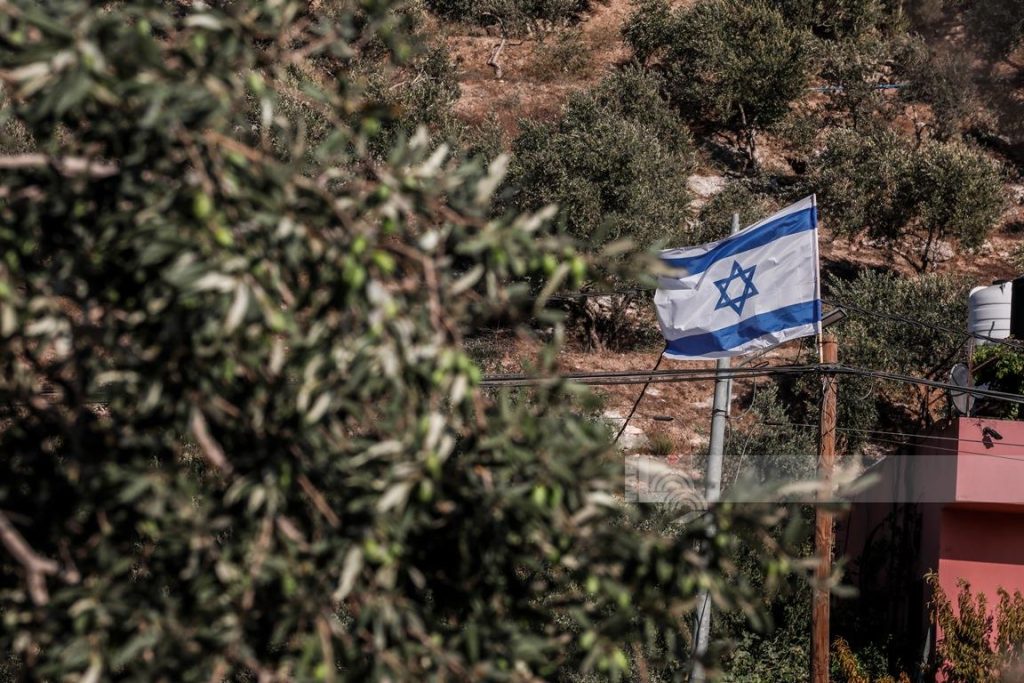
WEST BANK, (Palestine Foundation Information Center), The olive picking season in the West Bank is no longer an agricultural season awaited by Palestinian families to harvest the fruits of their trees and secure part of their annual needs, but has turned into a station in which Israeli attacks are renewed, amid the escalating targeting of farmers, their lands, and their trees, and the imposition of restrictions that prevent many from reaching their fields.
A new toll by the Wall and Settlement Resistance Commission revealed a remarkable escalation in these attacks, after documenting 674 attacks carried out by the Israeli occupation forces and settlers against olive trees and their farmers in the West Bank, including occupied Jerusalem, in just 37 days, extending from October 1 to November 6, 2026.
According to the report published by the commission on Saturday, the attacks were distributed as 520 attacks carried out by settlers, compared to 154 attacks carried out by occupation forces, in a toll that reflects the scale of risks facing farmers during the harvest season, turning agricultural activity in wide areas into an open confrontation with the attacks and restrictions imposed on the lands.
The danger of these figures does not stop at the number of recorded incidents, but extends to the nature and diversity of the attacks, from physical assault, intimidation, and preventing access to fields, to the theft of crops and the destruction of trees and agricultural equipment, threatening the livelihood of thousands of Palestinian families.
Nablus, Ramallah, and Salfit top targeted areas
Geographical data from the Wall and Settlement Resistance Commission shows the concentration of attacks in the northern and central governorates of the West Bank, where Nablus Governorate topped the list with 230 attacks, followed by Ramallah and Al-Bireh with 130 attacks, then Salfit with 129 attacks.
Thus, the three governorates recorded 489 attacks, equivalent to about 72.6% of the total recorded attacks during the mentioned period, which highlights the scale of targeting to which agricultural areas in this geographical expanse are subjected.
The commission also recorded 87 attacks in al-Khalil Governorate, 41 in Jenin, 30 in Bethlehem, 24 in Qalqilya, and three attacks in occupied Jerusalem.
This distribution reflects the expansion of the area of attacks and its lack of limitation to specific geographical focal points, even if the largest weight is concentrated in areas witnessing broad agricultural activity and an increasing settlement presence.
249 cases of intimidation and 76 physical assaults
Regarding the nature of the violations, the commission recorded 249 incidents of intimidation and violence against farmers, and 76 incidents of beatings and physical assault, in addition to 43 incidents of restricting movement or preventing access to agricultural lands.
The attacks also included arrest and detention inside the fields, firing live ammunition, tear gas canisters, and spraying pepper gas, alongside attacking solidarity activists and journalists who accompanied the farmers during the harvest season.
The report recorded the martyrdom of a Palestinian citizen who succumbed to his injury from settlers’ bullets while participating in olive picking, in an indicator of the risks that have come to surround farmers even while practicing their agricultural activity in their own lands.
These practices reveal that the attack on farmers is not limited to direct assault, but also includes restricting their movement and depriving them of reaching lands, making the process of picking the crop itself fraught with dangers.
In many areas, farmers are forced to wait for coordination or accompaniment that allows them to reach their lands, while others lose the opportunity to harvest their crops as a result of the threats and restrictions imposed on them.
Theft of crops and destruction of trees
Olive trees, their fruits, and farmers’ equipment were not spared from the attacks, as the commission monitored 91 incidents of olive fruit theft, and 37 incidents of theft or confiscation of agricultural equipment, alongside 20 incidents of breaking trees and 18 incidents of cutting and uprooting.
Violations also included burning agricultural lands and properties of farmers, and bulldozing fields, while the number of olive trees whose damage could be counted reached about 2,974 trees.
These damages exceed the value of the crop lost by the farmer during a single season, as the attack on perennial trees affects agricultural production for long years, and weakens the ability of families to benefit from their lands and continue working in them.
Also, the theft of fruits and equipment deprives farmers of the return of their season, and adds new financial burdens on them, especially in light of the difficult economic conditions experienced by Palestinian communities in the West Bank.
Escalation exceeding previous seasons
The toll of the current season gains additional importance when compared to past years, as data from the Wall and Settlement Resistance Commission indicates the recording of 333 attacks during the 2023 season, 407 attacks during the 2024 season, and more than 441 attacks during the 2025 season, compared to 674 attacks during the period covered by the current report.
Thus, the attacks recorded in the current period increased by about 102% compared to the 2023 season, and about 66% compared to the 2024 season, even though the current toll covers only 37 days, highlighting the acceleration of the pace of attacks during the ongoing olive season.
This comparison does not merely reflect a numerical increase, but indicates the expanding pressures to which the Palestinian agricultural sector is subjected to, and the increasing risks facing farmers in reaching their lands and protecting their crops.
From direct attack to restricting agricultural presence
In a reading of the nature of these attacks, the Wall and Settlement Resistance Commission confirms that the targeting is no longer limited to sporadic incidents or swift attacks, but has taken more extended forms, including the repeated siege of lands and the settlement presence inside fields or in their surroundings.
These practices are embodied in preventing farmers from reaching their lands, releasing herds of livestock into fields, stealing fruits and equipment, setting up settlement tents and structures and expanding existing outposts, alongside bulldozing agricultural lands.
The overlap of these methods leads to weakening the Palestinian farmer’s ability to continue his activity, as he not only loses his crop, but faces the danger of losing the possibility of reaching his land and investing in it on a regular basis.
Also, the damage to olive trees, their cutting, and uprooting carries effects beyond the current season, considering that these trees represent an inherited source of income for many Palestinian families, with which deeply rooted living, economic, and social patterns in the Palestinian countryside are linked.
Demands for protecting farmers and guaranteeing access to lands
In the face of escalating attacks, the Wall and Settlement Resistance Commission called for effective international intervention to provide protection for Palestinian farmers, guarantee their safe access to their fields, and hold accountable those responsible for attacks targeting people, lands, trees, and agricultural properties.
The new toll places the international community before the scale of challenges facing Palestinian farmers, at a time when the olive season is supposed to be an opportunity for work, production, and securing income, not an occasion for fear, threat, and loss of crops.
While olive picking operations continue in separate areas of the West Bank, fears increase that repeated attacks and restrictions imposed on lands will turn into a permanent factor threatening the continuation of agricultural activity, and undermining the ability of Palestinian families to hold fast to their lands and sources of livelihood.
For Palestinians, the olive tree is not merely a seasonal crop, but part of the attachment to the land and an economic and social source inherited by generations; therefore, targeting it is not limited to losing the fruits of one year, but extends to the future of agriculture and livelihoods in Palestinian rural communities.