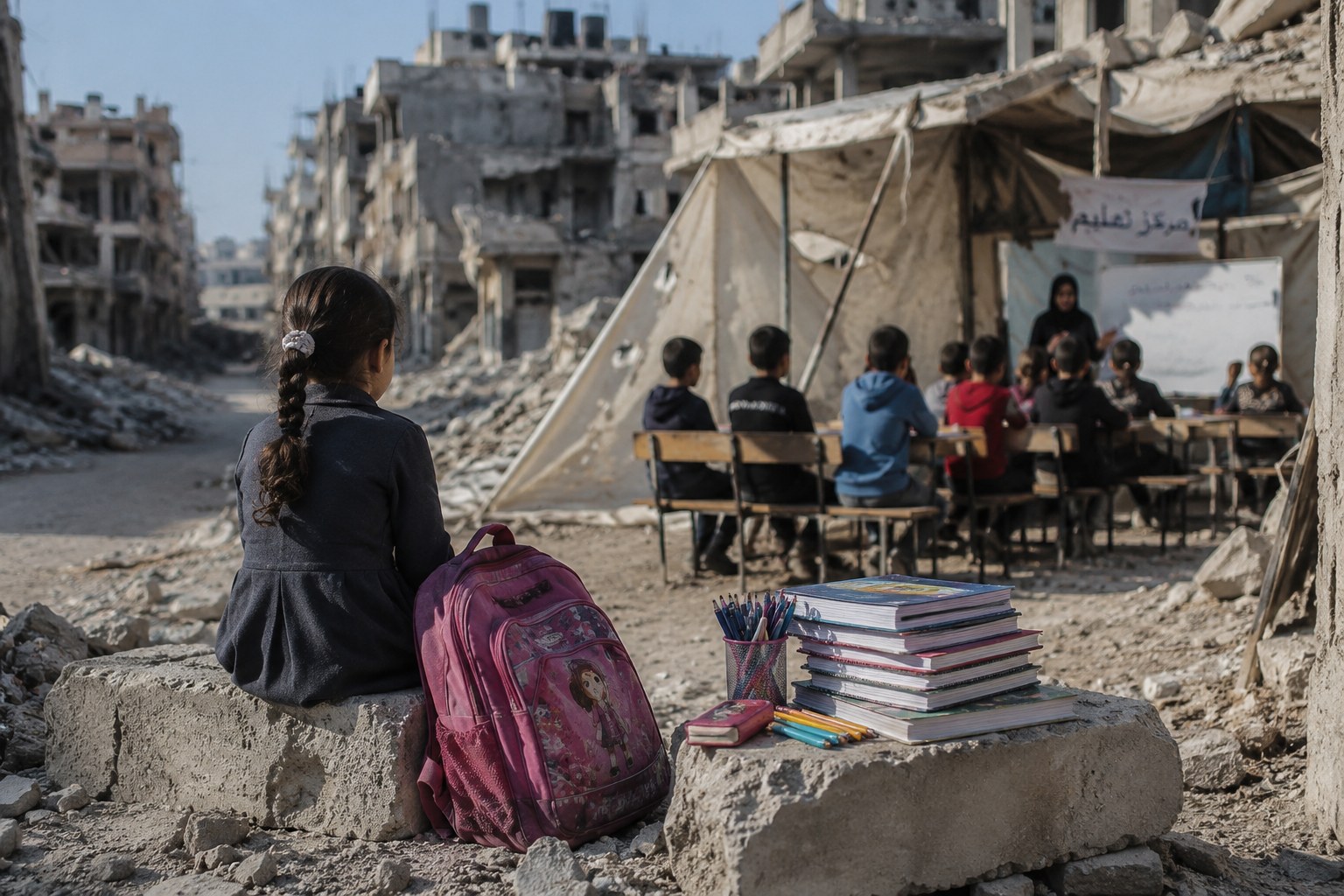
Gaza, (Palestine Foundation Information Center), Nearly 700,000 Palestinian students in the Gaza Strip began the 2026/2027 academic year on Saturday in one of the most difficult attempts to restore education after three years of imposed genocidal war. The return to education is taking place under exceptional circumstances, with schools and educational facilities extensively destroyed, severe shortages of resources, and thousands of students forced to study in tents, temporary facilities, or through online education.
The return to education this year is taking place in an environment where most schools have either been destroyed by Israeli bombardment or are being used as shelters for displaced people. As a result, education is being conducted through temporary alternatives rather than conventional school buildings.
According to the Gaza Ministry of Education’s plan, approximately 350,000 students are being targeted for enrollment in the new academic year, compared with 270,000 last year. Meanwhile, the United Nations Relief and Works Agency for Palestine Refugees (UNRWA) has adopted a combined attendance and online learning model to provide education to hundreds of thousands of students, while gradually establishing temporary educational centers.
School-Based Learning Replaced by Emergency Alternatives
Ahmed Ayish al-Najjar, Director General of Public Relations and Information at Gaza’s Ministry of Education, said the ministry had developed a flexible education plan based on the principle that children’s right to education cannot wait for schools to be rebuilt.
In statements to Safa news agency, al-Najjar explained that the plan includes usable schools, temporary educational centers, learning points established in tents, and digital platforms where resources are available.
The ministry announced that the academic year officially began administratively on September 16, while regular classes for students started on September 19.
Al-Najjar said the ministry estimates that the number of schools and educational points in operation will increase from approximately 270 last year to around 320 this year, helping expand educational coverage and accommodate more students.
He stressed that the return to education does not mean that all students are returning to conventional school buildings, as the educational infrastructure has been extensively destroyed and many schools are still being used by displaced people.
In a statement issued at the beginning of the academic year, the Ministry of Education and Higher Education confirmed that, with support from partners, approximately 500,000 students had been brought back into educational settings. Alternative learning spaces have also been provided, while dozens of field schools have been equipped with furniture and essential supplies according to available resources.
UNRWA’s Attendance and Online Learning Model
Meanwhile, UNRWA spokesperson Adnan Abu Hasna said the agency is implementing an educational model combining in-person attendance and online learning to ensure continuity in students’ education.
He explained that the agency had established 86 educational spaces at the beginning of the academic year and would gradually expand teaching activities depending on security conditions, available space, teachers, and basic facilities.
The model targets students from first through ninth grade. Around 280,000 students are enrolled in online learning, while the initial target for attendance-based education is 72,051 students, a figure that could be increased to approximately 100,000 depending on circumstances.
According to Abu Hasna, in-person education will be provided three days a week, with four hours of instruction per day, while guidance for students will continue through online platforms and educational channels.
Tents: A Temporary Alternative That Cannot Provide an Adequate Learning Environment
Tents and temporary facilities are helping keep education going, but al-Najjar said they are an emergency solution that cannot become a permanent substitute for schools.
He noted that these environments do not always provide suitable educational and health conditions, particularly during extreme summer heat and winter cold. Equipment and resources are also severely limited.
According to Ministry of Education figures, approximately 97 percent of educational buildings are no longer functional due to damage, destruction, or their use as shelters.
Heavy Losses Among Education Staff and Students
According to Ministry of Education figures, approximately 17,000 students and 770 people working in the education sector have been killed during the Israeli war.
The losses extend beyond human lives and buildings. Al-Najjar said the Ministry of Education’s headquarters had also been completely destroyed, while the ministry had lost most of its furniture, equipment, and transportation.
In its statement marking the beginning of the academic year, the ministry paid tribute to those killed and pledged to continue its efforts by every possible means to secure a brighter future for students and fully restore the educational system.