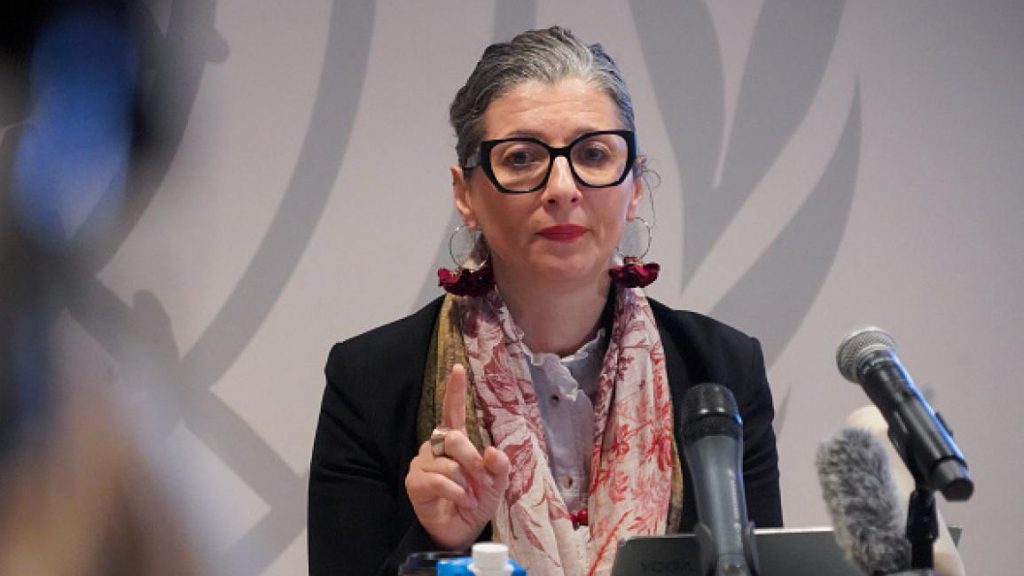
NEW YORK, (Palestine Foundation Information Center), UN Special Rapporteur on the situation of human rights in the occupied Palestinian territories Francesca Albanese said Israel’s genocide in the Gaza Strip has not ended, three years after it began, warning that the scale of destruction, continuing hunger and worsening conditions across the occupied Palestinian territories require action that goes beyond diplomatic condemnation.
In an interview with Anadolu Agency, Albanese said the situation in Gaza was “catastrophic” and beyond what words could adequately describe. She warned that the continuing destruction raises serious questions about the international community’s response, particularly that of governments that continue to support Israel.
Albanese said that referring to Palestinians as “genocide survivors” could wrongly suggest that the danger had passed, noting that around 70% of the Gaza Strip is under Israeli control while widespread destruction continues.
Her warning coincided with remarks by UN Special Rapporteur on the right to food Sofía Monsalve Suárez, who said humanitarian assistance is still not entering Gaza freely or at the scale required, leaving Palestinians trapped in severe food insecurity.
Gaza between destruction and hunger
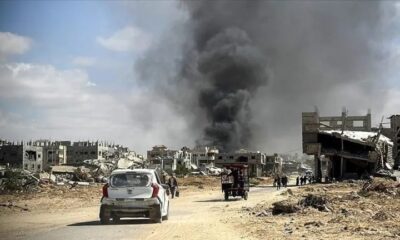
Despite the ceasefire announced on October 10, 2025, figures cited in Albanese’s interview indicate that Israeli attacks have continued. Since then, 1,467 Palestinians have been killed and another 5,161 wounded, most of them children and women, while destruction has continued and agreed quantities of food, medicine, medical supplies and shelter materials have not been allowed into Gaza.
Speaking to Al Jazeera on Wednesday, Monsalve Suárez warned that continuing restrictions on humanitarian assistance are worsening Gaza’s humanitarian and food crisis.
She said aid is not reaching Palestinians with the necessary freedom or in sufficient quantities while high levels of food insecurity persist across the Strip.
According to projections from the Integrated Food Security Phase Classification, more than 1.4 million people, representing around 67% of Gaza’s population, are expected to face Crisis-level or worse acute food insecurity between July and December 2026.
Around 212,000 Palestinians are expected to experience emergency levels of acute food insecurity, reflecting the continuing struggle of families to obtain sufficient food.
The United Nations has documented the severe impact that restrictions on humanitarian assistance, combined with the destruction of Gaza’s agricultural land and food-production systems, have had on the hunger crisis.
Albanese linked what is happening in Gaza to historical conflicts in which indigenous peoples were subjected to extermination during the colonial era, saying the way history is written will ultimately determine how Gaza is remembered.
She portrayed Gaza as the site of a confrontation between two camps: one seeking to continue genocide, exploitation and the erasure of Palestine, and another seeking to stop it. She placed the United States, Israel and their allies in the first camp, while saying peoples around the world and some governments stand on the other side.
Albanese said the genocide has also transformed public perceptions, stressing that killing children while attempting to portray Israel as the victim contradicts the reality on the ground and that this narrative is increasingly failing to withstand changes in public opinion.
West Bank faces expanding Israeli assaults
Albanese also warned that the situation in the occupied West Bank is deteriorating amid killings, arrests, detentions, demolitions and restrictions imposed on Palestinian communities.
Since the beginning of the genocidal war on Gaza, attacks by Israeli forces and settlers have intensified across the occupied West Bank and East Jerusalem. According to figures cited in the report, 1,210 Palestinians have been killed, 13,350 wounded and 26,000 arrested.
The violations include the demolition of homes and other structures, the burning of mosques and vehicles, the bulldozing of agricultural land, restrictions preventing farmers from reaching their land, displacement and continued settlement expansion.
Albanese welcomed moves by 12 Western countries to impose restrictions on trade with Israeli settlements in the occupied Palestinian territories but questioned how broadly those measures would be applied.
She said the British measures represented a long-overdue shift in policy but maintained that the approach remained too heavily focused on settlements, questioning whether it would also encompass occupied East Jerusalem.
Criticism of US policy
Addressing European-US relations, Albanese said the war on Gaza had exposed the cost of Europe’s dependence on Washington, maintaining that the relationship does not always function as an alliance between equal partners.
She urged Middle Eastern governments to take seriously links between US foreign policy and visions associated with a “Greater Israel” project, warning that, in her view, the project is not merely a future concept and that there are signs of its implementation.
Albanese said some supporters of this vision invoke biblical assertions extending to Jordan, Syria and Iraq, urging governments across the region to pay attention to its potential consequences.
US sanctions against Albanese
Albanese also discussed the US sanctions imposed on her in July 2025 following her repeated criticism of Israel and her reports examining companies she said were contributing to continuing Israeli activities in the occupied Palestinian territories.
She said the effects of the sanctions extend beyond the United States, restricting her access to banking and financial services and affecting her ability to work, travel and cover everyday expenses.
Albanese said she can no longer use her credit cards, has lost access to health insurance and remains barred from entering the United States. She said the restrictions have also affected her ability to carry out her UN mandate.
Her inability to conduct financial transactions or receive payment for other work has left her financially dependent on members of her family, she said, noting that her work for the United Nations is unpaid.
Three years into the genocide, Albanese’s warning and the latest UN food-security assessments point to a crisis that has not ended with the ceasefire. Palestinians continue to be killed and wounded, large parts of Gaza remain devastated, humanitarian assistance remains restricted, and more than 1.4 million people face severe levels of acute food insecurity.
For Gaza, the destruction is therefore not only measured in buildings reduced to rubble. It is also reflected in families struggling to obtain food, medicine and shelter while the conditions necessary for meaningful recovery remain out of reach.