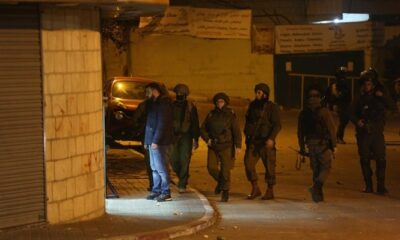
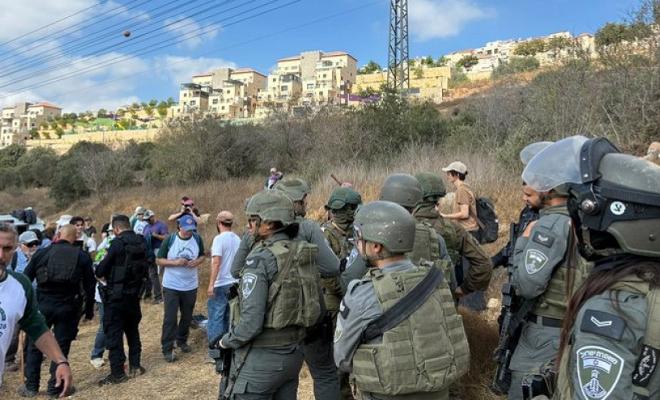
WEST BANK, (Palestine Foundation Information Center), Israeli occupation forces arrested Democratic congressional candidate Brad Lander, dozens of international solidarity activists, and an elderly Palestinian woman on Wednesday while they were helping Palestinian farmers harvest olives in the town of Nahalin, west of Bethlehem, in the southern occupied West Bank.
According to local sources, Israeli forces confronted farmers and volunteers in the al-Habla area, adjacent to the Israeli settlement of Beitar Illit, and detained approximately 90 volunteers from the organization Rabbis for Human Rights.
Those detained included Lander and former Israeli Deputy Attorney General Yehoshua Shoffman.
The detainees were taken to the headquarters of the Etzion Regional Brigade before being transferred to a police station. Some were later released after receiving warnings.
Israeli forces also arrested Fahima Issa Ghayatha, a Palestinian woman approximately 70 years old, and confiscated the olives harvested during the day’s work.
The incident comes as activists and human rights organizations say Palestinian farmers in the area have been prevented from accessing their land for the past three years because of military restrictions and continuing settler attacks.
Rabbis for Human Rights said its volunteers had accompanied Palestinian farmers to provide protection during the olive harvest.
The organization explained that Israeli forces declared the area a “closed military zone” approximately two hours after harvesting began. Although the activists complied with the orders and left the site, they were subsequently detained.
The attack sparked sharp criticism within Jewish organizations.
Rabbi Jill Jacobs, chief executive officer of T’ruah, described the incident as “an outrageous abuse of power,” accusing the Israeli military of targeting solidarity activists seeking to protect Palestinian farmers rather than stopping extremist settlers who commit violence against Palestinians.
Jacobs said these practices were part of “a systematic campaign of ethnic cleansing aimed at driving Palestinians from their land,” according to the Israeli newspaper The Jerusalem Post.
In a joint statement, the Israel Reform Movement and the Council of Reform Rabbis described the arrests as “appalling,” warning that detaining activists motivated by values of justice and humanity reflected “a loss of moral control” and damaged Israel and its relations with Jews in the diaspora.
Both organizations demanded the immediate release of all detainees and called for action against settlers involved in daily attacks on Palestinian farmers, rather than the prosecution of solidarity activists attempting to protect them.
The incident comes amid escalating Israeli attacks on olive-harvesting areas across the occupied West Bank, where farmers face severe restrictions and repeated assaults that prevent them from accessing their land and harvesting their crops.
The olive harvest is a vital source of income for thousands of Palestinian families.
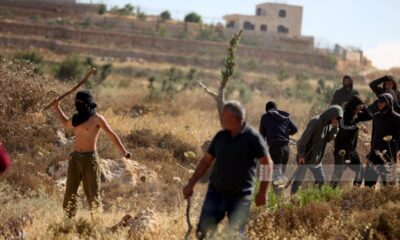
This year’s harvest season has witnessed a marked escalation in attacks by Israeli settlers and occupation forces against farmers and international solidarity activists, with repeated incidents of physical assault, vandalism, and property being set on fire across different parts of the West Bank.
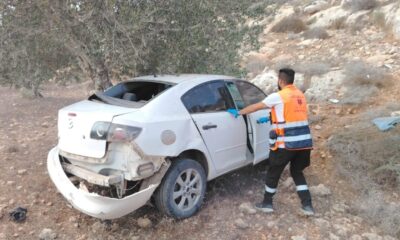
Over the past two weeks, international organizations have documented a series of attacks involving vehicles and olive trees being set on fire, farmers being pelted with stones, and foreign volunteers and journalists being assaulted.
The incidents have prompted criticism over the failure of Israeli forces to intervene and stop the attacks, along with accusations that they have provided protection to settlers carrying them out.
UN reports indicate that the number of attacks recorded in recent days has already surpassed the total documented during the entire olive harvest season last year, reflecting the expanding scale and increasing intensity of the violence.
The escalation has also heightened concerns that anyone attempting to help Palestinians access their land could become a target.
In an incident that drew international condemnation, American photojournalist Heidi Levine, who works for The Washington Post, was violently attacked by dozens of masked Israeli settlers while covering assaults on olive pickers in the village of Abu Falah, near Ramallah, a couple of days ago.
Levine suffered fractures and multiple injuries after the attackers repeatedly kicked and beat her for approximately 10 minutes, despite her wearing a protective vest clearly marked “PRESS.”
Her equipment, phone, and passport were also stolen.
American and French officials strongly condemned the attack, calling on Israeli authorities to take urgent action to stop the violence and hold those responsible accountable.
These attacks highlight the widening range of people being targeted. The violence is no longer directed solely at Palestinian farmers but also affects journalists, diplomats, and international solidarity activists who document abuses or attempt to protect civilians.
The olive harvest season in the West Bank typically runs from early October through the end of December and is one of the most important agricultural periods for thousands of Palestinian farmers, particularly in rural communities that depend on it for their livelihoods.
Beyond its economic importance, the harvest is a deeply rooted social and cultural tradition in Palestinian society.
Families gather in the fields, passing down their knowledge and traditions from one generation to the next. The olive tree itself represents far more than an agricultural resource: it symbolizes Palestinians’ connection to their land, national identity, and resilience in the face of land confiscation and displacement.
Amid escalating attacks and restrictions on access to farmland, the olive harvest has become, for many Palestinians, a daily struggle to preserve their livelihoods, secure their right to reach their fields, and protect their trees from uprooting and destruction, rather than a season of gathering crops and celebrating their connection to the land.