GAZA (Palestine Foundation Information Center), Parts of Gaza’s health and humanitarian aid systems are facing further deterioration as international and humanitarian organizations, under pressure from funding and supply shortages, have been forced to reassess their priorities and scale back some of their services. This is happening at a time when the devastated Gaza Strip can no longer afford to lose another health facility or humanitarian service.
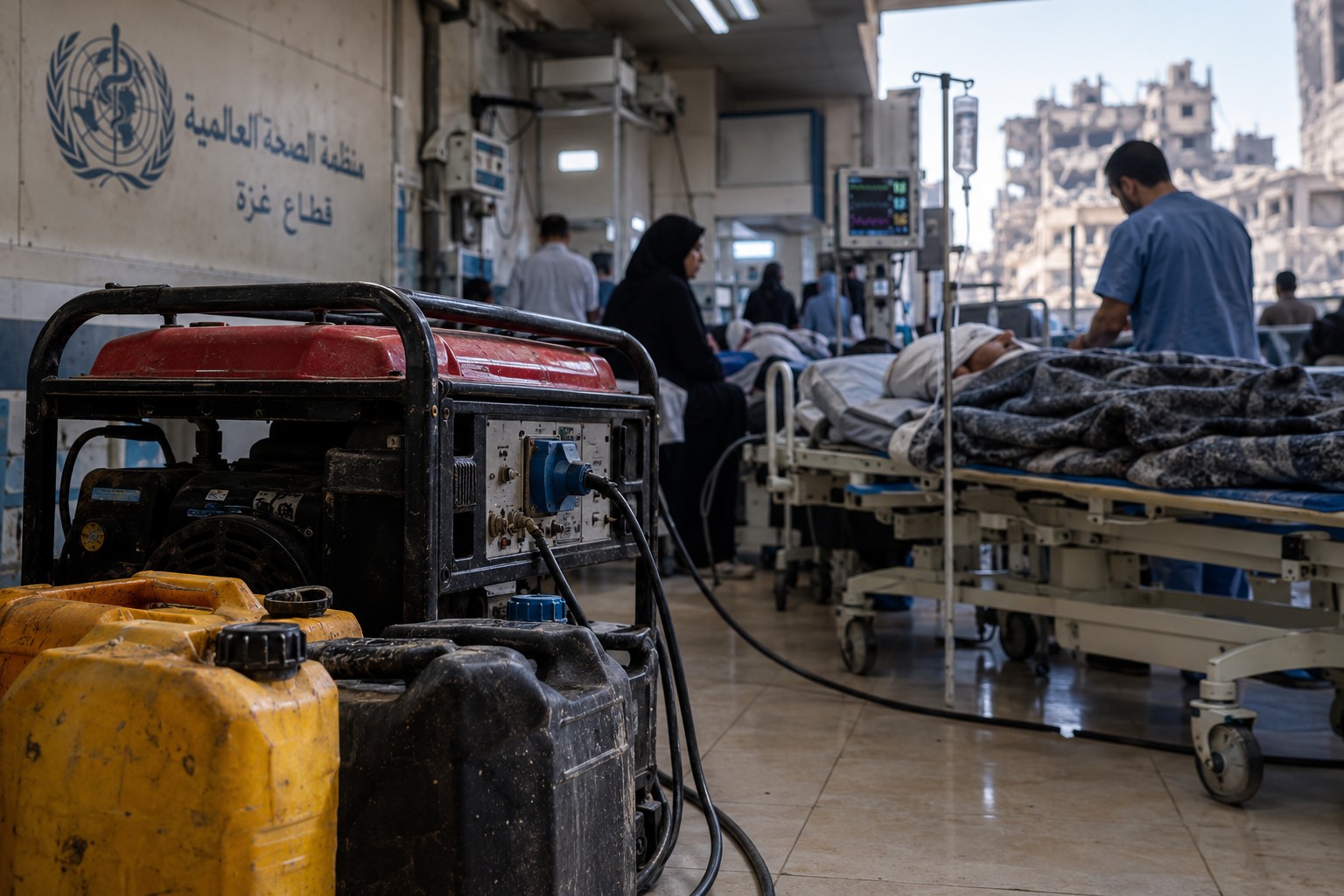
A number of non-governmental and charitable medical centers across the Gaza Strip have received notices indicating that fuel supplies provided to them by the World Health Organization (WHO) may be halted after September 19. Mohammed Abu Afash, Director of the Medical Relief Society in Gaza, disclosed this in an exclusive statement to the Palestinian Information Center.
Abu Afash said that if the decision is implemented, services at around seven medical centers could be suspended or shut down. He explained that some organizations have already received official notices, while others have not yet received such notifications. Nevertheless, there are concerns that the cuts could extend to additional organizations, including the Medical Relief Society.
According to Abu Afash, the issue does not concern government or public hospitals, but rather charitable and non-governmental centers, hospitals and medical institutions. However, this does not lessen the seriousness of the consequences, given that these facilities play a vital supporting role for public hospitals, which are already operating under extreme pressure and with limited resources.
A Range of Services at Risk
Charitable and private medical institutions receive thousands of patients and provide specialized services, surgical procedures, diagnostic tests and treatments that help ease the burden on public hospitals. As a result, the loss of any additional facility would push more patients toward public institutions that are already struggling to meet accumulated needs.
Abu Afash warned that losing these centers would not simply mean the loss of individual services. It would place additional pressure on major hospitals and cause further delays in surgical procedures, diagnostic tests and treatments urgently needed by patients.
Gaza’s health system has been operating with extremely limited resources since the beginning of the war compared with what was previously available. Large-scale destruction has affected medical facilities and departments, while shortages of equipment, medicines, consumables and medical personnel have further weakened the system. Any additional reduction in health services therefore has a compounded impact on patients.
Abu Afash pointed out that major hospitals, including Al-Shifa Medical Complex and Nasser Medical Complex, are carrying workloads far beyond their operational capacity, particularly following the Al-European Hospital’s suspension of services. This makes supporting medical institutions an indispensable component of Gaza’s healthcare network.
Fuel: An Indispensable Backup Power Source With No Substitute
The severity of the fuel crisis is not limited to the operation of ambulances or the transportation of patients. Medical facilities fundamentally depend on generators to provide electricity for operating rooms, intensive-care equipment, laboratories, refrigerators used to preserve medicines and vaccines, and other life-saving services.
Consequently, fuel shortages directly translate into a reduced capacity to provide healthcare, even at facilities whose buildings and equipment remain operational.
In its latest reports, the United Nations has pointed out that shortages of motor oil and spare parts, along with restrictions on their entry, are placing services dependent on generators at risk. These include hospitals, primary healthcare centers and blood banks, as well as water wells, desalination plants and sewage stations.
Since March 1, only 13,445 liters of motor oil have been approved for entry, while 92,778 liters remained awaiting approval, including more than 22,000 liters designated for health services.
The fuel crisis has therefore evolved from a logistical problem into a factor threatening a broad range of essential services, from healthcare, water and sanitation to humanitarian aid transportation and waste disposal.
The fuel crisis is also inseparable from the broader funding crisis affecting the humanitarian response in Gaza. Last June, OCHA said funding shortages had forced some humanitarian partners to reduce or suspend life-saving services, while others had begun scaling back their operations or lost the capacity to plan and respond at the required level.
The impact included water services, food assistance, management of displacement sites, child protection, psychosocial support, and specialized services for women and girls.
As the crisis continues, the problem is no longer limited to the scale of humanitarian needs. It has become increasingly tied to the ability of the organizations responding to those needs to continue operating. This is why any new funding disruption directly affects residents who rely heavily on aid and humanitarian services.
In its latest report, OCHA said funding shortages and restrictions on the entry of essential goods and equipment are severely limiting humanitarian partners’ ability to improve conditions at displacement sites and prepare for the rainy season, while health, water and sanitation services remain under continuous pressure.
This represents a dangerous trajectory for a health system that has almost no room left to absorb further shocks. According to the World Health Organization, Gaza’s health system remained in severe decline throughout 2026, amid continued damage to infrastructure and restrictions on access and supplies. Data from the organization’s resources and health-service monitoring mechanisms showed that service-providing facilities continued to face major obstacles in delivering basic healthcare.
Last July, OCHA warned that funding shortages had resulted in shortages of essential medicines, including insulin and cardiovascular drugs, as well as declining stocks of dialysis supplies and cardiology catheterization materials. This has limited facilities’ ability to regularly provide specialized services to patients in need.
The crisis facing charitable medical centers demonstrates that the threat to Gaza is no longer limited to the possibility of a major hospital going out of service. It increasingly concerns the hollowing out of the network of supporting services surrounding hospitals — the network that helps distribute patients and provide primary and specialized care, surgeries and diagnostic tests.
With each center that closes, its workload is transferred to other facilities, and with every service that is reduced, waiting lists grow longer while the entire health system’s capacity to respond to new needs continues to decline.
Gaza is therefore facing a bitter contradiction: humanitarian and medical needs continue to expand, while the ability of service providers to fund their operations and secure the fuel and supplies required to maintain those operations continues to shrink.