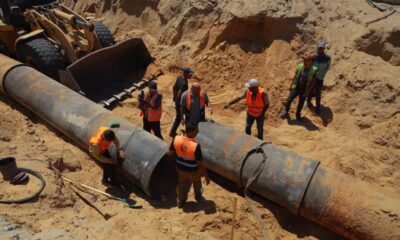
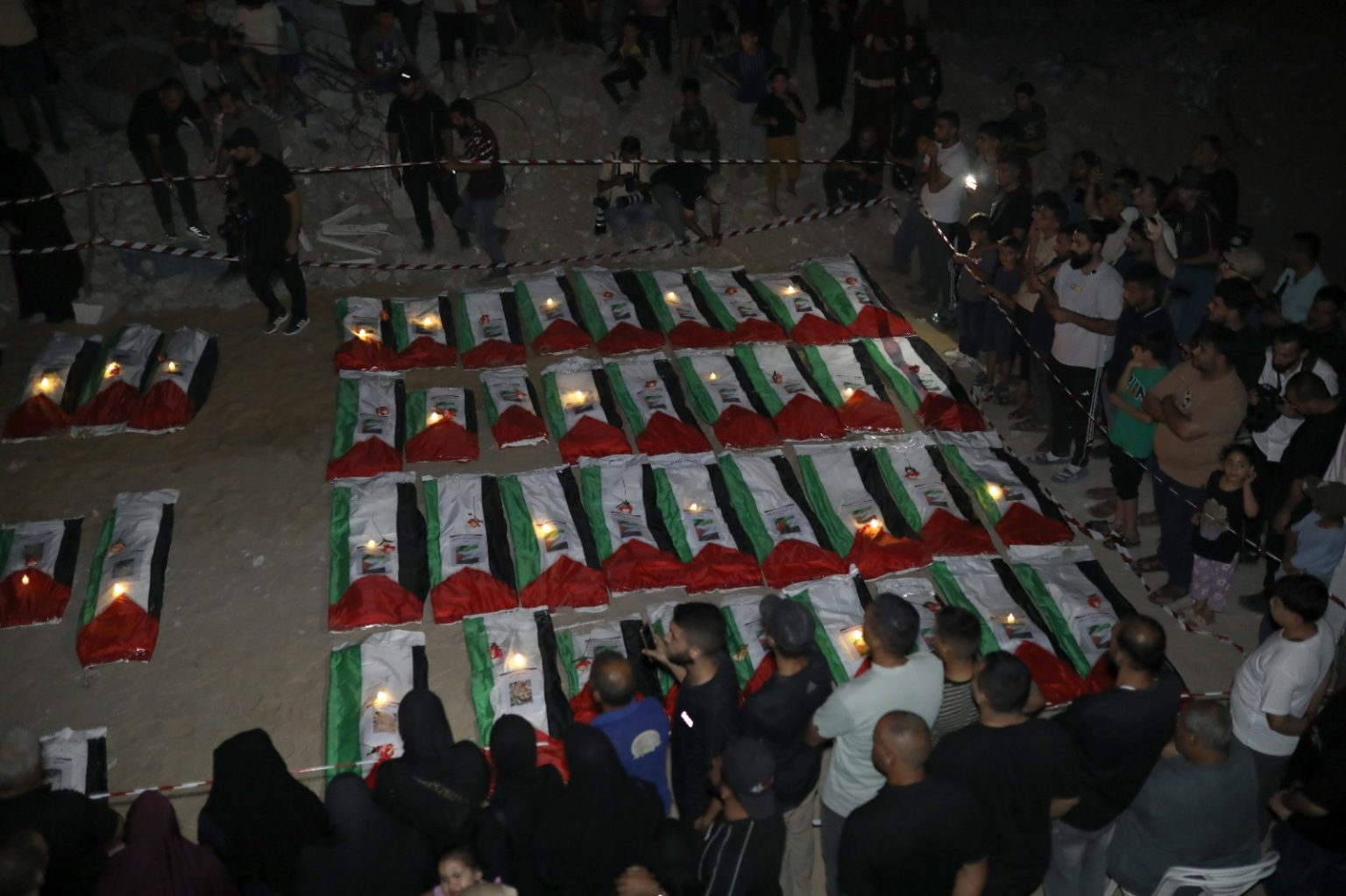
GAZA, (Palestine Foundation Information Center), Gaza City residents bade farewell to the bodies and remains of 105 martyrs recovered from under the rubble of Al-Taj residential block on Yarmouk Street, after a long wait, while other families still wait to reach their relatives, amidst a shortage of heavy equipment and Israeli restrictions hindering search operations and rubble removal.
A farewell ceremony was held on Wednesday evening, in coordination between the Civil Defense, the Egyptian Committee, and the Victims’ Families Association, in a yard at the destroyed site. Paramedics and rescue workers carried the shrouds and arranged them near the rubble, where families gathered to take a final look at their relatives.
The Civil Defense announced that recovering the martyrs took 17 days of work in cooperation with the Egyptian Committee, before completing the search in the targeted area within Al-Taj block.
Civil Defense spokesman Mahmoud Basal said that reaching the martyrs under the rubble required grueling efforts that extended for a long time, renewing the call to protect the Strip’s residents and guarantee their right to life and safety.
Re-exposing the tragedy
For its part, Hamas said in a press statement on Thursday that the scene re-exposes the scale of the tragedy of families who waited to find their children to bury them, considering it evidence of the Israeli crime of genocide committed against civilians in the Gaza Strip.
The Movement added that the continued prevention of entry of equipment and machinery necessary for rubble removal doubles the suffering of families who do not yet know the fate of their children and relatives.
It called for pressure on Israel to compel it to allow entry of rubble removal machinery and heavy equipment needed by Civil Defense crews, enabling them to search for missing persons and recover bodies.
Hamas demanded that the International Criminal Court continue investigating and prosecuting Israeli leaders responsible for crimes against civilians. It also called on competent courts around the world to activate their legal powers to hold war criminals accountable and prevent their impunity.
Ongoing recovery operations
The recovery operation comes within the second phase of the martyr body retrieval project, which was launched on July 19, to reach martyrs who remained under the rubble of buildings destroyed by Israeli bombing, despite the limited machinery and capabilities available.
According to Civil Defense data, the second phase plan includes searching under the rubble of 147 destroyed homes in the Gaza, North Gaza, and Central governorates, where 1,072 bodies are believed to remain, as part of a program targeting the provision of 800 working hours.
The first phase, which began in late November 2025, resulted in the recovery of about 333 bodies and remains out of 559 missing persons believed to be under the rubble of 54 homes and buildings. These figures pertain to sites included in the project and do not represent the total number of missing persons in the Strip.
This gap between the numbers of recovered persons and missing persons illustrates the magnitude of the task facing rescue teams, as reaching a destroyed site does not mean the ability to complete the search, especially when bodies are under concrete blocks that cannot be moved with simple tools.
Lack of machinery hinders search
Obstacles are not limited to the scarcity of heavy equipment, but include a decline in the operational capacity of available machinery, as rubble removal equipment suffers frequent breakdowns amidst a shortage of spare parts, engine oil, and materials necessary for operation and maintenance.
The United Nations Development Program estimated the volume of rubble in Gaza at about 61 million tons, illustrating the wide gap between the scale of destruction and the capabilities available to deal with it.
Many recovery operations are carried out manually. In a briefing published by the UN website in Palestine on September 16, UN High Commissioner for Human Rights Volker Turk pointed to Israel’s continued refusal to allow the entry of heavy equipment required for rubble removal.