GAZA, (Palestine Foundation Information Center), Ramiz Alakbarov, acting UN Special Coordinator for the Middle East Peace Process and UN Humanitarian Coordinator for the Occupied Palestinian Territory, has warned that Palestinians in the Gaza Strip continue to face a complex humanitarian crisis despite some progress in allowing food supplies to enter.
In an interview, Alakbarov said humanitarian conditions in Gaza remain difficult, with persistent problems involving water, sanitation, shelter and waste management. At the same time, residents have become increasingly dependent on humanitarian assistance and cash transfers as the labor market has yet to recover.
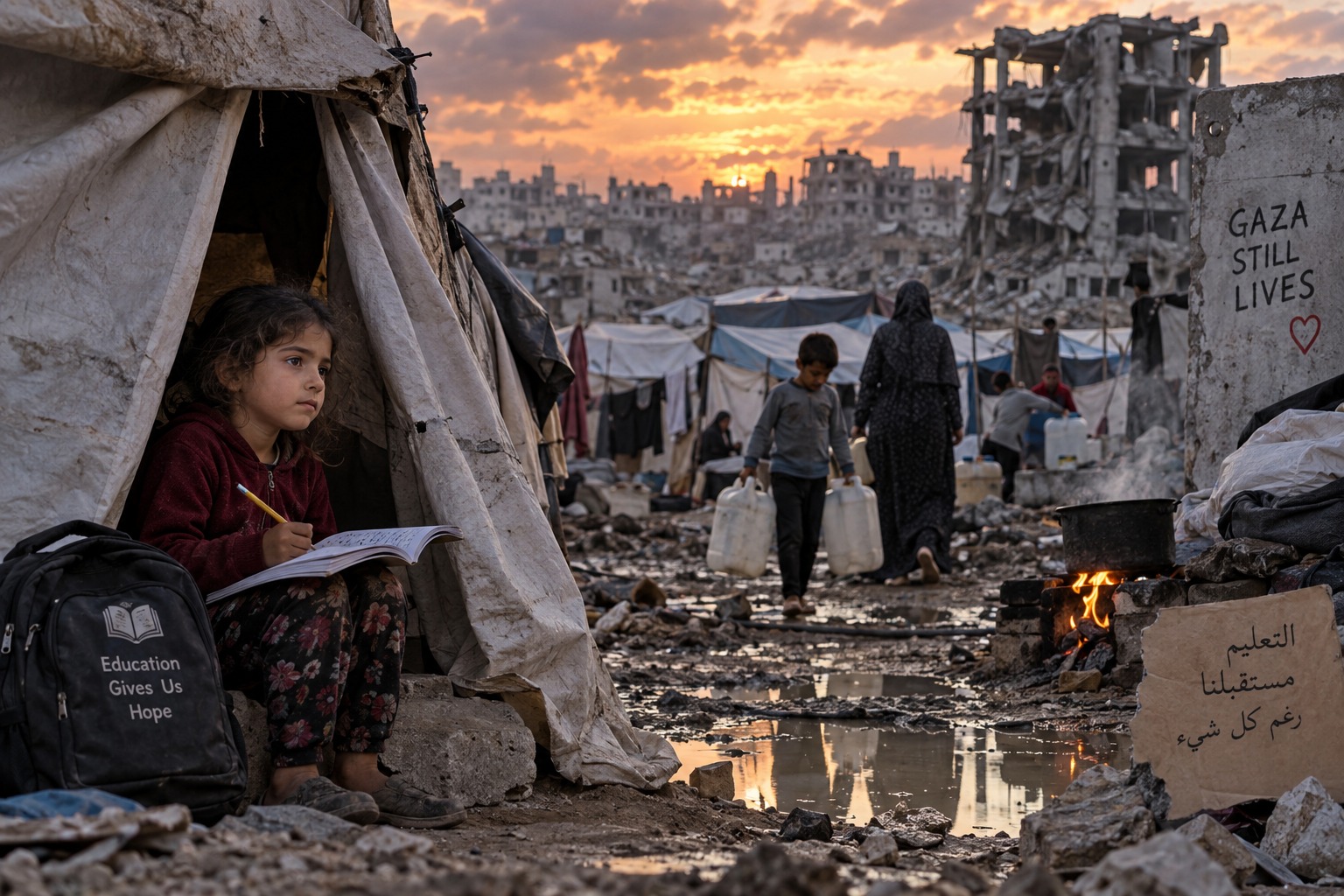
He said the United Nations continues to carry out work in water and sanitation, healthcare, debris removal and education, while also supporting farmers in the Gaza Strip. More than 300,000 children are currently receiving education in temporary learning spaces, he said, while only a limited proportion of land remains available for agricultural activity.
Alakbarov said the UN Relief and Works Agency for Palestine Refugees (UNRWA) continues to operate in Gaza despite restrictions imposed on its work. He added that more than 8,000 people remain missing beneath the rubble of buildings across the Strip.
The UN official said Gaza residents have expressed a desire not to spend another winter in tents, but instead to return to schools and workplaces, take part in rebuilding their communities, and see water, sanitation and electricity services restored.
In the occupied West Bank, Alakbarov described the situation as “extremely tense,” pointing to continued settlement expansion, settler violence, movement restrictions and mounting economic pressure on Palestinians.
He said the UN continues to provide grants, cash assistance and legal support to affected families and communities across the West Bank in an effort to mitigate the impact of deteriorating humanitarian and economic conditions.
On the political track, Alakbarov stressed that there is “no alternative to the two-state solution,” calling for a comprehensive approach to the Palestinian issue, efforts to rebuild trust, an end to incitement to violence, and support for the unity of Palestinian institutions.
Gaza’s economy in ruins as 92% of rconomic establishments are damaged or destroyed
The rubble across the Gaza Strip no longer conceals only homes destroyed by the war. Beneath and among the devastation are factories, workshops, farms and businesses that once provided livelihoods for hundreds of thousands of families, as widespread destruction across productive sectors has severely undermined the economy’s ability to function and recover.
The latest data from the United Nations Conference on Trade and Development (UNCTAD) show that around 92% of economic establishments in the Gaza Strip have been damaged or destroyed since October 2023, while the economy has lost much of its capacity to produce goods, generate employment and provide income.
An economy in free fall
The scale of the collapse is clearly reflected in GDP per capita, which fell to $212 in 2025, equivalent to about 58 cents per day in economic output, just 17% of its 2022 level.
This does not mean that an individual in Gaza receives 58 cents a day. Rather, the figure illustrates the scale of the contraction in the economy’s ability to generate economic value and create jobs.
Agricultural and industrial output each fell by around 94%, while the construction sector contracted by 99% compared with 2022, highlighting the scale of the damage inflicted on sectors most closely tied to production and employment.
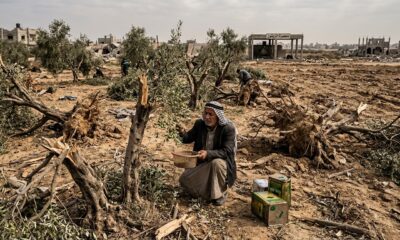
In the agricultural sector, Mutasim Elagraa, coordinator of UNCTAD’s Assistance to the Palestinian People Unit, said less than 1.5% of Gaza’s agricultural land remains accessible, intact and undamaged, while agriculture’s contribution to Palestinian GDP has fallen from 17.4% before the war to less than 4%.
Widespread unemployment and soaring prices
The collapse has extended beyond businesses and production to Gaza’s labor market, where unemployment has risen to around 78%. Elagraa said more than 90% of the working-age population is now without employment.
The loss of hundreds of thousands of jobs since the beginning of the war has wiped out around $2.8 billion in cumulative labor income across the Palestinian territories, while families face a severe decline in their sources of income.
Alongside job losses and the contraction in production, Gaza’s overall price level in 2025 was 274% higher than in 2022.
Prices of some goods reached extraordinary levels. Potatoes, for example, cost more than 20 times their pre-war price, leaving families caught in a punishing equation: fewer jobs and less income, but dramatically higher prices and living costs.
Rebuilding Gaza’s economy
These indicators show that Gaza’s economic crisis is no longer simply a matter of humanitarian assistance or liquidity. The destruction has reached the foundations of the economy’s productive capacity. Aid may provide food for a period of time, but it cannot restore a lost job, restart a factory or return agricultural land to production.
UNCTAD estimates Gaza’s recovery and reconstruction needs at approximately $71.5 billion. Direct physical damage to infrastructure stands at around $35.2 billion, while broader economic and social losses are estimated at $22.7 billion, according to a joint assessment by the World Bank, European Union and United Nations.
Pedro Manuel Moreno, UNCTAD’s acting secretary-general, stressed that “peace cannot be built on a collapsed economy.”
UNCTAD has called for the release of Palestinian clearance revenues withheld by Israel, whose cumulative value has exceeded $3.67 billion since 2019. The organization has also called for measures to protect the Palestinian banking system and for international assistance to be directed toward rebuilding productive sectors, particularly technology, energy, agriculture and industry.
Gaza’s economic recovery, therefore, is not simply a matter of reconstructing facilities destroyed by the war. It requires rebuilding and restarting a broad productive base that has lost most of its capacity to function, at a time when unemployment is soaring, household incomes are eroding and the cost of living continues to rise.