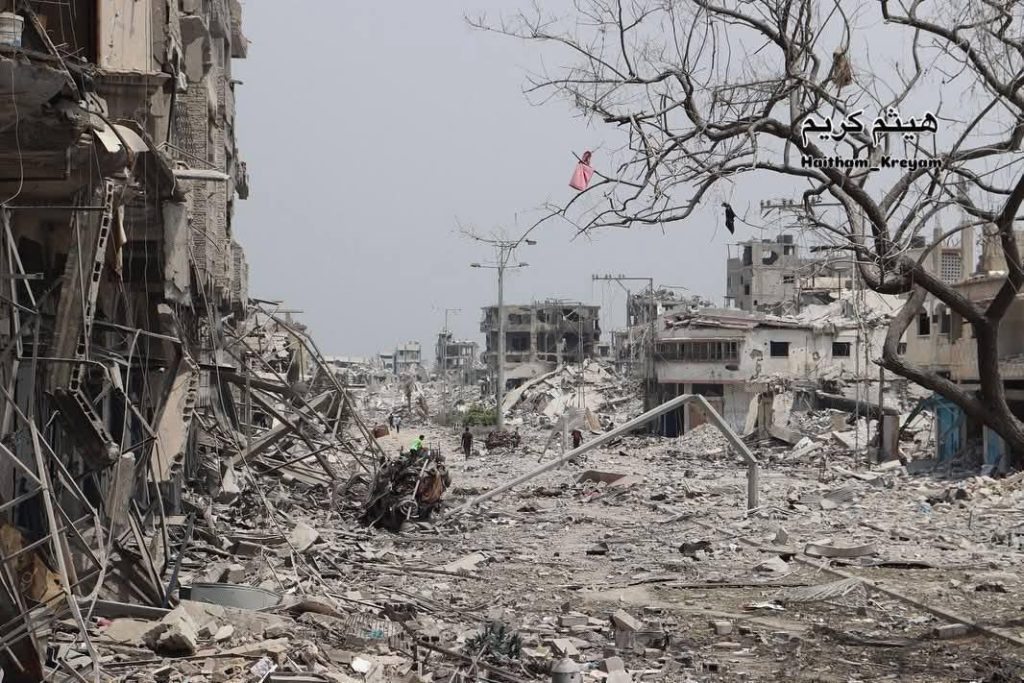
Gaza (Palestine Foundation Information Center), As the world marks World Habitat Day under the slogan “Adequate Housing for All,” Palestinians are living through the stark opposite reality. Israel has turned the Gaza Strip into a vast landscape of destruction, forcing hundreds of thousands of families from their homes. At the same time, the demolition of homes, land seizures and forced displacement have intensified across the occupied West Bank, including occupied Jerusalem.
Data from the Palestinian Central Bureau of Statistics (PCBS) shows that approximately 201,290 buildings in the Gaza Strip were affected by Israel’s ongoing aggression between October 7, 2023 and June 16, 2026, accounting for nearly 82 percent of all buildings in the Strip. Of these, 134,422 buildings were completely destroyed, while approximately 328,627 housing units were affected.
The significance of these figures becomes even more severe amid the continuing displacement crisis and destruction of the basic necessities of life. The damage is not limited to homes but extends to water and sewage networks, infrastructure and essential services, deepening the housing crisis and turning the search for safe shelter into a daily struggle for hundreds of thousands of Palestinians.
Gaza: Destroyed Homes and Continuing Displacement
According to Palestinian statistics, the scale of destruction has spread across most of Gaza’s urban fabric, as the effects of extensive military operations continue to force the majority of the Strip’s approximately 2.1 million residents to relocate repeatedly.
Restrictions on access to large areas have confined the population to less than 40 percent of the Gaza Strip, according to the figures, creating severe overcrowding and increasing pressure on areas where displaced people have sought refuge.
The housing crisis extends beyond the destruction of homes. By the first half of 2026, approximately 90 percent of Gaza’s water and sanitation infrastructure had been damaged or destroyed.
In addition, 82 percent of families in the Strip are experiencing water insecurity, while up to 70 percent of families receive only around six liters of water per person per day—significantly below the World Health Organization’s estimated minimum requirement of approximately 15 liters per person per day.
West Bank: Demolitions, Displacement and Targeting of Palestinian Presence
The housing tragedy is not confined to Gaza. Across the West Bank, including occupied Jerusalem, the demolition of Palestinian homes and structures intensified during 2026, alongside land seizures and an increase in attacks by Jewish settlers.
According to data from the Wall and Settlement Resistance Commission, Israeli authorities carried out approximately 341 demolition operations during the first half of the year, resulting in the destruction of 740 Palestinian structures, including inhabited and uninhabited homes, agricultural facilities, sources of livelihood and other structures.
Israeli authorities also issued 254 demolition notices on the pretext of lacking permits. These were concentrated particularly in Hebron, where 102 notices were issued, Bethlehem with 70, and Jerusalem with 34.
At the same time, attacks by Jewish settlers increased, reaching 3,488 incidents during the first half of 2026. The attacks targeted Palestinian communities, property, land and sources of livelihood.
According to data from the United Nations Office for the Coordination of Humanitarian Affairs (OCHA), more than 4,000 Palestinians in the West Bank have been forcibly displaced since the beginning of the year due to demolitions, evictions, settler attacks and related restrictions.
Northern Camps: Housing Under Attack
Destruction figures from the northern West Bank refugee camps reveal the scale of attacks on housing and urban infrastructure.
In Jenin camp, 680 buildings were affected, accounting for approximately 53 percent of all buildings in the camp. In Nur Shams camp, 434 buildings—around 55 percent of the total—were affected. In Tulkarm camp, 407 buildings had been affected by February 2026, representing approximately 37 percent of the camp’s buildings.
These developments have taken place amid Israeli military operations that have forced tens of thousands of Palestinians to flee the northern West Bank camps, further deepening the housing and basic-services crisis.
Overcrowding and Alternative Housing
The figures also highlight the pressures facing Palestinian families in the West Bank. In 2025, approximately 3.4 percent of families were living in overcrowded housing where an average of three or more people occupied each room.
The proportion was significantly higher in refugee camps, reaching 8.9 percent, compared with 3 percent in urban areas and 3.8 percent in rural areas.
Similarly, the proportion of families living in residential structures classified as “other” increased from 0.4 percent in 2024 to 1.6 percent in 2025. In refugee camps, the figure reached 20.1 percent, reflecting the distinctive housing crisis facing the camps, particularly Jenin and Tulkarm.
Housing Crisis Extends Beyond Walls
These facts reveal that the Palestinian housing crisis is no longer simply about having a home. It has become directly linked to the Palestinian right to remain on their land, access water and basic services, and preserve their sources of livelihood.
In Gaza, most buildings have been destroyed or damaged, entire neighborhoods have been reduced to ruins, and displaced people are struggling amid severe shortages of shelter, water and essential services.
In the West Bank, meanwhile, attacks on housing have taken the form of demolitions, evictions, land seizures and settler attacks, gradually narrowing the space available for Palestinian presence and pushing more families toward forced displacement.
In contrast, building permit figures in Palestine recorded a one-percent decline during the second quarter of 2026 compared with the first quarter. A total of 1,814 permits were issued, including 1,199 permits for new buildings. The number of licensed housing units stood at 4,105, including 3,554 new units.
Thus, World Habitat Day arrives this year at a time when Palestinians are facing one of the deepest housing crises in their modern history. On one side is Gaza, where the majority of buildings have been destroyed, while on the other is the West Bank, where homes and structures face demolition and displacement. The struggle over housing has consequently become a direct part of the broader struggle for Palestinian survival and steadfastness on their land.