WEST BANK, (Palestine Foundation Information Center), Israeli authorities issued a military order requiring the removal of almond trees and natural vegetation from Palestinian land in the towns of Dura and Tarqumiya in the occupied West Bank’s al-Khalil governorate, the Palestinian Colonization and Wall Resistance Commission announced on Thursday.
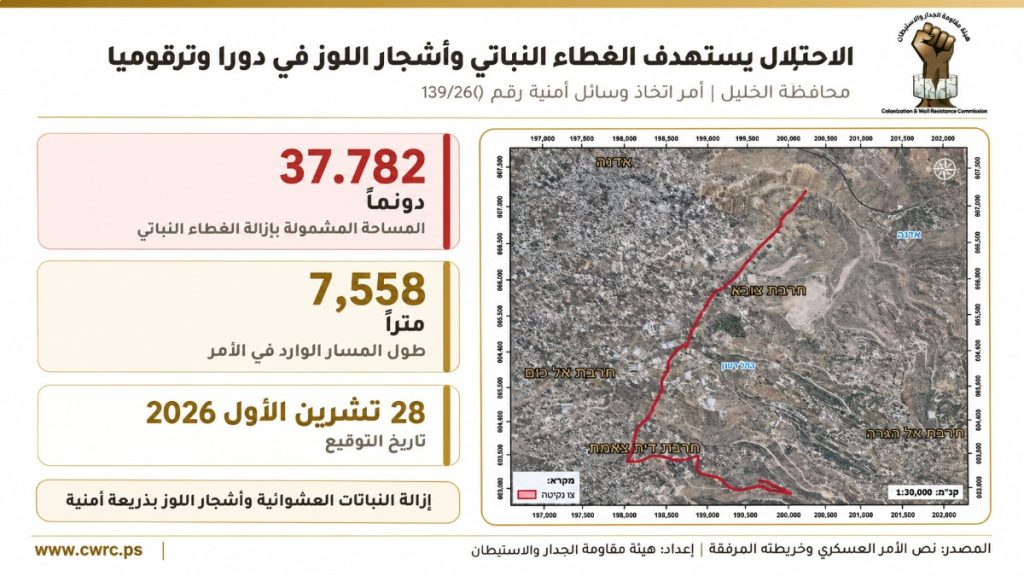
The order covers 37.782 dunums of land along a stretch measuring 7,558 meters, threatening agricultural land and vegetation across the area.
According to a statement issued by the commission, the military order, numbered 139/26, was signed by an Israeli military commander on October 28, 2026.
The order targets several locations in Dura, including Tars, Wadi Khuzaym, Khirbet Deir Samit, Khirbet Sabr, Jabal al-Saadi, and Khirbet al-Deir, as well as agricultural land in Tarqumiya.
Palestinian landowners given seven days to remove trees
The commission explained that the military order requires landowners or those responsible for managing the affected properties to remove the trees and vegetation within seven days of a field inspection scheduled by the Israeli military’s liaison authorities.
If landowners fail to comply, the order authorizes personnel designated by the Israeli military commander to carry out the removal themselves.
The order also grants affected landowners a maximum of seven days to submit objections, with the deadline beginning on the date of the field inspection.
Agricultural and environmental consequences
The commission warned that the decision could have serious agricultural, environmental, and economic consequences for Palestinian communities in the al-Khalil governorate.
It stressed that removing almond trees and vegetation along more than 7.5 kilometers would not merely destroy crops but also threaten the agricultural productivity and environmental value of the affected land.
The commission further warned that the measure could undermine Palestinian farmers’ ties to their land and jeopardize their livelihoods.
Israeli military cites security grounds
The commission criticized the use of security-related justifications to impose such measures, describing them as a means of interfering with Palestinian land use and altering conditions on the ground.
It noted that the military order specifically requires removing trees and vegetation and does not authorize the transfer of land ownership.
However, the commission emphasized that the lack of an ownership transfer does not diminish the decision’s seriousness or the potential harm to landowners and the agricultural character of the affected areas.