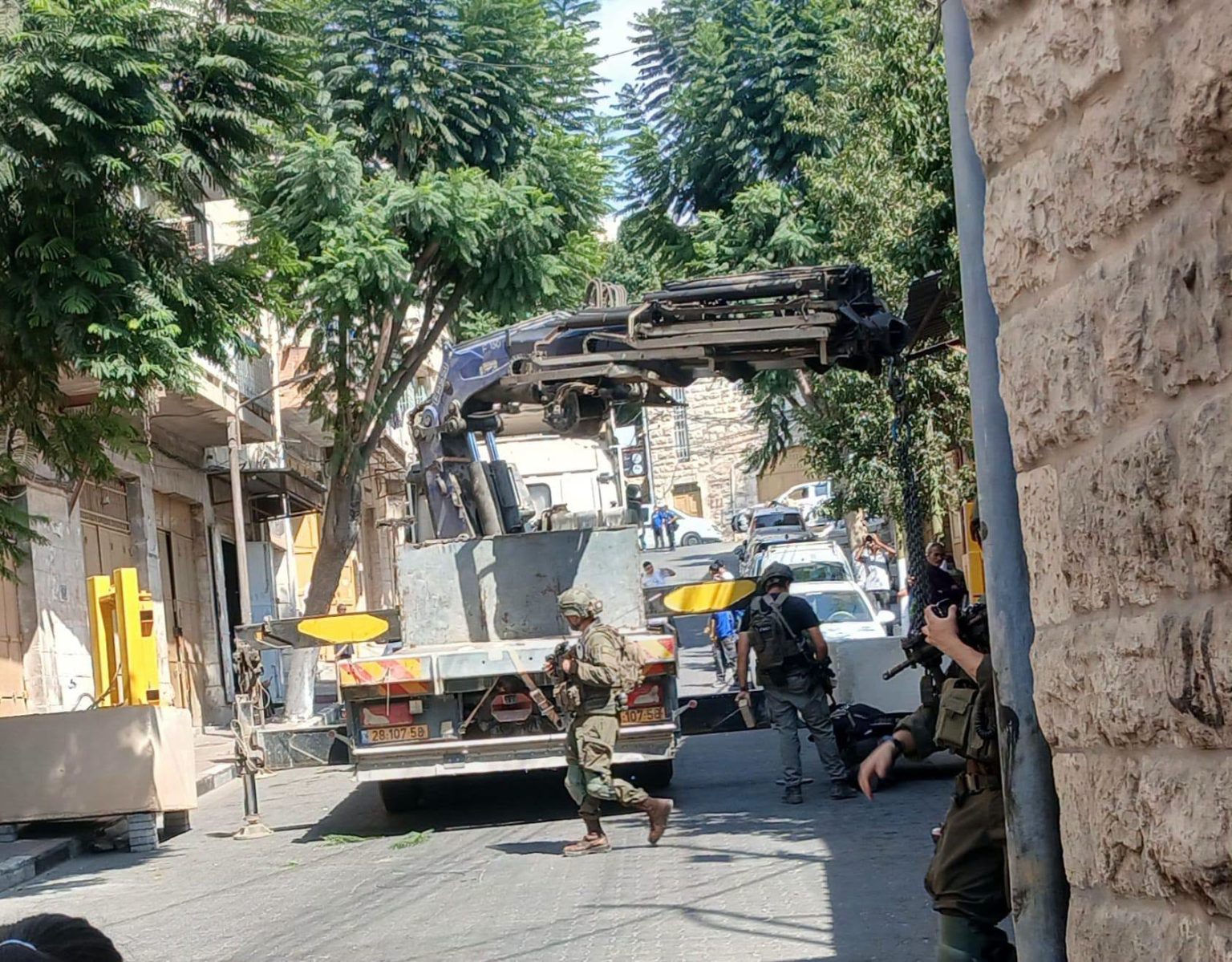
AL-KHALIL, (Palestine Foundation Information Center), The Israeli military installed three new iron gates in central al-Khalil on Sunday, adding to dozens of checkpoints and restrictions already imposed on Palestinians around the city’s Old City and further complicating movement for residents and traders.
Bader al-Daour, head of the Old City Committee in al-Khalil, said Israeli occupation forces placed the three gates around Bab al-Baladiya, the main entrance of the Old City, alongside a fourth gate that had already been installed at the same site.
Al-Daour explained that the four gates were set up within an area of no more than 200 square meters, at a junction where several roads leading into the Old City meet at its vital western entrance.
He warned that the new measures would create an additional obstacle for hundreds of families and shopkeepers, who will no longer be able to use vehicles to transport their needs and goods. Instead, they will have to rely on small carts or carry items by hand for nearly 800 meters toward the Ibrahimi Mosque to the east.
Al-Daour said the rapid escalation in Israeli measures had exceeded all expectations, describing the restrictions as part of a plan to facilitate settler incursions into the area and create conditions that push Palestinian residents and traders to leave.
He noted that the Old City is home to 14 patients suffering from kidney failure and cancer who need vehicle access, making them among the groups most affected by the new restrictions.
Data from the Wall and Settlement Resistance Commission shows that al-Khalil governorate has the highest number of Israeli movement obstacles in the West Bank, with 221 fixed checkpoints and closure points out of 942 barriers and gates cutting across the territory.
According to earlier data from the Youth Against Settlements group, the Israeli military maintains more than 120 staffed and physical obstacles in the streets and alleys of the Old City alone.
Under the 1997 Al-Khalil Agreement between the Palestine Liberation Organization and Israel, al-Khalil was divided into two areas: H1, under Palestinian control, and H2, under Israeli control. H2 makes up about 20% of the city and includes the Old City, the Ibrahimi Mosque and neighborhoods subject to curfew restrictions.