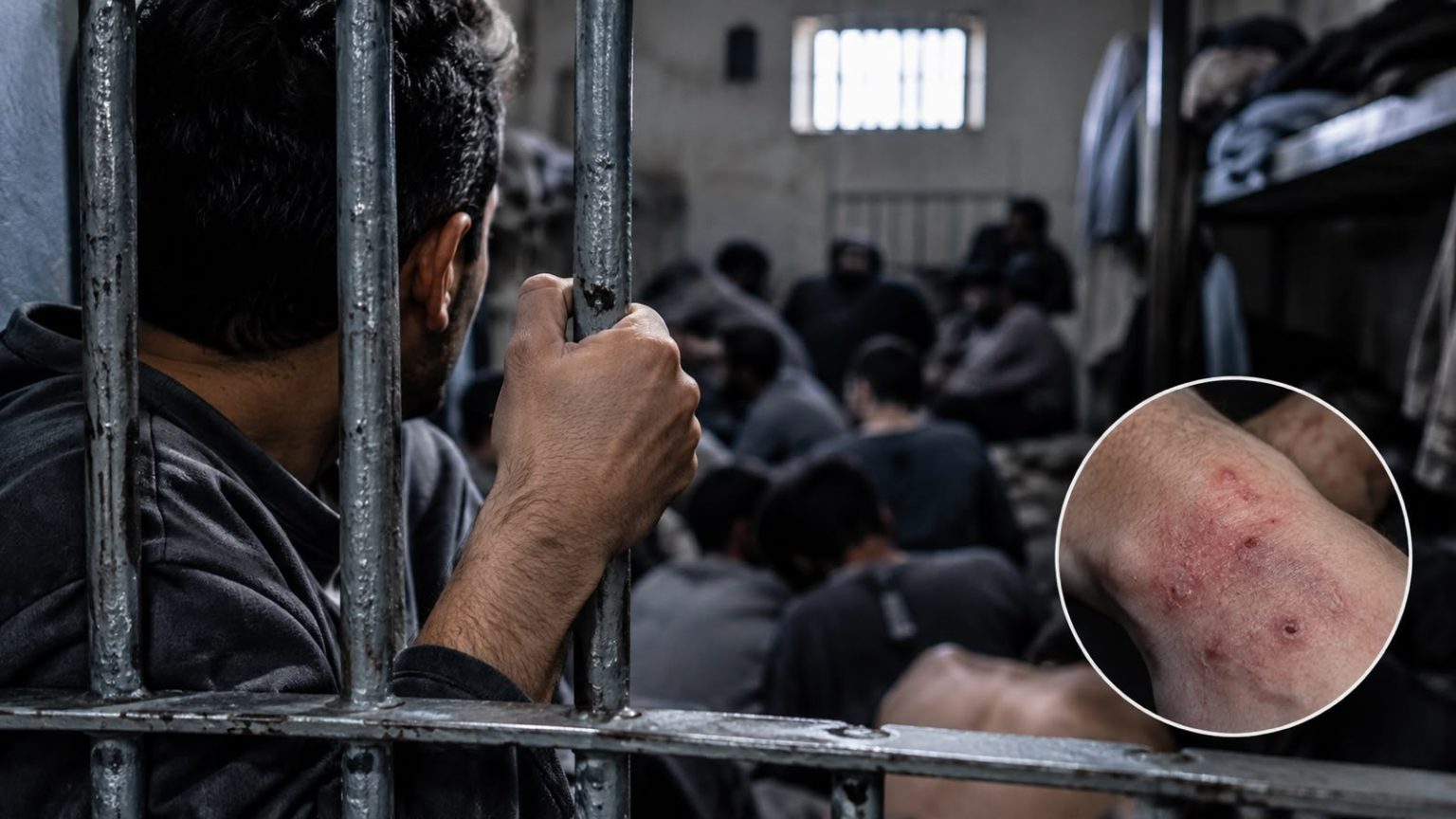
RAMALLAH, (Palestine Foundation Information Center), The Commission of Detainees and Ex-Detainees Affairs revealed on Sunday a deterioration in the health conditions of several prisoners in Negev prison, including those with gunshot wounds who suffer from chronic pain and difficulty moving and breathing, while others suffer from worsening scabies and spreading boils across their bodies, amid a lack of medical treatment and non-responsiveness to requests for clinic visits.
The Commission based its report on a visit conducted by its lawyer to the prison, during which he documented the conditions of six prisoners, five of them held under administrative detention.
Bullet injuries and continuous pain
Among the cases documented in the report is 23-year-old prisoner Thaer Bkeerat, from the town of Sur Baher in occupied Jerusalem, who suffers from difficulty moving his right foot, shortness of breath, lung pressure, and pain throughout his body, without being provided with painkillers, according to the Commission.
It clarified that Bkeerat was shot with four bullets during his arrest, two in his right hand causing bone shattering, a third in his right foot causing severe destruction, and a fourth penetrated his chest and lodged in his left lung.
He underwent three operations at Hadassah Ein Kerem Hospital at the time, including the installation of metal fixators in his foot, before being transferred to house arrest and then re-arrested, having been detained since May 10, 2023, serving a 54-month sentence.
The Commission described the health status of prisoner Hasan Jalaita, from the city of Jericho, as very bad, noting that he was subjected to assault and shot above his right knee during his arrest.
According to the report, Jalaita was transferred to Hadassah Hospital for three days without improvement in his condition, later undergoing surgery that included installing metal fixators and surgical interventions in the arteries and tendons, while he continues to suffer severe pain in his foot and back.
The Israeli occupation authorities issued seven consecutive administrative detention orders against him, with his current order scheduled to end on November 9, alongside a decision not to renew it, according to the Commission.
Scabies worsens and treatment requests ignored
Regarding skin diseases, the Commission documented the deteriorating health of prisoner Amr Mansour, from Nablus, due to his infection with scabies and the wide spread of boils across his body over the past few days, alongside suffering chronic head pain due to migraines.
Mansour remains under administrative detention after four consecutive orders were issued against him, each lasting six months, with the fourth order set to end on January 25, 2027.
Prisoner Mohammad Bkhit, from Askar camp in Nablus, has suffered from worsening disease symptoms for about a month without receiving the necessary treatment, having had three administrative detention orders issued against him.
The health of prisoner Nawar Mshati, from the town of Deir al-Hatab east of Nablus, is deteriorating as boils spread across his body due to scabies, and the Commission said he repeatedly requested transfer to the medical clinic, but the prison administration did not respond.
Mshati is administratively detained under three orders, each lasting four months, with his current order set to end on February 7, 2027, along with a decision not to renew it.
Spinal pain and severe itching
Prisoner Salah al-Bishtawi, from Nablus, suffers from disc problems in his neck and back, in addition to severe itching in his feet that appeared three days prior to the documentation of his condition.
The Commission noted the issuance of two administrative detention orders against him, each lasting six months, with the second order ending on February 27, 2027.
These testimonies come as 9,400 Palestinian prisoners are held in Israeli prisons, including around 88 female prisoners, more than 350 children, and about 3,100 administrative detainees, according to a statistical paper issued by the Asra Media Office (AMO) published on October 24, 2026.
The paper monitored the escalation of torture, starvation, medical neglect, and isolation, alongside the continuation of enforced disappearance against detainees from the Gaza Strip.
On the health level, the Palestine Center for Prisoners Studies reported last month that more than 1,500 prisoners suffer from poor health conditions, including dozens suffering from serious illnesses.
It documented the deprivation of sick prisoners from medical follow-up and transfer to hospitals, while malnutrition, overcrowding, and the removal of hygiene products contribute to weakening their immunity and spreading contagious skin diseases, including scabies, describing these practices as a systematic policy of slow killing that has escalated since October 2023.
According to the AMO paper, the number of martyrs of the captive movement whose identities are known since the start of the war reached 92 martyrs, including 53 from the Gaza Strip, accompanied by the continued detention of the bodies of 99 martyred prisoners of known identity from various periods, amid calls to reveal the fate of Gaza detainees, provide treatment, and enable international bodies to visit prisoners and investigate the circumstances of their martyrdom.