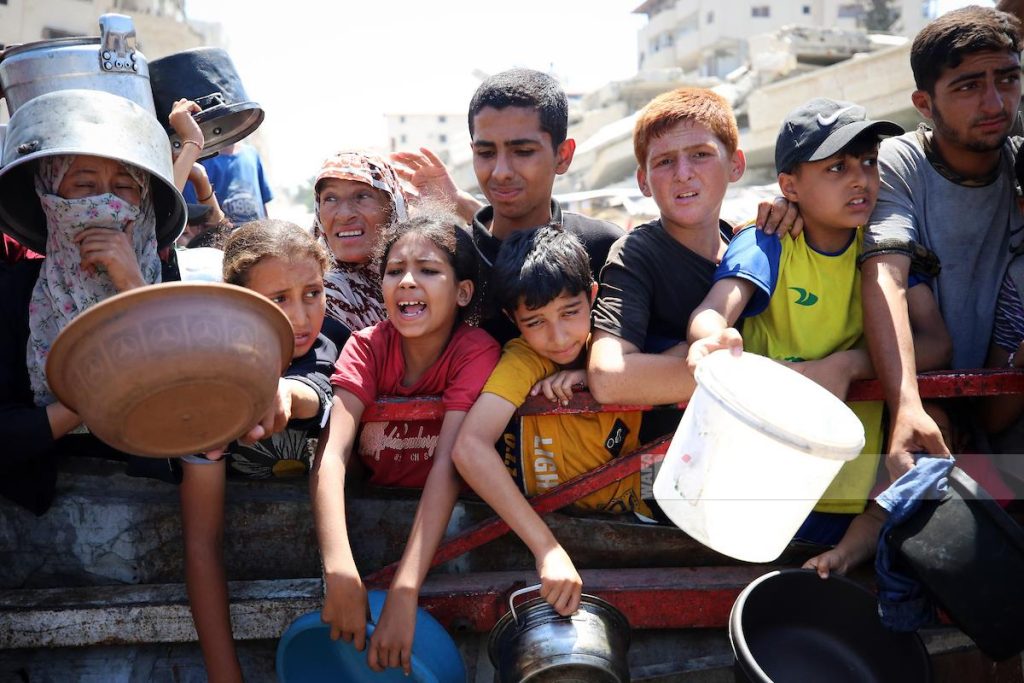
GAZA, (Palestine Foundation Information Center), In the Gaza Strip, securing a meal is no longer a matter related only to what is available in the markets, but to what can reach the Strip in aid, and to whether the family actually has the purchasing power to buy what reaches the market. Between the scarcity of supplies and the collapse of purchasing power, the circle of reliance on aid is expanding to include the overwhelming majority of the population.
This picture painted by the Government Media Office (GMO) in Gaza in its latest warning about the food crisis, on Tuesday, reveals a highly fragile humanitarian reality, as it says that more than 95% of the Strip’s population relies fully and exclusively on aid, while more than 90% of them have lost their ability to buy food.
The crisis does not stop, according to the Office, at the collapse of purchasing power, as aid itself does not enter in the quantities it deems necessary to cover the needs of the population. The Office speaks of an Israeli policy it calls “silent starvation” and “starvation engineering,” based on keeping the flow of aid at limited levels.
Trucks that do not arrive
The figures announced by the GMO reveal the scale of the gap between what was supposed to enter Gaza and what actually entered. During 330 days since the signing of the ceasefire agreement, 69,387 aid and food trucks entered the Strip out of 198,000 trucks that were supposed to enter under the agreement.
This means that only about 35% of the supposed number entered Gaza, while nearly 128,600 trucks remained outside the Strip, according to calculations based on the numbers in the statement.
For a population where more than 95% rely on aid, this gap does not look like a mere difference in truck numbers. Every drop in the volume of supplies means, in an exhausted economic reality, fewer families who can access food or basic materials.
This burden increases with the collapse of purchasing power. When more than 90% of the population loses the ability to buy food, the market becomes unable to provide an alternative for large segments of society, even when some goods are available in it.
Hunger between aid and market
This equation places the people of Gaza in a closed loop: limited aid, collapsed purchasing power, and growing reliance on what arrives through the crossings.
Hence, the GMO describes what is happening as “starvation engineering,” accusing Israel of preventing the entry of hundreds of thousands of trucks and allowing only a fraction of the quantities supposed to arrive.
Under this reality, the question for families is no longer just about food prices or availability, but about accessibility in the first place.
A family that has no income or purchasing power cannot deal with the market as an independent source of food, making aid a main lifeline for daily life.
The Office warns that the continuation of this equation worsens the humanitarian crisis, holding Israel, supporting countries, and backing parties responsible for the continuation of “systematic starvation.”
The GMO called on the international community, the Security Council, mediators, and sponsors of the ceasefire agreement to exert immediate pressure on Israel to compel it to abide by what was agreed upon and ensure the flow of food and aid trucks into the Strip.
It called on international institutions and organizations to clarify the truth of the crisis to the world public opinion and expose its dimensions, warning that the continuation of the current situation will lead to more dangerous humanitarian repercussions.
While waiting for international demands to turn into measures that guarantee the flow of aid, millions of Palestinians in Gaza remain before a severe equation: more than 95% rely on aid, and more than 90% cannot buy food, while only 69,387 trucks entered out of 198,000 that were supposed to arrive.
Thus, the food crisis in Gaza does not appear to be just a crisis of goods shortage, but a crisis of access and purchasing power together; an equation that makes aid, for the vast majority of the population, not an additional support, but the primary means to obtain food.