LAHORE (Palestine Foundation Information Center), The Milli Yakjehti Council Pakistan has announced that Palestine Solidarity and Martyrs’ Day will be observed across the country on October 9, with various programs and activities planned to express solidarity with the Palestinian people and highlight the council’s unified position on Palestine and Kashmir.
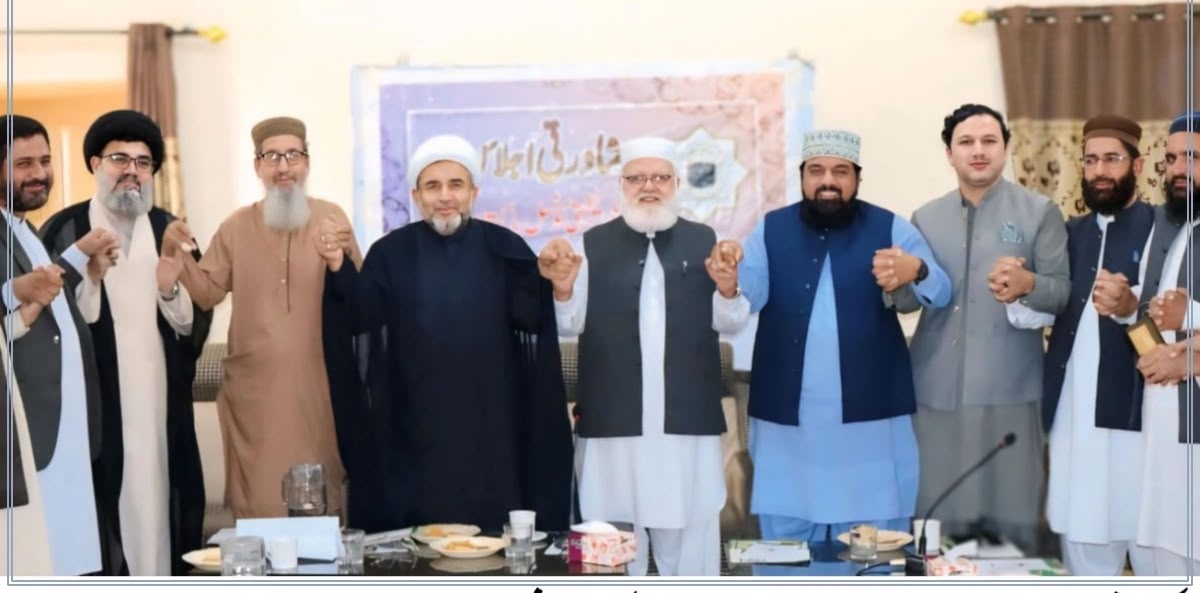
The decision was taken during an important consultative meeting of the Milli Yakjehti Council Pakistan held at the council’s central office at Jamia Naeemia in Islamabad. The meeting was chaired by Secretary General Liaqat Baloch and discussed the country’s current political and economic situation, Palestine and Kashmir issues, developments in Iran, Saudi-Yemen tensions, challenges facing the Muslim world and the council’s future course of action.
The meeting was attended by Mufti Gulzar Ahmed Naeemi, head of Jamaat Ahle Haram; Allama Arif Hussain Wahidi, Vice President of Tehreek-e-Islami; Syed Ahmed Iqbal Rizvi, Vice Chairman of Majlis Wahdat-e-Muslimeen; Dr. Zamir Akhtar Khan, central leader of Tanzeem-e-Islami; Syed Nasir Abbas Shirazi, central leader of Majlis Wahdat-e-Muslimeen; Dr. Ali Abbas Naqvi, head of Al-Basira; Tahir Rashid Tanoli, central leader of Jamiat Ulema-e-Pakistan; Maulana Irfan, Central Coordination Secretary; Shahid Shamsi, Central Press Secretary; Qazi Shahid Hameed, General Secretary of Azad Jammu and Kashmir; Maulana Abdul Rahim; Israr Ahmed Naeemi, Central Office Secretary, and other central leaders.
The council decided that various programs and activities would be organized across Pakistan on October 9, 2026, under the theme “Palestine Solidarity and Salute to the Martyrs of Palestine.” Activities aimed at raising public and political awareness about Palestine and expressing solidarity with the Palestinian people will continue from October 7 to 13.
During this period, central leaders will hold media talks in Islamabad, Karachi and Lahore. A press conference on Palestine will be organized in Karachi or Hyderabad on October 9, while another press conference will be held in Islamabad on October 10 to raise an effective and sustained national voice in support of Palestine.
A major conference hosted by Jamiat Ulema-e-Pakistan in Multan on October 13 will also highlight the message of solidarity and support for Palestine.
The meeting decided that the council’s unanimous position on Palestine and Kashmir would be effectively highlighted through social media and other communication platforms. It also expressed support for resolving disputes among Muslim countries through dialogue, reconciliation and diplomatic means rather than war and confrontation, while stressing the need for practical steps to promote unity and solidarity in the Muslim world.
The participants emphasized the need to promote cooperation, unity and a joint defence strategy among Muslim countries instead of relying on foreign military bases for their security. The meeting also called for the inclusion of all Muslim countries, including Iran, in the proposed Makkah Peace Agreement.
Regarding Pakistan’s internal situation, the council called on all political and influential forces to end confrontation and strengthen the constitutional, democratic and political process in order to promote political stability, national unity and economic stability.
The meeting paid tribute to the unprecedented sacrifices, steadfastness and resistance of the Palestinian people following Operation Al-Aqsa Flood.
The participants said that the extraordinary sacrifices and continued resistance of the Palestinian people had once again brought the Palestine issue to the forefront of global attention. They said that the ongoing oppression of Palestinians under the patronage of the United States and Israel was unacceptable.
They stressed that the unwavering commitment to the first Qibla, Al-Aqsa Mosque and the liberation of Palestine conveyed a message of unity, awareness and struggle to the entire Muslim Ummah.
The meeting also stated that attempts to ignore the fundamental rights of the Palestinian people in the name of the so-called Abraham Accords and the two-state solution could not provide a permanent solution to the issue. The Muslim world, it said, must make its political, moral and diplomatic support for the Palestinian people more effective.
The meeting also discussed the situation surrounding the Iran-US war. Participants said disputes among Muslim countries should be resolved through negotiations, reconciliation and diplomatic channels rather than war and confrontation.
The Milli Yakjehti Council warned that using the territory of any Muslim country for military action against another Muslim country would pose a serious threat to regional peace and stability. It also called for serious consideration of the role of foreign military bases located in Muslim countries.
The participants urged Saudi Arabia, Iran, Türkiye, Pakistan and other Muslim countries to play a constructive role in reducing tensions in the region and resolving disputes peacefully. They said any war among Muslim countries would further weaken the Muslim Ummah and that dialogue and reconciliation were the best way forward.
Discussing Saudi-Yemen tensions, participants said the issue should not be viewed as a Shia-Sunni conflict. They noted that a large number of Ansar Allah members are Sunni Muslims who respect the holy sites in Makkah and Madinah as much as Muslims living in any other part of the world. They stressed that the tensions should be resolved through dialogue.
The meeting also discussed Pakistan’s domestic situation and observed that political instability and continued confrontation had adversely affected national and economic affairs. The government and all influential stakeholders were urged to take serious and effective measures to end confrontation and promote political stability.
The participants said political stability was the foundation of economic stability, national unity and the country’s overall development. They emphasized that strengthening the constitutional, democratic and political process was an urgent national need.
Regarding Kashmir, the meeting reaffirmed its commitment to continuing full support for the Kashmir freedom movement and vowed to raise the voice for the Kashmiri people’s right to self-determination at every legitimate political, diplomatic and moral forum.