
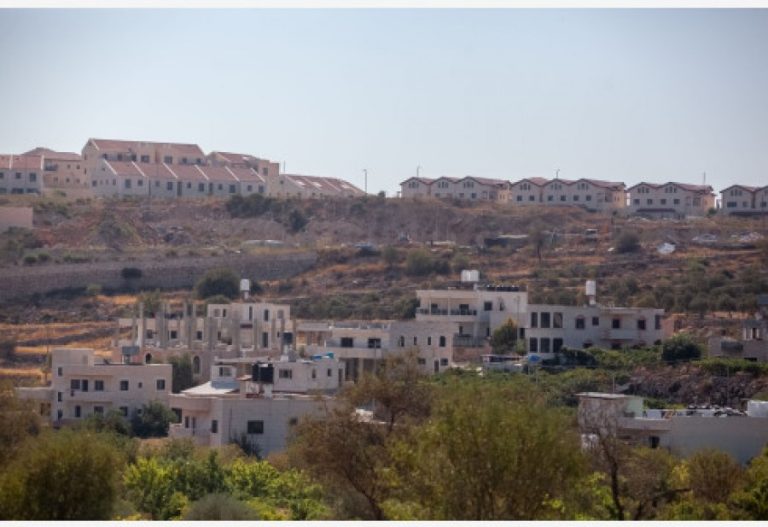
SALFIT, (Palestine Foundation Information Center), Israeli occupation forces (IOF) on Wednesday seized 694 dunums of Palestinian land in the northern occupied West Bank, targeting the towns of Kafr Thuluth in Qalqilya governorate and Deir Istiya and Biddya in Salfit governorate.
Moayad Shaaban, head of the Wall and Settlement Resistance Commission, said in a statement that the land was confiscated under the pretext of being designated as “state land,” a classification frequently used by Israeli authorities to legitimize land appropriation.
Shaaban warned that the move represents a dangerous escalation in Israel’s systematic policy of land seizure, describing it as part of a broader effort to forcibly reengineer Palestinian geography through colonial-era legal tools.
He said the decision is linked to plans to establish a new settlement bloc east of Qalqilya, specifically south of the settlement of Karnei Shomron, under the name “Dorot.”
According to Shaaban, the declaration relies on a framework of military orders and unilateral administrative procedures that entirely disregard Palestinian property rights and violate international humanitarian law, particularly the Fourth Geneva Convention, which prohibits an occupying power from seizing land or altering its legal status.
He stressed that the practice of declaring land as “state land” is not a technical or administrative measure, but a core instrument of Israel’s settlement project. The policy, he said, is designed to drain Palestinian land ownership and prepare areas for future settlement expansion as part of Israel’s creeping annexation of Palestinian territory.
Shaaban added that the timing of the seizure is especially dangerous, as it coincides with an intensifying political phase in which legislation, master plans, land confiscation orders, and settlement tenders are working in tandem to impose permanent facts on the ground. These measures, he said, aim to transform the occupation from a temporary situation into a system of enforced and lasting sovereignty.
He said the Wall and Settlement Resistance Commission is following the case on both legal and field levels and will support affected landowners while pursuing all possible legal avenues to obstruct the plans. The commission will also continue exposing these policies to the international community and relevant UN institutions.
Shaaban concluded that Palestinian land is not the subject of an administrative dispute but an inherent right of a people living under occupation. Attempts to legitimize land seizure through military orders and declarations, he said, will not change the reality that what is taking place amounts to organized colonization, requiring a serious international response that goes beyond silence and rhetorical condemnation.