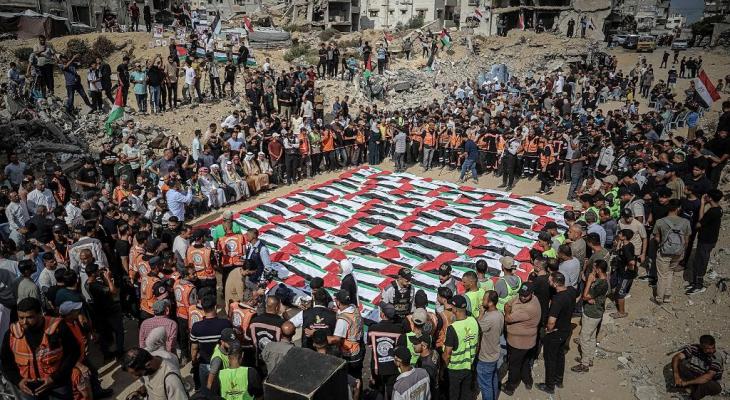
GAZA, (Palestine Foundation Information Center), Palestinian families in the Gaza Strip on Sunday laid to rest the bodies of 69 martyrs recovered by Civil Defense crews from beneath the rubble of homes and buildings destroyed by the Israeli occupation forces in the Jabalia refugee camp and the town of Beit Lahia in the northern Strip, in a scene that renews the tragedy of thousands of families still waiting to find their loved ones and lay them to rest.
The recovery operations included the Al-Hakoura area and the vicinity of schools in the Jabalia refugee camp, alongside scattered locations in the town of Beit Lahia, where bodies belonging to the Abu Warda, Nabhan, Al-Yaziji, Masoud, and Al-Dibs families were found.
These scenes unfold amidst the continued presence of thousands of bodies beneath the debris of homes and residential neighborhoods destroyed by Israeli bombardment, amid major difficulties facing rescue teams in reaching targeted sites, due to the lack of heavy equipment and machinery needed to remove the rubble.
An arduous journey to recover the martyrs
Efforts to recover the bodies of martyrs from beneath the rubble began as part of the first phase of the project, which was launched in late November 2025, during which Civil Defense crews managed to recover 333 bodies from beneath the rubble of 54 buildings, while reaching other bodies proved impossible due to limited capabilities and the difficulty of removing concrete blocks.
On July 19, 2026, the Civil Defense launched the second phase of the project, targeting 147 destroyed homes in the Gaza, North Gaza, and Central governorates, where an estimated 1,072 bodies lie beneath the rubble, within a plan requiring around 800 working hours.
Operations in this phase, at the beginning of last August, resulted in the recovery of 112 bodies from a residential block in the Al-Sabra neighborhood in Gaza City, while 157 other bodies believed to remain beneath the rubble of the same site could not be found.
Crews also recovered 21 bodies from two destroyed homes in Gaza City, in the middle of the same month, and began searching for around 40 missing people beneath the rubble of a third home.
In a report issued on September 21, 2026, the United Nations Office for the Coordination of Humanitarian Affairs (OCHA) reported that Civil Defense crews recovered more than 630 bodies and remains from beneath destroyed buildings, during the period between November 2025 and September 2026.
Palestinians had previously laid to rest, on October 18, the remains of 75 martyrs recovered from beneath the rubble of destroyed homes in the Al-Daraj neighborhood in Gaza City, belonging to around 20 families, after weeks of search operations that faced a severe shortage of heavy equipment and machinery.
More than 8,500 bodies beneath the rubble
Civil Defense spokesperson Mahmoud Basal said that more than 8,500 bodies remain missing beneath the rubble of destroyed homes across various areas of the Strip, at a time when families continue to appeal to find and bury their loved ones.
Basal warned that continuing to work with the available capabilities severely limits the crews’ ability to recover bodies, explaining that their capacity does not exceed around 1,000 bodies annually, which could make completing search operations take many years.
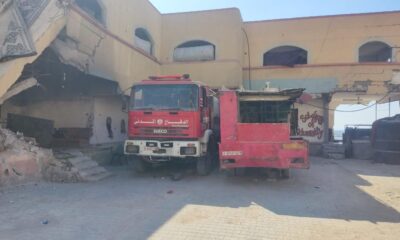
Civil Defense teams face a severe shortage of heavy equipment, bulldozers, machinery, spare parts, oils, and fuel, amidst the Israeli restrictions imposed on bringing these necessities into the Strip, forcing crews to use primitive means and rely on manual labor at many sites.
The OCHA report called for allowing the entry of more heavy machinery, specialized equipment, spare parts, oils, and fuel, to strengthen the capabilities of rescue teams and expand search and debris removal operations.
61 million tons of debris
The obstacles facing operations to recover the martyrs are not limited to the lack of equipment, but are also tied to the massive scale of destruction left by Israeli bombardment across various areas of the Gaza Strip.
According to estimates by the United Nations Development Program (UNDP), the volume of debris resulting from the destruction in Gaza has exceeded 61 million tons, making rubble removal and search operations for the missing an arduous task requiring massive machinery, specialized teams, and extensive technical capabilities.
This massive volume further complicates reaching the bodies of martyrs, especially in areas where entire residential neighborhoods were leveled to the ground, and where concrete blocks became mixed with property and human remains.
The suffering of families never ends
The tragedy of Palestinian families does not stop at losing their loved ones beneath the rubble, but extends to being deprived of knowing their fate and burying them, amidst the continued inability to reach thousands of bodies, and the accompanying harsh psychological and humanitarian suffering.
Search operations also raise fears of losing the evidence needed to identify victims and document the circumstances of their martyrdom, especially with remains mixed together beneath the rubble and the difficulty of determining their identities.
United Nations High Commissioner for Human Rights, Volker Türk, had warned that the remains found beneath the rubble of sites subjected to Israeli bombardment may represent only a limited fraction of the scale of the tragedy.
Türk called for preserving forensic evidence, information, and biological samples, documenting burial sites, and informing families of the fate of their loved ones.
While Civil Defense teams continue search operations with the limited capabilities they possess, thousands of families in Gaza remain suspended between waiting to find the bodies of their loved ones and fearing they will remain buried beneath the debris for years, in one of the harshest humanitarian tragedies left by the Israeli war of extermination on the Strip.