PARIS, (Palestine Foundation Information Center), A photograph taken by Palestinian photographer Jihad al-Sharafi in the Gaza Strip has become the center of a major political and cultural controversy in France after it was abruptly removed from an exhibition at the Deauville sports photography festival and replaced with an image of cyclists.
The incident has raised questions about freedom of the press and photography, as well as political pressure linked to the war on Gaza.
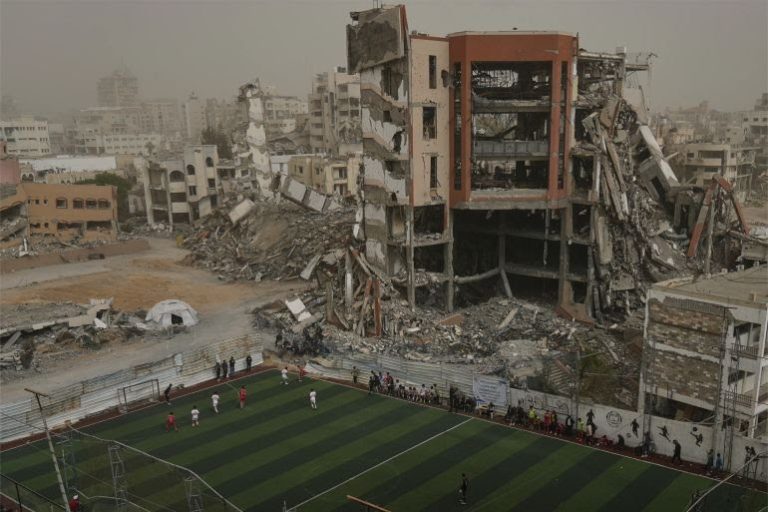
The photo, taken by al-Sharafi, an Associated Press photographer, documents a soccer match between young Palestinian men on a rehabilitated field in Gaza City, surrounded on all sides by buildings destroyed during the war.
The image was scheduled to remain on display as part of the festival until September 6, as one of the photographs documenting the relationship between sport and daily life. But it suddenly disappeared from its place and was replaced by a photo of cyclists, without any clear initial explanation for the change.
According to the French newspaper L’Humanité, the removal came after pressure from pro-Israel supporters. Deauville’s municipality justified the decision by saying it wanted to avoid controversy and avoid hurting the feelings of any side. The municipality acknowledged receiving requests concerning the photo, but did not clearly identify the parties behind them.
A photo that does not show war, but life
What made the incident more striking is that the image does not show bombing, gunfire, or a military scene. It shows a group of young men playing soccer.
Yet the rubble surrounding the field turns the scene into more than a sports photograph. The players appear to be trying to live normally in a place devastated by war, as if the match itself is an attempt to hold on to something ordinary amid an exceptional and brutal reality.
That is why the image took on a meaning that goes beyond sports. It documents Palestinians’ will to live and shows how young people are trying to reclaim a space for life and play despite the destruction around them.
How did the photo disappear?
Sylvain Larcher, a local official in France’s Socialist Party, reported the disappearance of the photo after noticing it during a visit to the exhibition. He questioned why an image that documented nothing more than a soccer match amid destruction had been removed.
As the controversy widened, it emerged that pro-Israel activists had launched a campaign against displaying the image, describing its presence at the festival as a form of propaganda for Palestinians.
Activist Mike Krief was among the most prominent participants in the campaign against the photo. He later celebrated its removal and portrayed it as the result of his efforts. Krief also posted a sarcastic comment about the controversy sparked by the removal, boasting about the level of engagement this matter had generated and describing himself as a “very extreme Zionist.”
His remarks have intensified criticism, especially as they coincided with the photo’s disappearance from the exhibition.
Although no official announcement has directly proven that Israeli pressure was the decisive reason behind the removal, the timing of the campaign, the disappearance of the image and the reaction of its critics have triggered widespread suspicion and criticism in France and beyond.
Political and rights criticism
The fallout from the incident extended beyond the festival, reaching European political circles.
Member of the European Parliament Emma Fourreau sent a letter to the festival organizers and the Deauville municipality, criticizing what she described as an attempt to erase the Palestinian presence even from artistic and cultural spaces.
Former member of the European Parliament Mick Wallace also criticized the decision, saying it reflected growing restrictions on the ability to present the Palestinian narrative in Europe.
In the United States, former presidential candidate Jill Stein mocked the incident, saying the removal of the photo raised serious questions about freedom of the press and expression.
On social media, a counter-campaign emerged to widely republish the image, with journalists, bloggers and activists from different countries taking part in an effort to prevent it from disappearing from the public sphere.
When a photo becomes more visible after being removed
The irony is that the photo removed from the exhibition wall has become more widely circulated afterward.
Instead of remaining one among dozens of images displayed to festival visitors, it became the subject of a broad debate about Gaza, censorship, freedom of expression and the role of journalism in documenting wars.
Journalist Leila Hamed said the removal of the image reveals growing sensitivity towards any scene documenting Palestinian life in Gaza. Academic Zachary Foster also criticized a double standard in dealing with images that document Palestinian suffering.
Some activists also warned that the widespread circulation of the soccer field image could make the site vulnerable to Israeli attack, reflecting the fears Palestinians in Gaza face over facilities and places that remain standing amid the destruction.
The sports have paid the price of war
Al-Sharafi’s image cannot be separated from the reality facing Palestinian sports since the start of Israel’s genocidal war on the Gaza Strip in October 2023.
Sports facilities have suffered widespread destruction, while Palestinian athletes have also paid a heavy human price. According to estimates by the Palestinian Olympic Committee, around 400 Palestinian athletes have been martyred in the ongoing war on Gaza and the West Bank, alongside the destruction of many sports facilities and the suspension of sports activity in the territory.
That is why al-Sharafi’s photo has gone far beyond a snapshot of a soccer match. It shows young men playing in a space surrounded by rubble, documenting a daily struggle to restore life in a place exhausted by war.
While Deauville’s municipality said it wanted to avoid controversy, removing the image created an even larger one. A photo that was supposed to speak about sports ended up speaking about Gaza, war, press freedom, the limits of censorship and the fear that even an image of children and young men playing soccer amid the rubble could become subject to political calculations.
In the end, the photograph did not disappear. It moved from the exhibition wall into the public sphere, and its story has become part of the debate over who has the right to tell what is happening in Gaza, and how a single image can reveal what some may try to hide.