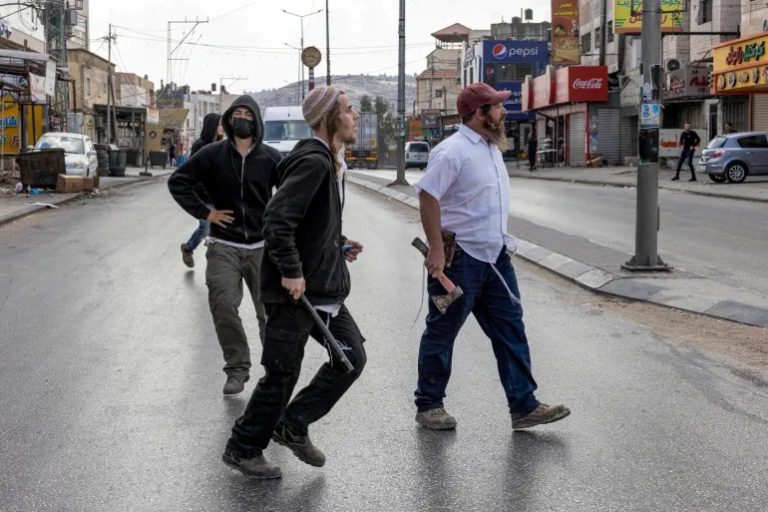
WEST BANK, (Palestine Foundation Information Center), Settler attacks in the occupied West Bank are no longer isolated incidents on the margins of daily life. They are occurring with increasing frequency and taking multiple forms, including attacks on homes, incursions onto farmland, destruction of property, uprooting of trees, and the release of livestock onto Palestinian land, as the geographical scope of the attacks continues to expand.
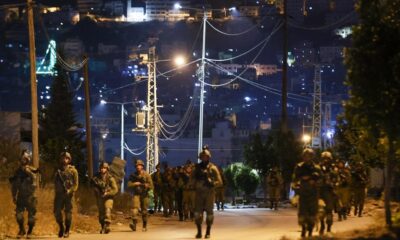
Over the past 24 hours, several Palestinian towns and villages in the Nablus, Ramallah, and Salfit governorates have reported settler attacks, some involving armed settlers. The attacks coincided with intensified incursions in Occupied Jerusalem, reflecting both the widening geographical scope of the attacks and the different methods used to target Palestinians and their land.
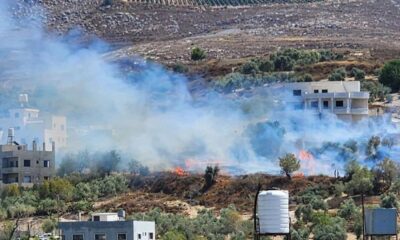
In the Nablus governorate, settlers attacked Palestinian homes in the al-Dhahra area of Beita, south of Nablus, while settlers, some of them armed, entered land belonging to the village of Umm Safa, northwest of Ramallah.
In al-Mazra’a al-Gharbiya, northwest of Ramallah, an armed settler entered Palestinian land and began bulldozing and damaging it. Settlers also released their livestock onto farmland between the towns of Silwad and Yabrud, northeast of Ramallah, threatening agricultural land and the livelihoods of its owners.
Armed settlers also stormed the outskirts of Burqa, east of Ramallah, while others attacked Palestinian homes in Yasuf, east of Salfit. Within a short period, the attacks spread across several areas and affected different aspects of Palestinian life.
In Occupied Jerusalem, the escalation took another form as approximately 480 settlers entered the courtyards of Aqsa Mosque and performed Talmudic rituals there. The incursions coincided with calls by settler groups to intensify raids on the Mosque and blow the shofar inside its courtyards.
Official figures reveal a broader pattern. The Colonization and Wall Resistance Commission documented 4,286 settler attacks during the first seven months of 2026, an increase of 63% compared with the same period in 2025.
In August alone, the commission documented 628 settler attacks, with Ramallah and al-Bireh recording the highest number at 157, followed by Nablus with 137, al-Khalil with 120, Bethlehem with 73, Tubas with 40, Jenin with 36, and Occupied Jerusalem with 31.
Including the August incidents, the total number of settler attacks documented from the beginning of 2026 through the end of August reached 4,914, according to figures cited by Sanad News Agency from the Colonization and Wall Resistance Commission.
The figures reveal not only the scale of the attacks but also their direct impact on Palestinians, their land, and their property. During August, 164 Palestinians were affected by settler attacks, including 20 children and 17 women, while settlers damaged or uprooted 21,508 trees, including 19,375 olive trees.
The targeting of trees carries particular significance for Palestinians because they are not merely property but are directly tied to the land and to families’ sources of income. Olive trees, in particular, are central to agricultural life and livelihoods across large areas of the occupied West Bank.
From Beita, Umm Safa, al-Mazra’a al-Gharbiya, Silwad, Yabrud, and Burqa to Yasuf and Occupied Jerusalem, the attacks take different forms but share a common pattern: Palestinians are being targeted in their homes, on their land, and through their property, turning wide areas of the occupied West Bank into sites of repeated settler attacks.
With new incidents being reported almost daily, the situation extends far beyond individual attacks. It reflects an accumulating pattern with human, agricultural, and material consequences, as the Colonization and Wall Resistance Commission continues to document both a rising number of attacks and their expanding geographical reach.
Palestinian land across the West Bank is therefore facing sustained pressure that extends beyond direct land seizure to attacks on the foundations of Palestinian life itself, targeting homes, farmers, trees, and property. As these attacks expand in frequency and scope, settler violence has become one of the defining features of the escalating situation across the occupied West Bank.