Gaza (Palestine Foundation Information Center), The events of October 7, 2023 were not merely a sudden military operation along the borders of the Gaza Strip. Rather, they marked a decisive turning point that reshaped several formulas that had governed the Palestinian-Israeli conflict for decades. From behind walls that had appeared impenetrable, resistance forces emerged and shook the foundations of Israel’s security and deterrence systems. At the same time, after years of efforts to push Palestine and its cause to the margins, the issue returned to the forefront of the global political and public scene.
Three years later, October 7 can no longer be viewed separately from the war that followed or from the effects it produced on Palestinian, Arab and international consciousness. Its impact spread from the battlefield to politics and negotiations, and from Gaza to the West Bank and occupied Jerusalem, reaching streets and public spaces around the world, where waves of solidarity with Palestine expanded on an unprecedented scale.
A Day When the Illusion of “Secure Borders” Was Shattered
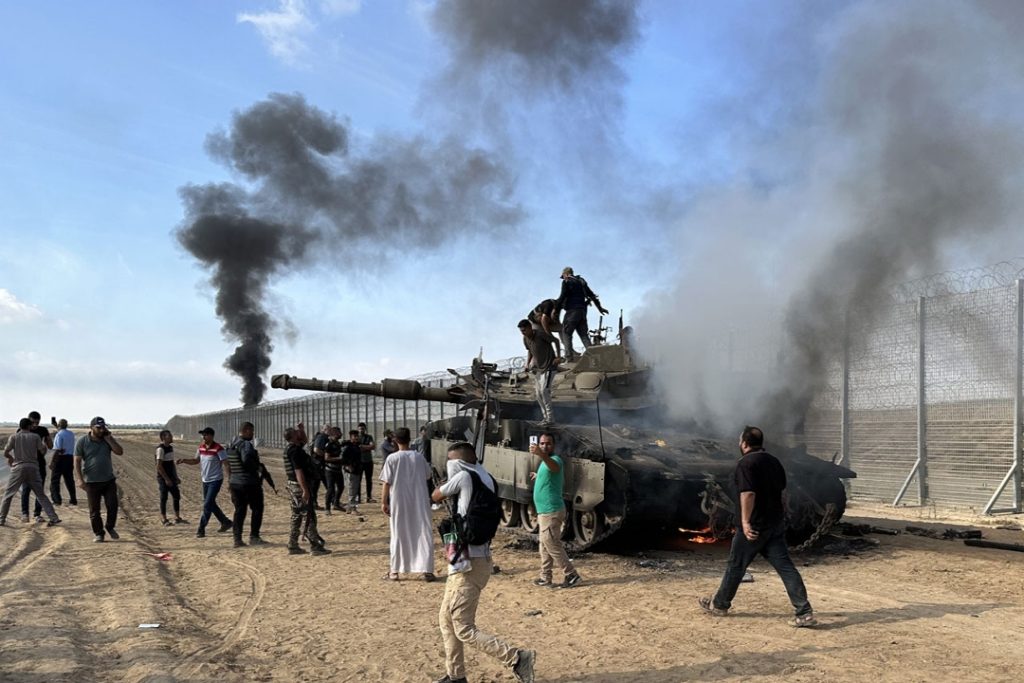
In the early morning hours, the Al-Qassam Brigades announced the launch of Operation Al-Aqsa Flood, which began simultaneously with a broad and coordinated attack on Israeli military posts and settlements adjacent to the Gaza Strip.
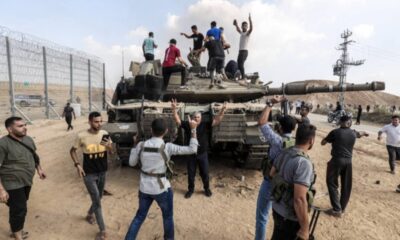
Figures presented by Palestinian sources in assessments of the operation indicate that nearly 3,000 fighters took part in the attack and its supporting activities. Heavy rocket fire was also launched to disrupt Israel’s system and delay the arrival of reinforcements. Border fences were breached at several points, while major military positions were stormed.
The significance of the operation lay not only in the scale of the attack, but also in its ability to reach areas that Israel’s security establishment had portrayed as protected by walls, sensors, surveillance equipment and highly advanced intelligence systems.
Israeli accounts and investigations have revealed serious shortcomings in threat assessments, including reduced troop deployments along the Gaza border, excessive reliance on technology, and an inability to translate available information into an accurate assessment of the intentions and capabilities of the resistance.
Thus, the matter was not simply about breaching a physical barrier. It was a major blow to an entire narrative based on the belief that technology, deterrence and defensive fortifications were sufficient to prevent any large-scale confrontation along the Gaza Strip.
An Intelligence Surprise That Shook Israel
Experts believe that one of the most striking aspects of October 7 was that Israel was not completely deprived of information. Rather, it failed to interpret and connect the available information. It possessed intelligence regarding the resistance’s exercises and preparations, but remained trapped in the assumption that the resistance was “under pressure” and interested in maintaining the existing situation in Gaza.
Israeli affairs expert Amin al-Hajj says the central problem was not the absence of information but the failure to grasp the full picture. He pointed to the resistance’s success in maintaining secrecy over the operation, its timing and its nature until the final moment.
This contradiction brought down several fundamental assumptions within the Israeli security establishment. Among the most prominent was the belief that secure borders could prevent infiltration, technology could provide sufficient early warning, and deterrence was powerful enough to prevent the resistance from entering into a large-scale confrontation.
The operation consequently developed into an internal crisis of confidence within Israel’s security establishment. Its implications were not limited to the initial hours of the attack but expanded into political and military debates over responsibility for the failure and the factors that had caused it.
From the Battlefield to the Negotiating Table
With the passage of time, it became clear that the war following October 7 was not solely military in nature. Alongside bombardment and ground operations, Palestinians also faced a highly complex political and diplomatic battle.
International law expert Anis al-Qasim points out that throughout the years of war, the resistance faced a broad system of international and regional pressure that was not limited to Israel. He argues that the objective was to push the Palestinian position toward compromises that could ultimately amount to permanent concessions on national rights.
According to al-Qasim, the real challenge was to distinguish between negotiations aimed at stopping aggression and protecting the Palestinian people, and agreements that could perpetuate occupation or impose a new political and security framework on Gaza.
From this perspective, negotiations became a parallel front to the battlefield, particularly amid repeated proposals concerning a ceasefire, prisoner exchanges and security arrangements. At the same time, demands for an end to the war, an Israeli withdrawal, rejection of forced displacement and protection of Palestinian rights remained at the heart of the conflict.
Al-Qasim believes that flexibility over means and mechanisms does not necessarily mean abandoning objectives. In his view, the success of any agreement should not be measured merely by the achievement of temporary understandings, but by its ability to protect Palestinian rights and prevent the imposition of new realities on the ground that serve the interests of the occupying state.
A Land That Has Not Forgotten Its Names
Another dimension of October 7 extends far beyond military geography, as the events revived memories of Palestinian villages located on the other side of the fence surrounding Gaza.
In the same area where the operation began, Palestinian collective memory recalls the names of villages whose inhabitants were displaced by Israel in 1948, including Damra, Simsim, Burayr, Deir Sunayd, al-Muharraqa, Najd and Huj. These are names that, despite being erased from the modern geographical landscape, have remained alive in the hearts and memories of refugees.
Thus, the image of crossing the border on that day became intertwined with the memory of villages and homes that had never disappeared from Palestinian consciousness. These locations consequently became part of a broader narrative concerning the origins of the conflict, forced displacement and the right of return.
For generations of Palestinians, the land on the other side of the fence was not an unknown territory. It represented villages, fields, homes and cemeteries, as well as names carried by refugees and passed down from one generation to another.
Three Years of War — Gaza Pays the Price
October 7 did not end with its first day. It gave rise to a prolonged war that left deep scars across the Gaza Strip and transformed daily life into an open struggle for survival.
Our correspondents have documented continuing scenes of displacement, destruction and families being torn apart, while thousands of people remain missing beneath the rubble. The details of everyday life have become centered not only on obtaining water and food but also on finding a safe place of shelter.
Yet at the heart of this catastrophe, Palestinian efforts to sustain life have never stopped. The doctor whose home was destroyed returned to the hospital. The volunteer who carried the wounded continued his work, while the journalist kept his camera in hand to document events. Families continued searching for the means to survive amid the ruins.
Over the past three years, therefore, Gaza’s story has not remained merely the story of a military confrontation. It has become the story of a society struggling to preserve its existence in the face of destruction, displacement and the loss of loved ones.
Al-Aqsa Flood Brought the Palestine Issue Back to the Forefront
At the political level, October 7 once again placed the Palestinian issue at the center of international attention after years of efforts to sideline it through normalization and regional alliances.
The world once again found itself confronting questions concerning occupation, siege, forced displacement and the right to self-determination. Palestine resonated through streets, universities and public squares around the world, while calls for an end to the war, an end to occupation and support for Palestinian rights grew louder.
In this context, Jordanian tribal leader Trad al-Fayez believes that the Palestinian resistance restored the issue to its central position in Arab and Islamic consciousness. He considers October 7 a decisive turning point that exposed weaknesses within Israel’s system and once again highlighted the centrality of Palestine.
Al-Fayez stresses that the developments following the operation cannot be separated from the political and military support Israel received. In his view, the subsequent war exposed the scale of the contradiction between international rhetoric concerning human rights and what occurred on the ground in Gaza.
Three Years Later — The Equation Is No Longer the Same
While Gaza continues to bear the heavy consequences of the war, these three years have demonstrated, according to the article, that October 7 was not a temporary event in the history of the conflict.
At the military level, it exposed weaknesses in a security system that had long been presented as one of the most advanced in the region. Politically, it opened a prolonged struggle over Gaza’s future, Palestinian rights and the nature of any future agreement. At the public level, it brought Palestine back into a broad field of Arab and international attention.
Muhammad Ahmad al-Bashir, a member of Jordan’s National Forum for Supporting the Resistance, describes October 7 as a “strategic earthquake.” He believes it revived the question of resistance in contrast to previous political approaches that sought to present normalization and peace as alternatives to the conflict.
As for Palestinian collective memory, the villages and their names remain alive. Damra, Simsim, Burayr, Deir Sunayd and other villages have not become merely names in history books. They remain part of the story of a people who regard the land as the essence and foundation of their cause.
Three years later, the events of October 7 appear far larger than a single day. For Israel, they represent a crisis involving deterrence, confidence and security. For Palestinians, they mark a turning point that brought their cause back to the center of the international scene. For the region and the world, they reopened questions that previous years had sought to push aside: Who owns the land? Who decides its future? And can the cause of a people that continues to hold onto its rights simply be ignored?
Three years have passed, but the questions that emerged that morning have not disappeared, nor has the story of a land that continues to preserve its names and pass them on to each generation, returning the story to its original source.