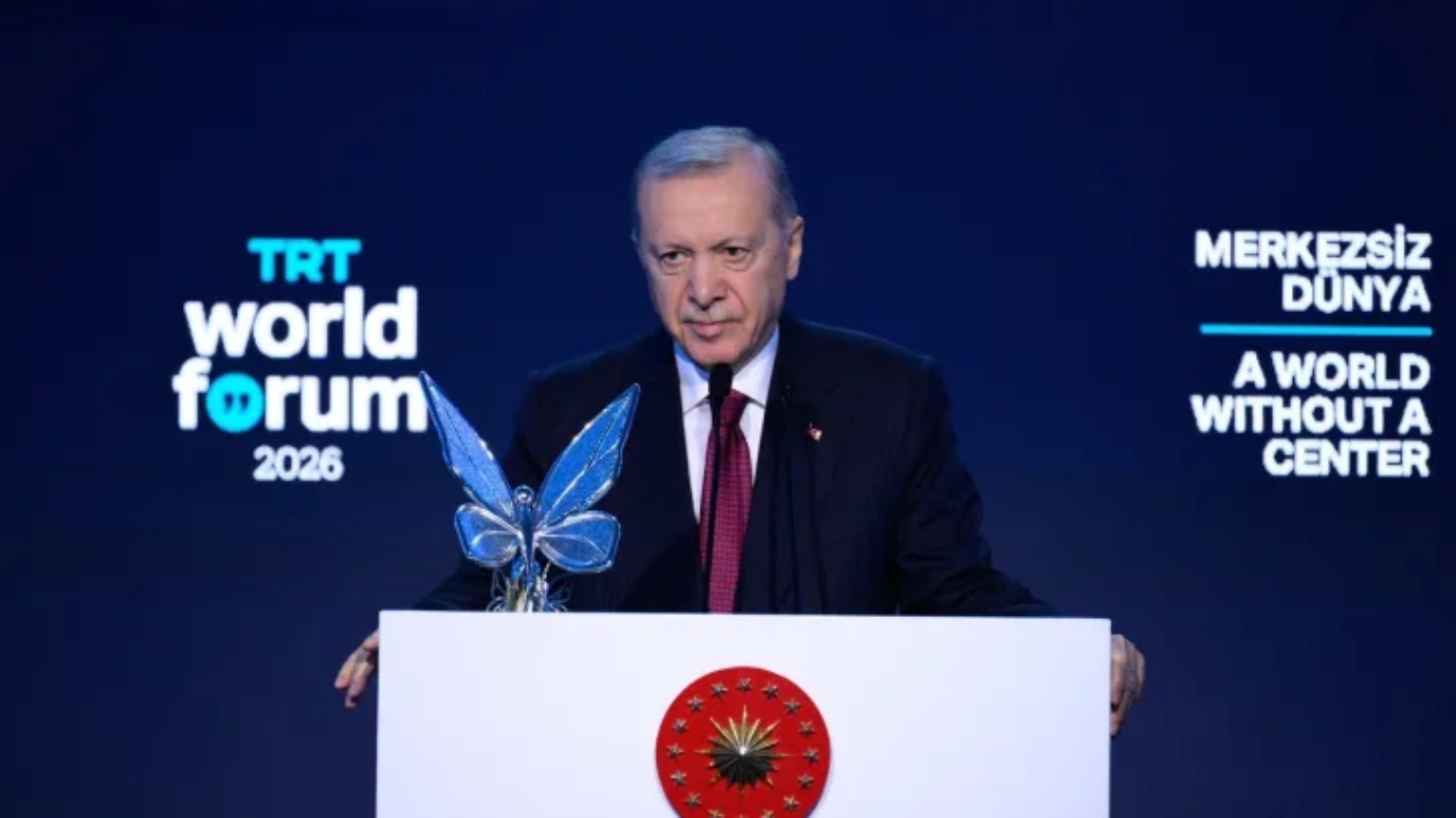
Speaking at the opening of the 10th edition of the TRT World Forum in Istanbul, Erdoğan said that failure to respect international agreements and treaties makes it impossible to resolve crises. He strongly criticized the failure of international institutions to fulfill their responsibilities in protecting security and stability and preventing violations against Palestinians.
Erdoğan’s remarks came as Turkish intelligence chief Ibrahim Kalin disclosed details of the obstacles to implementing the Gaza agreement, which was reached on October 10, 2025, in Egypt’s Sharm el-Sheikh, with the participation of Türkiye, Qatar, Egypt, and the United States.
Agreement Provisions Remain Unimplemented
Kalin explained that the agreement included several commitments, foremost among them the cessation of military operations, the release of hostages and prisoners, and the daily entry of 500 to 600 aid trucks. These measures were intended to pave the way for the withdrawal of Israeli occupation forces, the formation of a Palestinian administration for the Gaza Strip, the deployment of an international security force, and the launch of reconstruction efforts.
However, the Turkish official confirmed that most of these provisions had not been implemented. He pointed out that more than 1,800 Palestinians had been killed in Israeli attacks since the agreement was signed, while all Israeli hostages had been returned.
According to Türkiye’s position, these facts reflect a major gap between the agreement’s provisions and the situation on the ground in Gaza. The ceasefire has neither halted the attacks nor created the conditions necessary to move towards recovery and reconstruction.
Israeli Control and Suspension of Gaza Administration
Regarding the situation on the ground, Kalin said that Israel continues to control approximately 60 percent of the Gaza Strip. Meanwhile, the agreed increase in the flow of humanitarian aid has not materialized, despite the urgent need for assistance in light of the humanitarian catastrophe caused by the war.
He noted that the national committee appointed to administer Gaza remains in Egypt’s capital, Cairo, awaiting the necessary approvals and security guarantees to enter the Strip and assume its responsibilities.
He also revealed that the international security force intended for deployment in the buffer zone had not been deployed because of Israel’s continued attacks. Meanwhile, reconstruction efforts have yet to begin, despite estimates that 65 percent of buildings and infrastructure in Gaza have been destroyed.
These developments highlight the severe deadlock facing the next phase of the agreement. The problem is not limited to the continuation of attacks; it also extends to the suspension of administrative, security, and humanitarian arrangements intended to move the Strip from a state of war towards stability and reconstruction.
Palestinians Comply with Agreement, Israel Held Responsible
In a significant development, the Turkish intelligence chief revealed that Hamas had agreed not to participate in Gaza’s governing administration and had also agreed to surrender its weapons. He described this as a political sacrifice and a historic development.
However, he pointed out that Israel had taken no corresponding steps to fulfill its commitments under the agreement in response to these measures. This has raised fresh questions about the prospects for completing its subsequent phases, particularly as Israeli control continues and the entry of the Palestinian administration and international security force remains suspended.
According to Türkiye’s assessment, these facts make clear that the crisis is not merely about reaching agreement on arrangements for the next phase. Rather, it stems from the absence of balanced implementation of the agreement and the imposition of realities on the ground that prevent the transition to a new phase.
Erdoğan: International System Remains a Spectator to Events in Gaza
Meanwhile, Erdoğan intensified his criticism of international institutions, saying that the international system is going through a deep structural crisis. He said that institutions responsible for safeguarding peace, security, and stability are merely watching the events unfolding in Gaza in silence.
The Turkish president criticized the growing double standards in dealing with Israel, pointing out that international institutions had remained silent spectators in the face of atrocities in Gaza, just as they had in the past during the events in Rwanda and Srebrenica.
He reiterated that Türkiye would not abandon its position of supporting the Palestinians despite any pressure or negative campaigns. He also reaffirmed his country’s commitment to defending Palestinian rights and working towards a more just and free world.
More Than 3,000 Violations Recorded in the West Bank During October
Erdoğan’s warnings were not limited to Gaza. He also addressed the growing violence by Israeli settlers in the occupied West Bank, saying that what he described as “settler thuggery” was escalating day by day before the eyes of the international community.
He explained that these attacks aim to forcibly displace Palestinians from their ancestral lands, which they have inhabited for centuries. More than 3,000 attacks and violations against Palestinians were recorded in the West Bank during October alone.
According to Türkiye’s position, these conditions are exposing the West Bank to mounting challenges, as attacks targeting Palestinians, their property, and their lands are accompanied by the threats of forced displacement and the expansion of settlement colonies.
Ending Israeli Occupation Is the Only Condition for Peace
Regarding the future of a political settlement, Kalin stressed that the continuation of Israeli occupation could trigger new waves of extremism and violence. He affirmed that lasting peace cannot be achieved unless the occupying force’s control comes to an end and an independent Palestinian state is established on the 1967 borders, with East Jerusalem as its capital.
He emphasized Türkiye’s continued efforts to support the two-state solution, making clear that stopping military operations alone is not enough. What is needed is the establishment of genuine peace based on justice and guarantees of Palestinian rights.
These Turkish statements indicate that the Gaza agreement is facing a real test, as implementation of its fundamental provisions has stalled while Israeli violations continue. This raises fears that the agreement may become nothing more than a political declaration without any practical implementation on the ground.
The situation places responsibility on the mediators to exert pressure to ensure that commitments are fulfilled and prevent the understandings reached from collapsing.