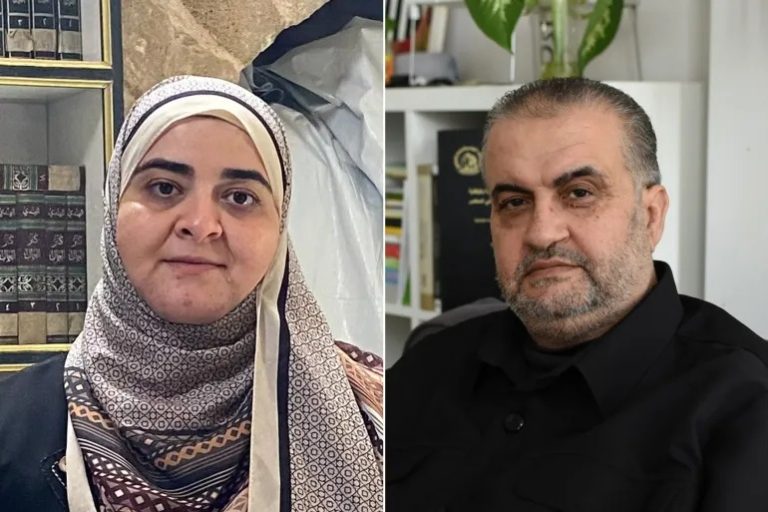
Gaza (Palestine Foundation Information Center), At a time when Israeli bombardment was destroying neighborhoods in Gaza and erasing its historical landmarks, engineer Haneen al-Omousi searched through the rubble of the Shuja’iyya neighborhood for documents, manuscripts, and photographs that had survived the bombing. She knew well that saving even a single document meant preserving a fragment of the memory of a city whose features were being erased.
According to a report by Al Jazeera, this mission to rescue heritage from beneath the rubble became a journey into danger. It was led by Haneen al-Omousi, Executive Director of the Eyes on Heritage Foundation, together with historian Dr. Abdul Latif Abu Hashem, former Director of the Department of Manuscripts, Antiquities and Libraries. Their efforts culminated in winning the 2026 UNESCO/Jikji Memory of the World Award.
The award was granted by a unanimous decision of the judging committee, marking the first distinction of its kind since the award was introduced in 2024. It was jointly presented to two individuals in recognition of their outstanding efforts to protect Palestinian documentary heritage during wartime. The award ceremony was held on September 4 in the South Korean city of Cheongju as part of the Jikji Day celebrations.
Heritage restoration in the heart of war
The selection of al-Omousi and Abu Hashem was not the result of a sudden achievement. It was linked to the establishment of the first specialized laboratory in the Gaza Strip for restoring manuscripts, as well as the development of emergency methods and protocols to protect documents and historical assets during conflicts.
Their dedicated efforts played a significant role in digitizing and preserving 228 rare manuscripts. They also rescued around 8,000 books and restored 25,000 pages of manuscript heritage. A large portion of these materials dates back to the Mamluk and Ottoman periods, giving them immense historical and cultural importance for Gaza and Palestine.
The field rescue operations required extraordinary efforts under extremely difficult conditions. Al-Omousi led a team of 11 volunteers and was the only woman in the team working at locations closest to the so-called Yellow Zone, which was under Israeli military control.
Due to the lack of heavy equipment and severe shortages of basic restoration materials, the team was forced to work among the rubble under the constant threat of being targeted. They raced against time to recover everything that could be saved before further damage occurred.
Al-Omousi said that simply standing by while heritage faced the threat of disappearance was not an option. She stressed that extracting even a single document from beneath the rubble represented a major victory in a war targeting not only people and homes, but also the collective memory that preserves the history of the city.
The Captive Quran: Where the story began
Behind this remarkable achievement lies a long history of efforts to preserve Palestinian memory. Dr. Abu Hashem spent nearly 35 years collecting personal and family archives and rescuing old documents. He visited homes across Gaza to raise awareness among residents about the valuable documents and manuscripts they possessed and to encourage them to transform these family treasures into part of the national memory.
For Haneen al-Omousi, her connection to this field began with a wooden chest containing a manuscript that caught her attention. When she asked Abu Hashem about its contents, he introduced her to the manuscript known as the “Captive Quran.”
The story of this Quran dates back to World War I, when a British soldier, impressed by the beauty of its calligraphy, took it from the library of the Great Omari Mosque in Gaza. The manuscript was later transferred to one of the soldier’s friends, who eventually handed it over to the Palestinian Ministry of Endowments along with a letter of apology. The ministry subsequently returned it to Gaza.
This discovery proved to be a turning point for al-Omousi. She realized that manuscripts were not merely old pieces of paper, but carried within their pages the stories of a city, the identity of a society, and memories passed down from one generation to another.
Gaza’s memory surrounded by flames
Al-Omousi describes with deep sorrow the scale of the transformation Gaza has undergone during the war. Historic churches, monasteries, cemeteries, mosques, and historic homes have suffered extensive damage, while parts of the urban landscape that shaped the city’s memory for decades have disappeared.
She believes that the damage goes beyond the destruction of buildings and sites. It also deprives future generations of the opportunity to learn about their city’s history and landmarks, placing collective memory itself at risk of being severed.
Although rescue efforts succeeded in protecting thousands of pages, manuscripts, and books, preserving the recovered materials remains fraught with danger. The archives of the Eyes on Heritage Foundation are still at risk beneath the rubble of the 18-story Al-Ghafari Tower, which was targeted by Israeli bombardment.
Al-Omousi fears that any new attack on the site could destroy the archives that survived the war, once again placing the manuscripts and documents that escaped the bombing in danger.
The struggle to save documents in Gaza is, in reality, an extension of the struggle to preserve existence and identity. Buildings that have been destroyed can be rebuilt and rubble can be cleared, but the loss of a manuscript or document means the loss of a historical story that can never be fully recovered.
That is why the efforts of al-Omousi and Abu Hashem have gone far beyond an ordinary project to restore books and preserve papers. They have become a determined effort to save the memory of an entire city and keep the pages of Gaza’s history alive despite a war that has sought to erase its people, homes, and heritage.