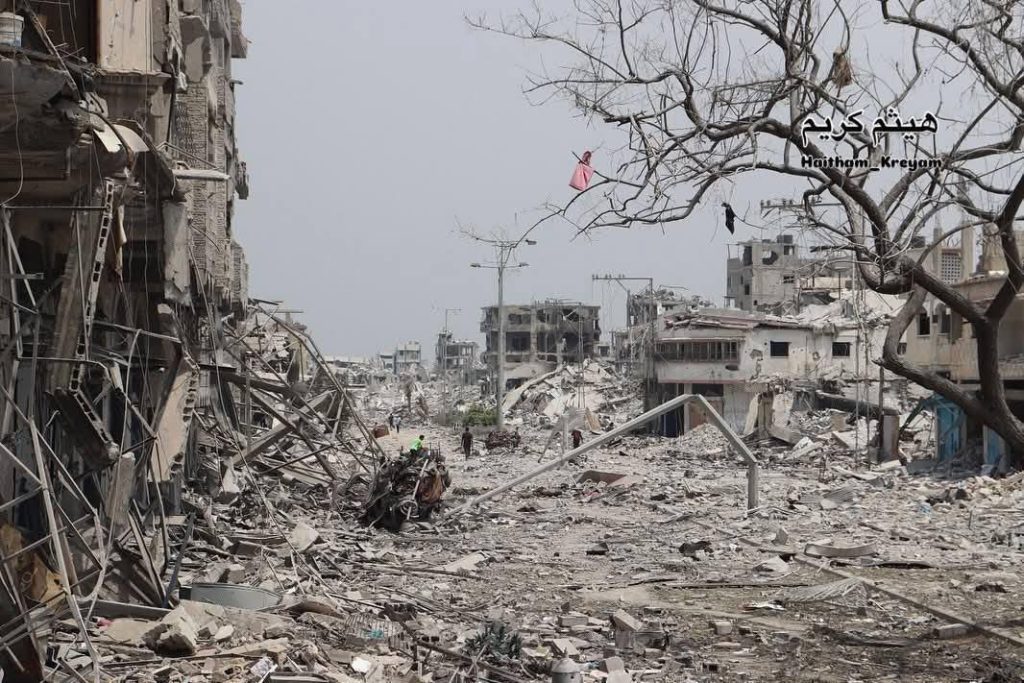
GAZA, (Palestine Foundation Information Center), The United Nations Conference on Trade and Development (UNCTAD) has warned of an accelerating economic collapse in the Gaza Strip, describing the situation as the most severe economic crisis recorded anywhere in the world. Israel’s genocidal war has damaged or destroyed around 92% of Gaza’s economic establishments, eliminated hundreds of thousands of jobs and pushed more than 90% of the working-age population out of employment.
Pedro Manuel Moreno, UNCTAD’s acting secretary-general, said during a press conference in Geneva that the Palestinian economy is experiencing a sweeping collapse that has erased decades of development gains, while Gaza has become the epicenter of an unprecedented economic and humanitarian crisis.
Moreno said UNCTAD’s latest report documents the scale of losses inflicted on the Palestinian economy, estimating Gaza’s recovery and reconstruction needs alone at approximately $71.5 billion, amid widespread destruction of infrastructure, productive sectors and essential services.
Figures reveal the scale of the collapse
The report found that 92% of Gaza’s economic establishments have been damaged or destroyed since October 2023. Per capita gross domestic product fell to just $212 in 2025, around 58 cents a day, equivalent to only 17% of its 2022 level.
Unemployment reached 78%, while more than 90% of Gaza’s working-age population was outside employment. Hundreds of thousands of jobs have been lost since the beginning of the war, wiping out billions of dollars in cumulative labor income.
No major productive sector escaped the collapse. Agricultural and industrial output each fell by 94%, while construction activity plunged by 99% compared with 2022 levels.
Agriculture and industry devastated
The report found that less than 1.5% of Gaza’s agricultural land remained accessible and undamaged, deepening the population’s dependence on humanitarian food assistance. Gaza’s agricultural and industrial productive capacity has also been severely damaged, stripping the local economy of much of its ability to sustain itself.
Prices have risen dramatically. Gaza’s overall price level in 2025 remained 274% higher than in 2022, while the prices of several basic necessities, including potatoes and cooking gas, climbed to several times their prewar levels.
West Bank faces mounting economic pressure
The economic crisis has also extended to the occupied West Bank, where access to land and natural resources has declined alongside expanding Israeli settlements. Displacement has also accelerated, with the number of Palestinians displaced during the first quarter of 2026 already exceeding the total recorded throughout 2025.
On the fiscal front, the report said deductions and Palestinian revenues withheld between January 2019 and March 2026 exceeded $3.67 billion, equivalent to around 83% of total Palestinian net revenues in 2025.
UNCTAD warned that mounting financial pressures are threatening not only the Palestinian government’s ability to provide essential services but also the stability of the banking sector. Banks’ exposure to the public sector has risen to around $5.3 billion, equivalent to 42% of total bank lending.
The figures come amid Israel’s war on Gaza, which has caused massive destruction, displaced the overwhelming majority of the population and damaged or destroyed much of the enclave’s buildings, infrastructure and productive sectors.
UNCTAD estimates physical damage to Gaza’s infrastructure at approximately $35.2 billion, while economic and social losses have reached $22.7 billion. Those costs could rise further if additional damage continues to accumulate.
The report stresses that restoring the Palestinian economy will require large-scale intervention to rebuild agriculture, industry, construction, energy and technology, while protecting the banking system and securing Palestinian revenues. Such measures, UNCTAD said, are essential to restarting economic activity and restoring some of the productive capacity destroyed by the war.