
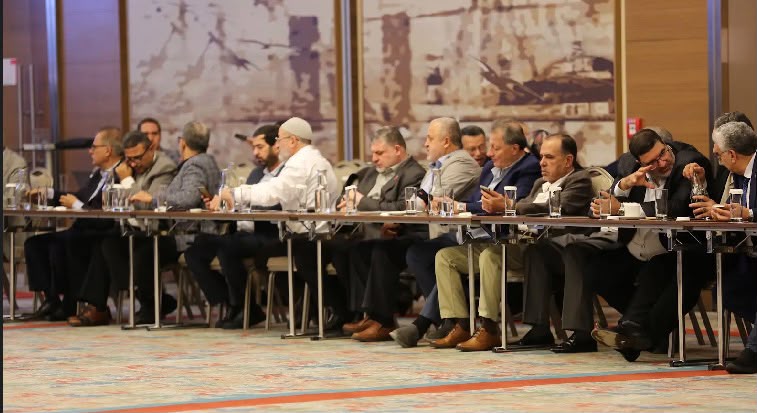
ISTANBUL, (Palestine Foundation Information Center), The Emergency Palestinian National Forum concluded its proceedings in Istanbul, Türkiye, on Saturday, September 26. Convened jointly by the National Authority for Palestinian Popular Action and the Conference of Palestinians in Türkiye, the forum brought together over 350 Palestinian figures from both the homeland and the diaspora, according to the official report issued by the organizing body.
Participation and scope
According to the official report, 216 participants attended in person from more than 17 countries, while 162 participants joined via Zoom. After filtering out duplicates, the total scope of representation spanned more than 30 countries worldwide.
The gathering united prominent public figures, activists, and representatives of Palestinian institutions and diaspora communities. Discussions centered on critical issues concerning Palestinian national representation, the role of the Palestine Liberation Organization (PLO), mechanisms for expanding popular participation, upcoming elections, and the reconstruction of national institutions.
Call for direct elections and rejection of appointment
At the conclusion of the forum, participants issued a political declaration emphasizing the urgent need to renew the legitimacy of Palestinian representative institutions through free, transparent, and direct electoral mechanisms.
The declaration strongly rejected what it termed “exclusion, marginalization, and selective appointments” in representing the Palestinian people, asserting that members of the Palestinian National Council (PNC) must be chosen based on popular will and free elections. Furthermore, participants called upon all Palestinian factions, political forces, public figures, and institutions to refrain from participating in or providing a national cover for “selective appointment” processes.
The declaration urged the PLO leadership to “correct its course” and pave the way for rebuilding the organization to renew its representative legitimacy, while reaffirming the vital importance of preserving the PLO as the overarching national framework for all Palestinians.

Key initiatives: “My Voice is My Decision – No to Appointments” and “Digital Palestine”
Among the prominent outcomes of the forum was the adoption of the “My Voice is My Decision – No to Appointments” campaign, launched by the Palestinian Return Center (PRC). The campaign aims to gather signatures from Palestinians globally on a charter affirming their right to choose their representatives while rejecting appointment, exclusion, and marginalization.
The forum also adopted the “Digital Palestine” initiative as a pathway to develop digital tools serving national participation and organization. This initiative ties into a proposal to establish a governed platform for the general registration of Palestinians in the homeland and diaspora, laying the groundwork for a national database that can evolve into a comprehensive Palestinian voter registry.
Seminar on the national project and elections
The forum’s agenda featured a political seminar titled “Priorities of the Palestinian National Project and the Elections File.” Key speakers included:
• Ahmad Ghunaim (Fatah Movement leader)
• Oraib Al-Rantawi (Writer and political analyst)
• Majed Al-Zeer (Vice Chairman of the General Authority of the Popular Conference for Palestinians Abroad)
• Mohsen Saleh (Head of Al-Zaytouna Center for Studies)
• Mustafa Barghouti (Secretary-General of the Palestinian National Initiative)
The seminar was moderated by Ziyad Al-Aloul, Spokesperson for the Popular Conference for Palestinians Abroad, and was followed by an open dialogue addressing national priorities, elections, and the reform of representative institutions. The event also featured a presentation on the “Digital Palestine” initiative and a closing session discussing the forum’s draft document.

Diverse representation from homeland and diaspora
The official report highlighted the active participation and contributions of numerous prominent Palestinian figures, including:
• Muhammad Mshanish (Head of the Conference of Palestinians in Türkiye)
• Hasan Khraisheh (Deputy Speaker of the Palestinian Legislative Council)
• Samaan Khoury (Head of the General Authority of the Popular Conference for Palestinians Abroad)
• Hisham Abu Mahfouz (Acting Secretary-General of the Popular Conference for Palestinians Abroad)
• Nawaf Al-Takrouri (Head of the Association of Palestinian Scholars)
Additional active interventions were made by Taysir Mohsen, Osama Al-Kurd, Ibrahim Ibrahim, Amin Abu Rashid, Nael Barghouti, Mahmoud Issa Abu Marsil, Iyad Abd Al-Aal, Ayman Najmeh, Hamdan Al-Dmeiri, Hussein Khader, Sami Shaheen, Sari Zeiter, Salah Zakout, Salah Abdel Ati, Adnan Sabah, Fayez Abu Eid, Muslim Imran, Moussa Al-Rifai, and Anas Al-Haj, alongside several other public figures. Their discussions addressed the current state of national representation, the challenges faced by Palestinians across all regions, and the future of the PLO.

Electoral governance framework and future steps
The final declaration stressed that holding elections for the Palestinian National Council requires a robust governance framework, which includes:
- Issuing a call to all eligible Palestinian voters in the homeland and diaspora.
- Forming an independent, specialized, and neutral oversight committee.
- Establishing a clear legal and regulatory foundation alongside a specialized judicial system to handle electoral disputes.
Participants warned that failure to address these popular demands would lead to “serious steps” at the popular and national levels, including the peaceful and democratic establishment of a participatory Palestinian popular governance system to organize public will and ensure accountability. The forum concluded by reiterating that rebuilding the PLO and uniting Palestinian ranks remain top national priorities.


