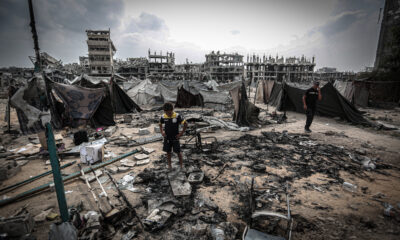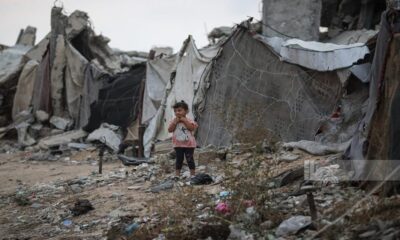
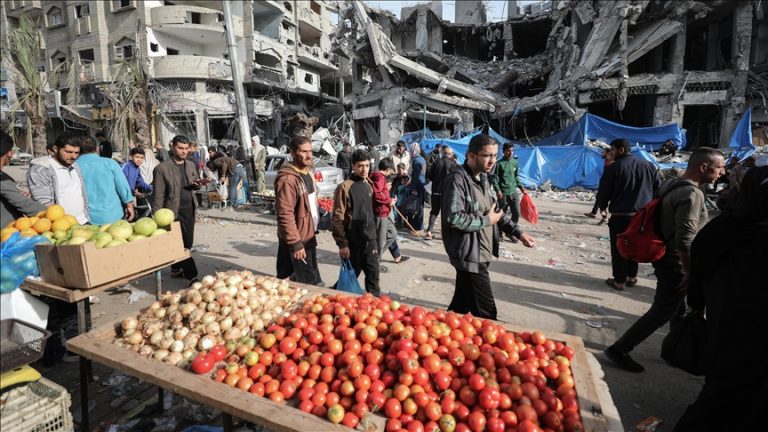
GAZA, (Palestine Foundation Information Center), The ceasefire in Gaza, which entered into force on October 10, 2025, has not translated into a tangible living recovery for households, as they have recovered only 26.3% of their real pre-war consumption level, according to a study published by the Arab Center for Research and Policy Studies on November 12, 2026, titled “Post-Ceasefire Gaza: Have Households Recovered Their Purchasing Power and Consumption Levels.”
The study was prepared by researcher Saif Al-Din Yousef Odeh, head of the Modeling and Forecasting Department at the Palestine Monetary Authority and part-time assistant professor of economics at the Islamic University of Gaza, within the center’s Economic Studies Unit. The study covers the period from October 2025 to June 2026, comparing it with the pre-war period (January, September 2023).
Short-term price improvement
The consumer price index in the Strip fell from 683.3 points in the third quarter of 2025 to 251.8 points in the fourth quarter, a drop of about 63% immediately following the ceasefire, according to data from the Palestinian Central Bureau of Statistics relied upon by the study.
However, this decline did not last, as the index returned to rising by 3.2% in the first quarter of 2026 and then by 12.7% in the second quarter to reach 292.8 points, a level exceeding the pre-war average of 105.3 points by about 178%. Consequently, the remaining purchasing power of the shekel rose from 15.4% to 41.8% after the truce, then fell to 40.5% and subsequently 36%, meaning that every 100 shekels now buys the equivalent of only about 36% of what it bought before the war.
Unrecovered consumption and cumulative gap
The average real household consumption index in the post-ceasefire period reached 26.3% of its level in the third quarter of 2023, compared to 15.9% during the pre-truce war period. The researcher estimated the cumulative consumption gap from the fourth quarter of 2023 through the second quarter of 2026 at about 6.3 billion dollars at 2015 prices, including about 1.56 billion dollars in the three quarters following the truce, assuming consumption remained constant at the third-quarter 2023 level.
Odeh links this reality to several factors, including ongoing restrictions on the entry of goods, a shift in spending toward necessities such as food, shelter, and transportation at the expense of less urgent goods, and households holding onto part of their money as a precaution for the future.
Ongoing cash drain
The study’s calculations show that in the post-truce period, households spent about 1.57 billion dollars on consumption after neutralizing the exchange rate effect, whereas the cost of purchasing the same goods and services at pre-war prices would not have exceeded 573.6 million dollars. This signifies a cash drain of about 995.2 million dollars, or 63.4% of total nominal consumer spending, or in simpler terms, a dollar that was enough to buy a specific good before the war now requires about 2.7 dollars to purchase it.
Eroding value of cash assistance
Multi-purpose cash assistance amounted to 1,250 shekels per household, with the total transferred up to the end of April 2026 reaching about 974.8 million shekels, according to reports from the United Nations Office for the Coordination of Humanitarian Affairs (OCHA) cited by the study. However, its real value at pre-war prices dropped from about 523 shekels in the fourth quarter of 2025 to 506.6 and then 449.6 shekels in the first two quarters of 2026, averaging about 493 shekels, equivalent to only 39.4% of its previous purchasing power.
In a related context, the study notes that the cost of the Minimum Expenditure Basket, according to World Food Program (WFP) data, reached 1,989 shekels in November 2025 after reaching 11,984 shekels in July of the same year, remaining about 16% higher than its pre-war reference level (1,717 shekels in 2022). Thus, the assistance covered about 62.8% of the basket in that month, compared to a recommended benchmark of 60%, noting that the study points out that the latest published update for the basket cost dates back to November 2025, which limits the ability to assess the adequacy of current assistance.
Entry restrictions and coordination mechanisms
The researcher attributes renewed price pressures to continued restrictions at the crossings, as the average number of humanitarian and commercial trucks entering daily declined from about 250 trucks in December 2025 to 130 in March 2026, according to the WFP, while the number of aid pallets fell from 58,600 in January to 41,800 in June, according to OCHA data.
The study mentions that security coordination permits to bring in goods are granted to a very limited number of merchants and companies not exceeding 15 companies, alongside what are known as coordination payments, arguing that this raises entry costs and keeps prices high.
Study recommendations
The study recommends intensifying pressure from mediators and guarantors to ensure the implementation of the agreement’s commitments and US president Donald Trump’s plan, expanding the scope of merchants permitted to bring in commercial goods, and restarting facilities, factories, and farms capable of production.
It also calls for a periodic review of the Minimum Expenditure Basket cost and the value of cash assistance rather than fixing it at 1,250 shekels, studying an increase in the coverage ratio or providing supplementary support for the neediest groups, developing indicators to monitor aid effectiveness, and combining cash transfers with direct commodity interventions when certain basic goods are absent from markets.