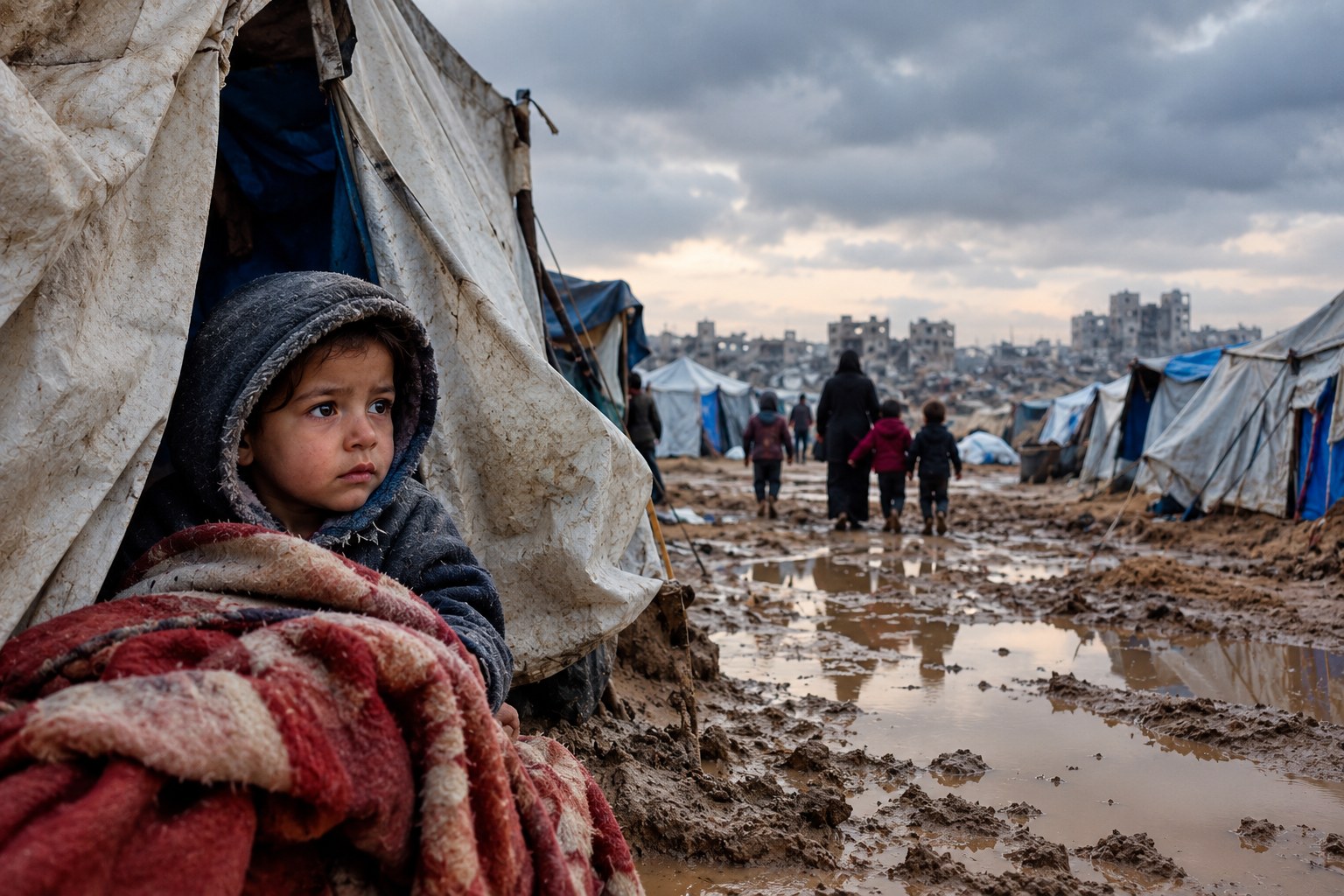
Gaza (Palestine Foundation Information Center), As winter rains approach Gaza, the shelter crisis has once again moved to the center of the humanitarian situation, with thousands of displaced families forced to live in tents and makeshift shelters that provide little to no basic protection from the cold and rain.
Against this backdrop, Ismail al-Thawabta, Director-General of Gaza’s Government Media Office, issued an urgent appeal to unify local and international efforts and protect displaced families from the impact of the coming winter season.
Speaking to journalists on Wednesday, al-Thawabta said the arrival of winter requires moving beyond emergency responses toward clear priorities. He warned that the extremely deteriorated condition of displacement camps makes rain and cold a direct threat to the lives and dignity of thousands of families, particularly widows, orphans, the elderly, patients, and people with disabilities.
The appeal comes as displacement camps prepare for another winter season, while most families continue to depend on tents and temporary shelters erected under extraordinary circumstances. These shelters suffer from weak drainage systems, inadequate infrastructure to prevent flooding, and a lack of resources needed to provide proper protection.
Al-Thawabta identified several urgent needs, including rain-resistant tents, insulation materials for tents, blankets and winter clothing, safe heating sources, the preparation and maintenance of rainwater drainage networks and pathways, and strengthened sanitation and public health facilities.
He called on refugee committees and field teams to provide logistical and technical assistance and to work according to needs assessments identifying the most vulnerable families, ensuring that aid reaches them before weather conditions deteriorate.
The concerns extend beyond the ability of tents to withstand rain. Weak sewage networks, damaged roads, and destroyed infrastructure further increase the risks of water accumulation, disease outbreaks, and damage to temporary shelters.
According to the latest United Nations figures, the scale of the shelter gap is enormous. The UN Office for the Coordination of Humanitarian Affairs (OCHA) says approximately 9.8 million Palestinians, or 94 percent of Gaza’s population, are in need of shelter and non-food-item assistance. Meanwhile, 58 percent of the population faces critical or catastrophic shelter needs, while 84 percent of families face severe restrictions and deteriorating living conditions, including inadequate protection from weather conditions.
Recent UN assessments reinforce warnings issued by the Government Media Office. Inspections of 22 displacement sites housing more than 87,000 people found that many solid-structure tents were deteriorating and urgently required insulation. Low-lying areas were also affected by poor drainage, unsafe sewage pits and facilities, overcrowding, and other hazards threatening residents’ safety.
OCHA has warned that winter preparations are being hampered by access restrictions and funding shortages, resulting in insufficient stocks of shelter materials and non-food items.
The UN agency said nearly 400 trucks would be needed to bring in the basic shelter materials awaiting entry, including thousands of tents, insulation materials, more than 442,000 wooden planks, and other supplies.
The extensive destruction of homes and infrastructure has further intensified the threat posed by winter. According to OCHA, 178,632 residential units have been assessed, with 60 percent severely damaged, destroyed, or rendered uninhabitable. In addition, all six wastewater treatment plants in the Gaza Strip are out of service, while 70 percent of pumping stations are non-functional, resulting in the discharge of more than 150,000 cubic meters of untreated sewage every day.
Against this backdrop, al-Thawabta urged the government, municipalities, humanitarian organizations, and donors to accelerate their interventions and not wait for the rainy season to begin. He warned that any delay would double the suffering of families already living in extremely vulnerable conditions.
The Government Media Office stressed that protecting displaced people is not merely a temporary relief effort but a collective humanitarian and moral responsibility. It called for the provision of at least the basic elements of protection and dignity before rain and cold turn into a new crisis within the tragedy imposed on the Gaza Strip.
The coming winter in Gaza is not expected to be an ordinary seasonal change. For families who have lost their homes and are living in deteriorating tents, preparations made today could make the difference between enduring a harsh rainy season and facing yet another humanitarian disaster.