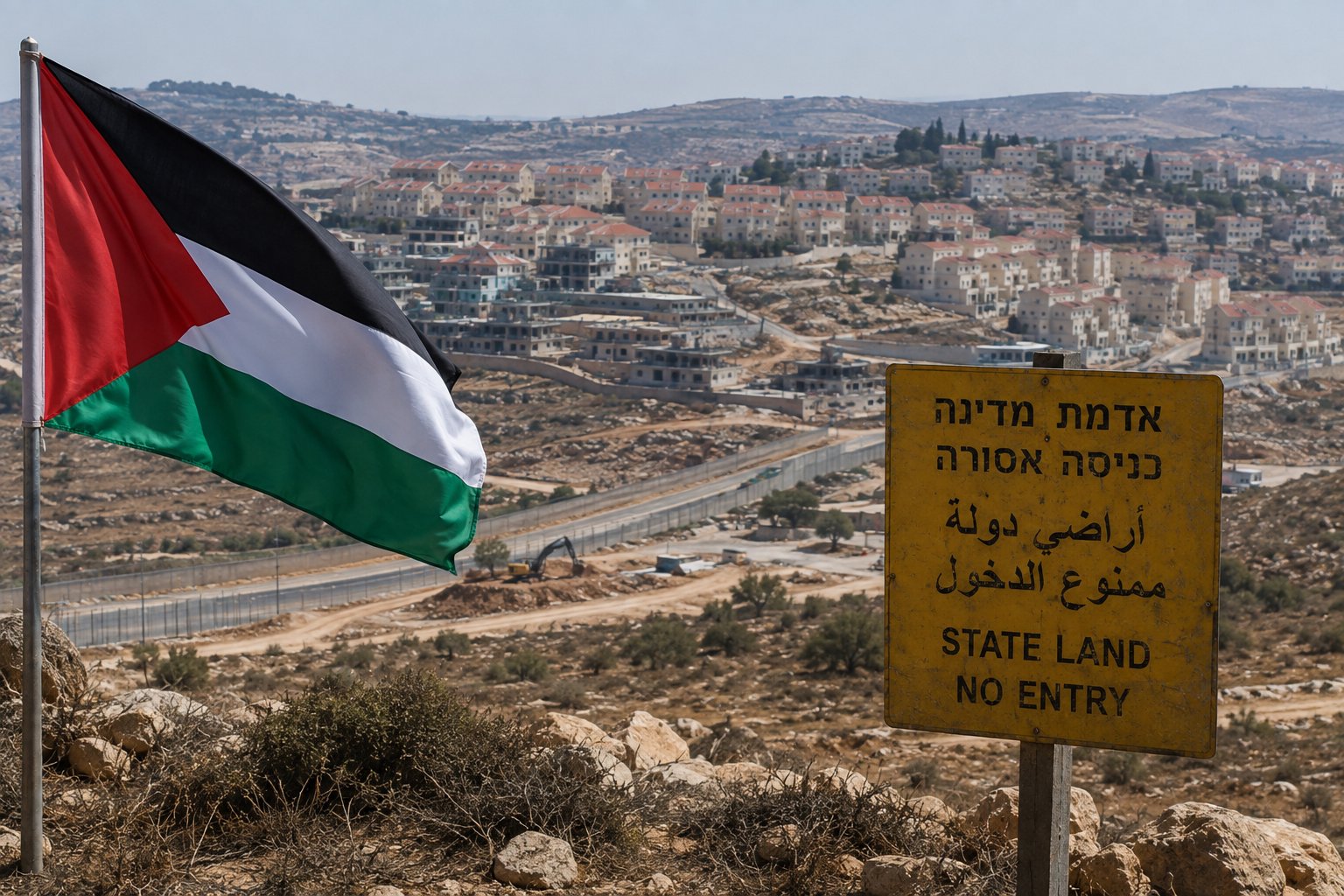
OCCUPIED JERUSALEM, (Palestine Foundation Information Center), Israeli authorities on Monday barred Palestinians from accessing lands near the al-Muntar Bedouin community and the wilderness of al-Sawahreh, east of occupied Jerusalem, claiming the area is “state land” in a move that further restricts residents’ movement and threatens their access to land and livelihoods.
The Jerusalem Governorate said Israeli Civil Administration crews began placing signs prohibiting Palestinians from reaching the targeted lands, noting that most of the affected area lies along routes used by residents and around al-Muntar and its school.
Around 112 families live in al-Muntar, which also has a school serving children from the community and surrounding areas. The new restrictions are expected to directly affect residents’ daily movement, children’s access to education and families’ ability to reach their land.
Hamas, for its part, condemned the move, describing the seizure of land east of occupied Jerusalem and its classification as “state land” as “a new crime” within Israel’s settlement plans aimed at geographically dividing the West Bank, isolating Jerusalem and tightening control over it.
In a press statement, the Movement warned of escalating displacement schemes targeting Palestinians and the confiscation of their land in Jerusalem and the West Bank.
Hamas called on the international community to break its silence over Israel’s settlement and Judaization campaign, and to take action to stop what it described as aggression against the Palestinian people, land and holy sites.
It said Israel’s plans would not break Palestinians’ steadfastness or attachment to their land, stressing that Palestinians would respond with further resilience and resistance to annexation and displacement schemes.
The Movement also called for unified Palestinian efforts and positions, and urged the United Nations, the Arab League, the Organization of Islamic Cooperation and supporters of justice worldwide to shoulder their responsibilities and act to stop Israel’s settlement, Judaization and displacement policies.
The latest measure comes amid a wider series of Israeli actions targeting Palestinian land and communities around Jerusalem, including demolition orders, land razing, confiscation, access restrictions, settlement outpost expansion and settler attacks.
In a recent report, the UN Office for the Coordination of Humanitarian Affairs (OCHA) documented continued restrictions on Palestinians’ access to homes, agricultural land and sources of livelihood as a result of demolitions, settlement expansion and settler violence.
In occupied Jerusalem, OCHA documented recent demolitions that displaced dozens of Palestinians. In the period covered by its August 28, 2026, report, 79 Palestinian structures were demolished in the West Bank, including 10 in Jerusalem. More than half of the 73 Palestinians displaced during that period were from the neighborhoods of Beit Hanina, Jabal al-Mukabber and Silwan.
The UN said the demolitions did not target homes alone, but also affected structures linked to livelihoods, agriculture, water and sanitation, increasing pressure on residents to leave their areas.
The Palestinian Authority’s Jerusalem Governorate, for its part, said occupied Jerusalem saw 29 demolition and land-razing operations in July, including 13 forced self-demolitions in which Palestinian Jerusalemites were compelled to demolish their own structures, 14 demolitions carried out by Israeli machinery and municipal crews, and two land-razing operations targeting Palestinian land and property.
The measures targeted agricultural and commercial structures, walls and roads, while Israeli occupation authorities continued imposing additional restrictions on Palestinians’ use of their land.
During the same month, the governorate recorded 27 notices and decisions, including 26 demolition notices and one order for confiscation and seizure for military purposes.
Land control is not limited to direct confiscation orders. It is also tied to access restrictions, settlement expansion and the establishment of settlement outposts.
In its August 28 report, OCHA said the expansion of settlement outposts in several parts of the West Bank has been accompanied by restrictions on Palestinians’ movement and access to land, including agricultural areas.
It also cited Israeli organization Peace Now as estimating that settlers have taken control of more than 100,000 dunums in Areas A and B of the West Bank, using violence and threats to restrict Palestinians’ access to land and, in some cases, pressure families to leave their homes.
These developments carry particular weight in areas east of Jerusalem, where Palestinian Bedouin and herding communities already face severe restrictions on construction and access to basic services.