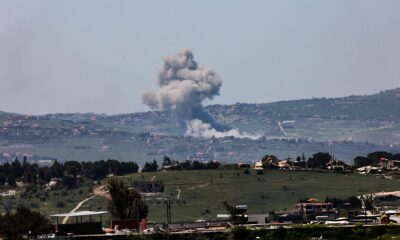
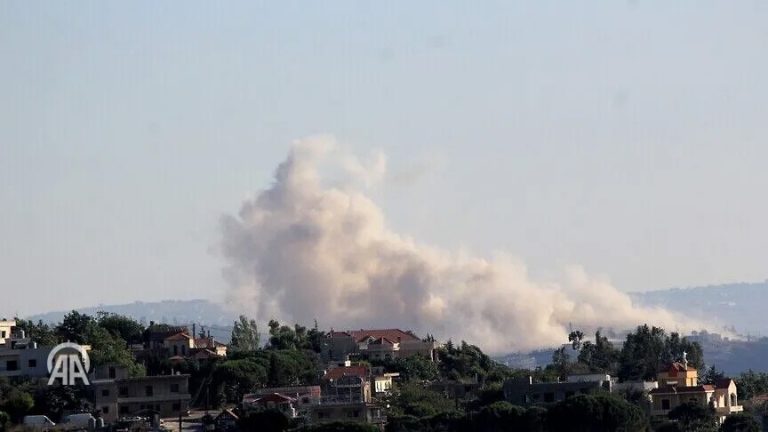
BEIRUT, (Palestine Foundation Information Center), Israeli forces renewed their attacks on southern Lebanon on Wednesday, with an airstrike targeting the town of al-Mansouri in the Tyre district, while the Israeli army simultaneously blew up buildings and civilian facilities in the town of Zawtar al-Sharqiyah in the Nabatieh district.
Local media reported that the airstrike targeted al-Mansouri, while Israeli media claimed the Israeli military struck what it described as a Hezbollah operational apartment in the town.
The strike came as the Lebanese army said continuing Israeli attacks were obstructing the completion of its deployment in southern Lebanon and preventing residents from returning to their towns. It said Israeli forces had blown up buildings and civilian facilities in Zawtar al-Sharqiyah.
In a statement, the Lebanese army said Israeli forces destroyed the town’s public school, health clinic, nursery and several homes, in addition to the municipal building, which had been blown up earlier.
The army accused Israel of continuing to target southern villages and towns, stressing that the attacks were obstructing its operations and deployment.
Civilian facilities destroyed
Lebanon’s National News Agency reported that Israeli forces blew up and destroyed the four-story Sheikh Naim Mahdi School building in central Zawtar al-Sharqiyah. Israeli forces also carried out explosions in the valley near the town of Touline, along the Wadi al-Salouqi road.
Overnight, Israeli forces carried out two explosions in the town of Haddatha and another in Beit Yahoun in the Bint Jbeil district.
An Israeli drone also directly struck a venue used for religious celebrations on the Kafra al-Asi road, causing injuries, while another Israeli drone flew over Beirut’s southern suburbs.
Israeli Army Minister Israel Katz said Israel would continue demolishing what he described as Hezbollah infrastructure and homes in the “security zone,” adding that he had instructed the military to prepare for a prolonged presence in the area inside Lebanon.
Katz added that Israeli forces would also remain in areas inside Syria and the Gaza Strip.
Lebanon rejects Israeli justifications
Lebanese Prime Minister Nawaf Salam rejected Israel’s justifications for destroying villages and towns in southern Lebanon, saying that describing entire villages as military facilities defied logic.
Salam said the nature of the sites targeted by Israel, including homes, residential neighborhoods, government buildings, public facilities, places of worship and infrastructure, contradicted claims that the areas contained military facilities.
He said the systematic bulldozing and destruction of homes, residential neighborhoods, infrastructure, government buildings and places of worship in al-Mansouri, Zawtar al-Sharqiyah, Kfar Tebnit and other southern towns constituted a serious violation of international law and international humanitarian law.
The Lebanese prime minister stressed that Lebanon’s sovereignty, the security of its population, and the right of southern residents to return to their land and rebuild their towns were not negotiable.
Efforts to implement the agreement
On the political front, Lebanese President Joseph Aoun discussed measures to implement the framework agreement with US General Clearfield, following talks the latter held in Israel last week.
Lebanese Armed Forces Commander General Rodolphe Haykal also discussed the agreement and the difficulties facing the army as a result of continuing Israeli attacks with Clearfield.
Haykal also received the United Nations Special Coordinator for Lebanon. Their talks addressed the general situation, the period following the United Nations Interim Force in Lebanon, and the UN coordinator’s upcoming visit to the Security Council in New York.
Israel has continued its military attacks in Lebanon since the beginning of March, killing 4,335 people and injuring 12,277 others, according to Lebanese authorities. More than one million people have also been displaced.
Israel occupies areas of southern Lebanon, some of them for decades, while its forces have advanced more than 10 kilometers into Lebanese territory during the current offensive.