
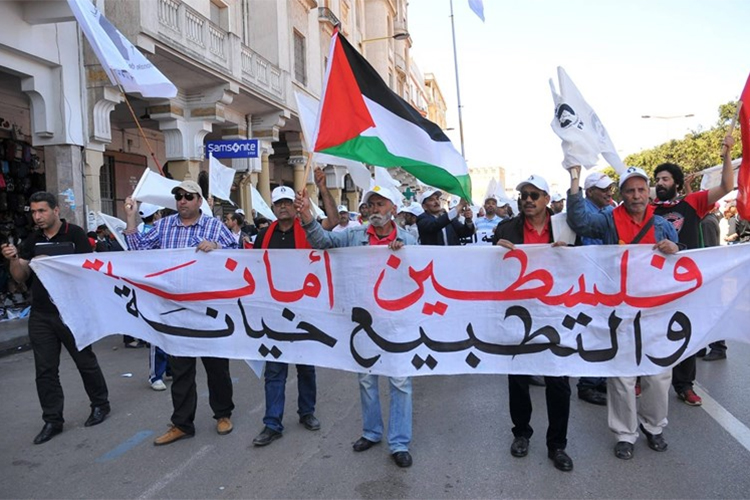
RABAT, (Palestine Foundation Information Center), Morocco’s reported move to elevate diplomatic relations with Israel to ambassadorial level has triggered renewed condemnation from organizations opposed to normalization, which describe the development as a major step toward institutionalizing Israel’s political, economic, cultural and symbolic presence in Morocco.
The controversy comes amid continuing Israeli military operations against Palestinians, settlement expansion, displacement and destruction, as well as repeated confrontations surrounding Jerusalem and the Al-Aqsa Mosque. For Morocco’s anti-normalization movement, the timing highlights what it sees as a growing contradiction between official diplomacy and the position of significant sections of Moroccan society on the Palestinian cause.
In a statement dated September 16, 2026, the Moroccan Commission for Supporting the Nation’s Causes condemned what it called an official rush to deepen ties with Israel. It referred to arrangements reportedly discussed following a trilateral diplomatic meeting in New York involving Moroccan Foreign Minister Nasser Bourita, Israeli Foreign Minister Gideon Sa’ar and US Ambassador to the United Nations Mike Waltz.
According to the commission, the proposed measures include raising diplomatic representation to ambassadorial level, appointing ambassadors, expanding economic cooperation and increasing official visits.
The Moroccan Monitor Against Normalization also rejected the reported move. It stressed that the announcement had come from the Israeli side and that, when its statement was issued, no Moroccan government clarification had formally confirmed or denied the agreement.
From liaison offices to full embassies
Morocco and Israel restored diplomatic ties in 2020, reopening liaison offices as part of the normalization process. The proposed transition to full embassies would represent a further institutionalization of those relations.
The Commission argues that deepening political and economic ties while Palestinians continue to face occupation, displacement and military violence gives Israel additional international legitimacy and economic space rather than using diplomatic relations to pressure it over Palestinian rights.
It also rejects reported economic arrangements, including agreements concerning investment protection and the avoidance of double taxation, arguing that such measures would give the relationship a more permanent economic foundation.
Both organizations are calling on Rabat to halt the move and close the Israeli liaison office.
What would an Israeli embassy represent
The Monitor has also revisited remarks attributed to Luna Fischer, former head of Israel’s liaison office in Morocco, during an inspection of construction work on the planned Israeli embassy in Rabat. According to the Monitor, Fischer described the facility as more than an embassy, calling it a “home” for Israelis around the world.
The organization says the remark raises questions about the intended scope of the diplomatic mission.
The Monitor has further cited controversies surrounding David Govrin, the former head of Israel’s liaison office in Rabat. It referred to reports that Israel’s Foreign Ministry investigated allegations involving sexual harassment and the exploitation of Moroccan women, as well as statements and conduct it attributes to Govrin that it says included insults directed at Morocco and its head of state.
Those allegations have been the subject of reporting and official scrutiny; the Monitor uses them as part of its broader argument for reassessing the trajectory of Morocco-Israel relations.
Al-Aqsa at the center of the dispute
For the Commission, the diplomatic developments cannot be separated from events in Jerusalem.
It condemned repeated incursions by Israeli settlers into the Al-Aqsa Mosque compound, describing them as violations of the site’s sanctity and attempts to impose new realities there. It called for serious Arab, Islamic and international action to protect the Mosque and preserve its historical and legal status.
Invoking Al-Aqsa’s religious significance, the Commission quotes the Qur’anic description of its surrounding land as “that which We have blessed.”
Its central argument is that Palestine, Jerusalem and Al-Aqsa cannot be treated as marginal issues while diplomatic and economic ties with Israel are being expanded.
The normalization debate moves into culture and symbolism
The Monitor argues that the relationship has also extended beyond conventional diplomacy and commerce into cultural, media, religious and symbolic spheres.
It cites, among other examples, a controversy in Marrakech involving the appearance of a group of rabbis near Bab Doukkala and references to the symbolic idea of a new “Western Wall” in the city.
The organization says such developments raise concerns about the use of Moroccan historical sites and symbols in narratives associated with Israel.
It has also criticized what it describes as a growing media and cultural discourse presenting Morocco through specifically Jewish or Israeli historical narratives, citing headlines such as “Morocco: A Jewish Land” and “Morocco, the Holy Kingdom of the Children of Israel.”
For the Monitor, these developments indicate that the dispute over normalization is also becoming a struggle over historical memory, cultural identity and the interpretation of Morocco’s past.
Western Sahara: Rejecting a diplomatic trade-off
The Monitor also rejects portraying normalization with Israel as a means of advancing Morocco’s position on Western Sahara.
It argues that linking the two issues risks undermining what it regards as the independent national character of Morocco’s position, and calls for the Western Sahara issue to be defended through autonomous national decision-making rather than dependence on political relationships with foreign powers.
This reflects a broader concern within the anti-normalization movement that foreign-policy gains should not come at the expense of Morocco’s political autonomy.
A growing confrontation over the direction of Moroccan foreign policy
Taken together, the two statements portray the proposed elevation of relations with Israel as more than a diplomatic adjustment. They see it as a decisive stage in a process that could consolidate ties across diplomacy, investment, culture and public life.
The Commission describes normalization as a political and economic choice with consequences for Palestine, Moroccan sovereignty and the country’s public position on the conflict. The Monitor similarly calls for the process to be reversed and for Israeli cooperation to be curtailed across the areas it identifies as politically and culturally sensitive.
Both organizations are demanding that Rabat stop the reported move toward full diplomatic relations, close the Israeli liaison office and end forms of cooperation they regard as incompatible with Moroccan sovereignty and support for Palestine. They are also urging political parties, trade unions, human-rights organizations and civil society groups to maintain peaceful mobilization against normalization.
At the heart of their position is a broader question: whether Morocco’s relationship with Israel will remain a limited diplomatic partnership or develop into a deeply embedded political, economic and cultural relationship.
For the Commission, the answer is clear. Palestine is not a subject for bargaining, Jerusalem is not a negotiating card, and Al-Aqsa is not a marginal issue.
Its closing message captures the position shared by Morocco’s anti-normalization organizations: no to normalization, no to what they describe as Israeli penetration of Moroccan society, and no to granting legitimacy to occupation.