BEIRUT, (Palestine Foundation Information Center), The Palestinian Democratic Women’s Organization (Nada) launched a protest campaign in Palestinian camps and gatherings in Lebanon, rejecting the cuts by the United Nations Relief and Works Agency for Palestine Refugees (UNRWA) to its health, educational, social, and relief services, and demanding guaranteed continued assistance to meet the growing needs of women refugees, especially women heads of household, elderly women, and women with disabilities.
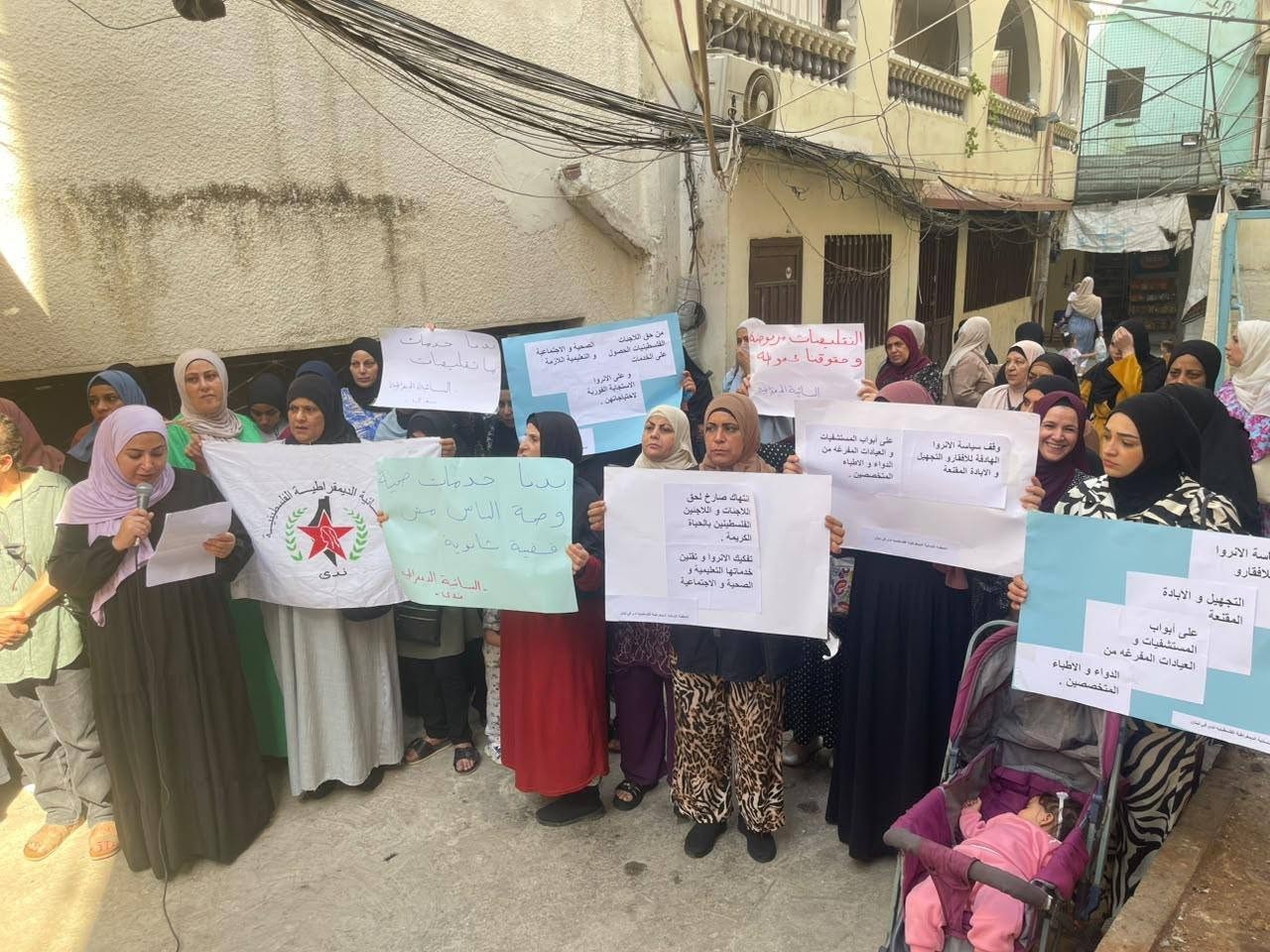
The campaign, titled “The Cry of Palestinian Women Refugees to Force UNRWA to Stop its Policy of Impoverishment, Ignorance, and Emptying Clinics of Essential Medicines and Specialized Doctors,” began with actions and sit-ins in Shatila, Burj al-Shemali, and Beddawi camps, before expanding to Ain al-Hilweh camp, with events scheduled to continue across the remaining Palestinian camps and gatherings.
The actions saw broad participation by women, alongside representatives from women’s organizations, social and educational institutions, civil associations, popular committees, and Palestinian factions, where participants raised slogans rejecting the reduction of agency services and demanding the protection of refugees’ rights to health, education, relief, and a dignified life.
Participants emphasized that service cuts worsen living burdens on Palestinian refugees amid unemployment, poverty, and high living costs, stressing the need to consider the special needs of women and girls, especially families headed by women, families of martyrs, the elderly, persons with disabilities, and patients requiring ongoing medical treatment.
Health and relief demands in Shatila camp
In Shatila camp, the organization held a protest sit-in rejecting the continued reduction of UNRWA services and the halting of some essential programs that Palestinian families rely on to secure their daily needs.
During the presentation of a memorandum on behalf of the organization, Haneen al-Zaabi emphasized the necessity of confronting the reduction measures that threaten the continuity of services and the dignity of refugees, as well as adhering to the right of return and defending the human and social rights of the Palestinian people.
For his part, the secretary of the popular committee in the camp, Naji Dawali, called on the agency to fulfill its commitments toward refugees, review the files of families whose assistance was canceled, and reactivate the cash assistance program for cases suffering from severe hardship.
Dawali stressed that the dignity and rights of Palestinians are non-negotiable, rejecting the reduction of their suffering to numbers, and emphasizing that the agency was established to provide services and respond to refugees’ needs until a solution to their cause is reached and the right of return is achieved.
From her side, Lina al-Souri, a leadership member of the Palestinian Democratic Women’s Organization (Nada) in Lebanon, warned of the impact of service cuts on women and children, especially in Shatila and Sabra camps and Palestinian gatherings in Beirut, where unemployment, poverty, and the economic crisis overlap with weak living security and stability.
She pointed out that burdens double for families headed by women, families of martyrs, and families living in dilapidated houses, in addition to the elderly and those with chronic diseases, stressing the necessity of providing medicines and specialist doctors, and guaranteeing access to medical treatment and hospitalization.
Emergency plan for Tyre area camps
In Burj al-Shemali camp in southern Lebanon, Heba Raheel, a leadership member of Nada and head of the organization in the camp, called for establishing a comprehensive health, social, and relief emergency plan for Palestinian refugees in the camps and gatherings of the Tyre area and its surroundings.
She emphasized the importance of the plan contributing to supporting the resilience of families and helping them face the humanitarian and living consequences of the Israeli aggression that targeted Palestinian camps and gatherings, as well as the losses, displacement, and additional burdens it left behind.
These demands come at a time when Palestinian families’ needs for healthcare, social assistance, and relief are increasing, making the continuation of essential services an important factor in protecting the most vulnerable groups from further living deterioration.
Warnings against worsening social crisis
Speeches delivered during the sit-ins warned that the continued reduction of UNRWA services worsens the suffering of refugees and burdens them with the consequences of a financial crisis they are not responsible for, at a time when many rely on the agency’s programs to secure their basic needs.
Participants also expressed their rejection of what they considered adaptation to projects aimed at weakening the agency and undermining its role, warning that the decline of its services could impact education, healthcare, and social protection, and increase pressure on women, children, and poor families.
The campaign affirmed that UNRWA services represent a right for refugees, not a favor, and that addressing the financial crisis should not come at the expense of the poorest and most needy groups, alongside the necessity of providing sustainable funding to guarantee the continued operation of the agency and the essential programs it provides.
In Beddawi camp, Dareen Aqla called for unifying the efforts of women’s organizations and social institutions, and enhancing women’s participation in movements aimed at pressuring the agency to ensure their access to necessary health, social, and relief services.
The campaign is scheduled to continue through various forms of protest in Palestinian camps and gatherings in Lebanon, with the aim of delivering the demands of women refugees and pressing for an end to cuts, ensuring the continuity of basic services, and responding to the special needs of women and girls.
These actions reflect growing fears within Palestinian camps over the consequences of declining agency services on the daily lives of refugees amid accumulated economic and social crises, and confirm participants’ adherence to refugees’ rights and the necessity of UNRWA continuing to fulfill its responsibilities toward them.