BEIRUT, (Palestine Foundation Information Center), The recent Israeli escalation in southern Lebanon has brought the Ali al-Tahir heights back to the forefront of the military scene, after the occupation forces intensified their raids on the area amid indicators that observers see as a prelude to a potential ground move. While estimates speak of an Israeli attempt to impose a new field equation, military experts warn that any incursion into these strategic hills could open up a wide confrontation with Hezbollah, given their military importance and the nature of their defenses.
Fiery prelude preceding the ground move
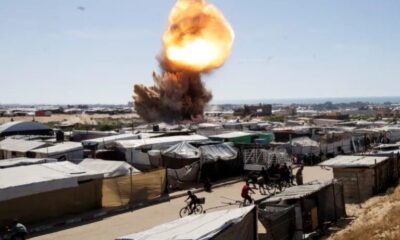
Israeli Channel 12 reported that the army launched an attack on the Ali al-Tahir heights area, while the Upper Galilee Regional Council informed the residents of the settlements that they would hear the sound of explosions resulting from the attacks in southern Lebanon.
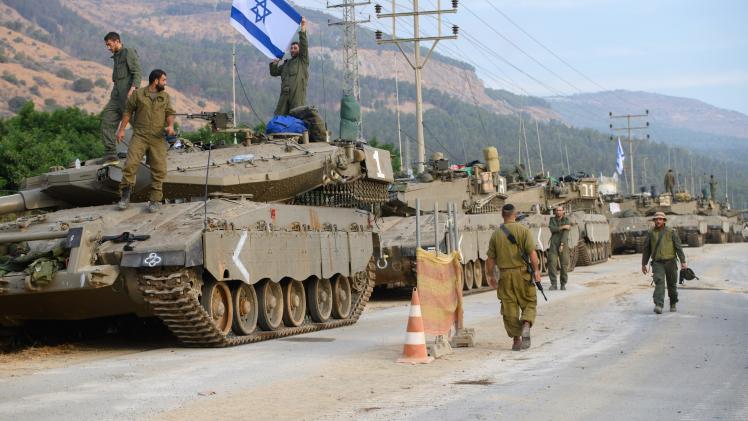
The military and strategic expert, Retired Brigadier General Khalil al-Jamil, believes that the nature of the Israeli operations indicates that what is happening goes beyond mere limited raids, explaining that the Israeli army usually relies on a wide fiery prelude to isolate the operations area and prevent the arrival of fighters or supplies to it before any ground move, according to Al Jazeera.
He added that the shelling targeting the villages and towns surrounding the Ali al-Tahir heights falls within this framework, expecting the strikes to continue for hours before moving to a new stage with the onset of night, which is the timing during which Israel is accustomed to executing its ground operations.
He pointed out that the scale of the airstrikes is disproportionate to a limited targeting operation, as it was possible to execute such missions using drones, which reinforces, according to his estimation, the hypothesis of preparing for a ground incursion into parts of the heights.
He noted that the Ali al-Tahir heights extend for about three kilometers, and any incursion at its beginning may be limited to specific parts of them, but the nature of the current movements is consistent with the military method followed by the Israeli army before any field advance.
Hezbollah’s readiness and field complexities
Al-Jamil confirmed that Hezbollah will be ready to defend the area, expecting that the fire support units deployed in Iqlim al-Tuffah and neighboring areas will begin executing support operations to prevent Israeli forces from establishing any presence inside the hills.
He added that Israel tried during previous stages to advance in the area, but faced great field difficulties due to the rugged geographical nature and defensive readiness, making any new attempt more complex and costly.
He explained that the Ali al-Tahir heights constitute the main line of defense for southern Lebanon and the Nabatieh district, suggesting that violent confrontations would break out if the escalation develops into a direct ground operation.
He also pointed out that any advance inside the network of tunnels scattered in the area would place Israeli forces before complex fighting conditions, unless a collapse occurs in Hezbollah’s defensive system, a scenario he said is not supported by any field indicators so far.
Despite Israel possessing military capabilities that qualify it to reach the heights if it makes a decision to do so, al-Jamil stressed that achieving this goal would have a high military and human cost.
The policy of “nibbling” and the possibilities of expanding the confrontation
Al-Jamil considered that Israel relies on a policy of gradual “nibbling” of the heights, by combining airstrikes, fire pressure, and limited ground advance, instead of executing a broad operation all at once.
He explained that the Ali al-Tahir heights grant whoever controls them a great field advantage, as they overlook wide areas of southern Lebanon and the vicinity of Nabatieh, making them a controlling point in managing military operations.
He added that Israel views these hills as being within the areas it believes it had previously controlled, and sees that any military operation in them does not conflict, from its point of view, with existing arrangements, although actual control over them has not been achieved on the ground.
He believed that any ground incursion could push Hezbollah to expand the circle of response by targeting Israeli settlements with rockets, in an attempt to pressure the internal front and impose a new deterrence equation, a matter that could reignite the entire southern front.
This escalation comes at a time when the Lebanese Ministry of Health announced that the toll of victims of the Israeli aggression since the second of March has risen to 4,303 dead and 12,203 wounded, amid the continuation of military tension despite efforts aimed at stabilizing the calm on the border.