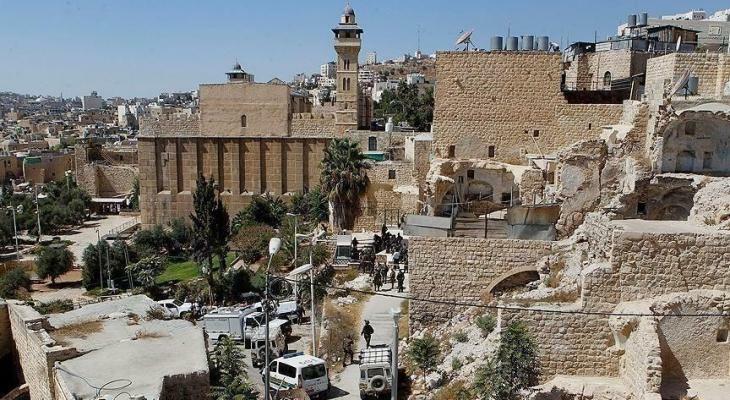
AL-KHALIL, (Palestine Foundation Information Center), Israeli occupation authorities completely closed the Ibrahimi Mosque in al-Khalil, in the southern West Bank, to Muslim worshipers and visitors on Friday, citing Jewish holidays.
The closure prevents Muslims from accessing one of their most significant religious sites while allowing Jewish settlers to enter and conduct religious ceremonies inside.
The Palestinian Ministry of Awqaf and Religious Affairs said Israeli authorities had ordered the Mosque closed to Muslims from the end of Friday prayer until Saturday night to accommodate settler visits and Jewish holiday celebrations.
In a statement, the ministry said the restrictions include barring worshipers and Islamic Waqf employees from entering the Mosque, as well as prohibiting the call to prayer and the performance of Muslim prayer throughout the closure.
The ministry condemned the measures as a blatant violation of religious freedom and the sanctity of the Ibrahimi Mosque.
It warned that the restrictions form part of a systematic policy aimed at Judaizing Islamic holy sites and imposing divisions over when and where Muslims and Jews can worship inside the Mosque.
The ministry called on international organizations and human rights institutions to intervene urgently, pressure Israeli authorities to halt the violations, and ensure the protection of Islamic holy sites.
Repeated closures tighten restrictions on Palestinians in al-Khalil
The latest closure comes amid a long-standing series of Israeli measures affecting Palestinian access to the Ibrahimi Mosque and the surrounding Old City of al-Khalil.
Israeli authorities frequently close the Mosque to Muslim worshipers during Jewish holidays, while imposing additional military restrictions on Palestinian residents, businesses, and movement throughout the area.
These measures often include intensified security deployments, restrictions at military checkpoints, and the closure of roads and entrances leading to the Mosque.
For Palestinians living in al-Khalil’s Old City, the restrictions further complicate daily life and limit access to religious sites, homes, and commercial areas.
The Mosque’s religious and historical significance makes these measures particularly sensitive. Located in the heart of the Old City, the Ibrahimi Mosque stands in an area where Palestinians face extensive Israeli military restrictions amid the presence of Jewish settlers and nearby settlement outposts.
Previous closure during Jewish holidays
Israeli forces previously closed the Ibrahimi Mosque for three days beginning September 28, citing the need to facilitate settler celebrations of the Jewish holiday of Sukkot.
The restrictions reportedly included closing checkpoints and electronic gates leading to the Mosque, increasing the Israeli military presence in the surrounding area, and shutting down several markets in al-Khalil’s Old City.
Throughout September, the Mosque also witnessed additional restrictions, including preventing Muslim worshipers from entering and removing Islamic Waqf employees and custodians from the premises.
Palestinian officials warned at the time that these measures reflected escalating interference in the Mosque’s Islamic administration and attempts to impose new arrangements governing access and worship.
The 1994 Ibrahimi Mosque massacre and its aftermath
One of the most consequential events in the Mosque’s modern history occurred on February 25, 1994, when Jewish extremist settler Baruch Goldstein opened fire on Muslim worshipers during dawn prayers in the holy month of Ramadan.
The attack, known as the Ibrahimi Mosque massacre, killed 29 Palestinians and wounded more than 150 others.
Following the massacre, Israeli authorities imposed new arrangements that divided the Mosque between Muslim and Jewish worshipers, both physically and according to designated times of access.
Large sections of the religious complex were allocated for Jewish worship, while additional restrictions were placed on Muslim entry and religious practices.
Since then, the Mosque has been subjected to repeated Israeli measures extending beyond temporary closures to restrictions on its administration, facilities, and religious activities.
These measures have included limits on the Muslim call to prayer, restrictions on worshipers’ access, and arrangements facilitating settler visits and Jewish religious ceremonies inside the complex.
Palestinians warn of attempts to change the Mosque’s religious identity
Palestinian officials and religious authorities warn that repeated closures, particularly during Jewish holidays, are not merely temporary security measures, as Israeli authorities maintain.
Instead, they view the restrictions as part of a broader policy aimed at changing the Mosque’s religious identity, consolidating Israeli control over the site, and gradually reducing the Muslim presence within it.
They also warn that the measures are closely connected to wider restrictions on Palestinian life in al-Khalil’s Old City, including settlement expansion, military checkpoints, and limitations on residents’ freedom of movement.
Amid the latest developments, Palestinian authorities renewed their calls for meaningful international intervention to protect the Ibrahimi Mosque, preserve its religious and historical significance, and end restrictions on Muslim worship and Palestinian life in al-Khalil’s Old City.