By Dr. Sabir Abu Maryam
Secretary-General, Palestine Foundation Pakistan
(Palestine Foundation Information Center), Against the backdrop of the prolonged conflict, destruction, and humanitarian crisis in Gaza, the comprehensive peace plan has been described as a major turning point following its endorsement by the United Nations Security Council and international mediators. The agreement, referred to as the “Gaza Peace Board,” was endorsed through UN Security Council Resolution 2803 and consists of 15 points.
Under the Gaza Peace Board plan, two key bodies have been established under US leadership. The first is known as the Gaza Executive Board, headed by Nickolay Mladenov, the High Representative for Gaza, along with international representatives. The second component is the National Committee for the Administration of Gaza (NCAG), a committee of 15 independent Palestinian technocrats headed by Ali Shaath. It is tasked with overseeing basic services, the economy, and reconstruction at the local level.
Under the first phase of the plan, a temporary ceasefire, the delivery of humanitarian aid, and the exchange of all Israeli and Palestinian prisoners were successfully implemented. At the same time, Hamas expressed its willingness to hand over technical and civil administration to the Palestinian National Transitional Committee (NCAG), established under international supervision, and announced its withdrawal from civil control in order to facilitate reconstruction and the restoration of essential services.
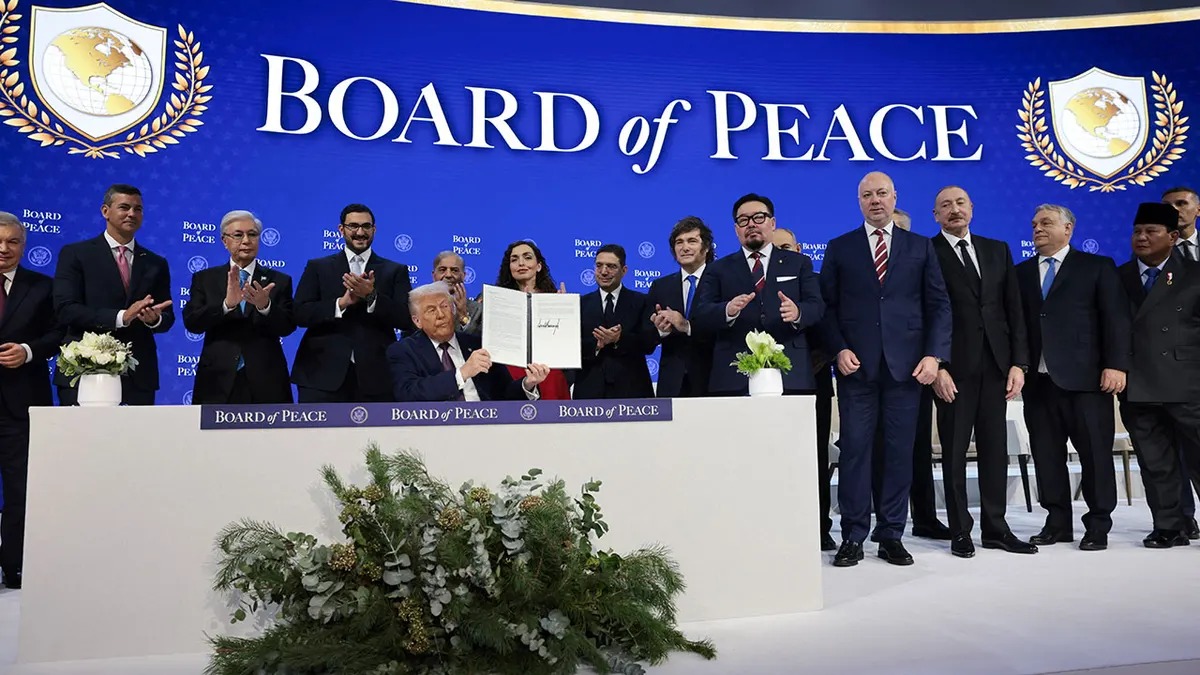
The basic framework of the second phase provides for an international central body known as the Board of Peace, which will oversee economic recovery and the funding mechanism with the participation of the United States, other international representatives, and regional allies. Under this phase, Palestinians have been promised the complete reconstruction of devastated infrastructure, including water, electricity, and hospitals, as well as housing projects and the establishment of a Special Economic Zone (SEZ) aimed at reviving Gaza’s economy through foreign investment.
However, in return for these measures, Hamas, Islamic Jihad, and other Palestinian factions are required to dismantle their military infrastructure, including tunnels and weapons-manufacturing facilities, and completely disarm. The deployment of an International Stabilization Force (ISF) has also been proposed to oversee security arrangements.
The most controversial and sensitive issue in the entire process concerns the complete withdrawal of Israeli forces from Gaza and the provision of security guarantees. Under the latest agreements and the 15-point roadmap, the withdrawal of Israeli forces is no longer tied to a specific timetable. Instead, it has been made conditional on the complete disarmament of Palestinian factions and verification of the security situation through US command and international forces.
According to international reports and global institutions, Israel has continued advancing beyond the border lines designated during the first phase, known as the “Yellow Lines,” while maintaining operational and security control over a significant portion of Gaza.
Given Israel’s conduct and the history of previous agreements, a critical question is increasingly being raised internationally: Can Israel’s complete withdrawal really be trusted after Palestinian factions have been disarmed?
Past experience, particularly from the 1993 Oslo Accords through the 2005 Gaza disengagement and the more recent expansion of security zones, suggests that Israel has repeatedly invoked security concerns to maintain permanent security zones and surveillance. Unless an independent, impartial enforcement mechanism exists to impose direct international sanctions or other penalties on Israel in the event of violations, relying solely on political commitments or statements for Israel’s complete and unconditional withdrawal would remain highly uncertain and constitute a major strategic risk.
Another important question is being raised regarding the broader regional situation. Following Palestine and Lebanon, Iran is now also facing war, while Iran is confronting the conflict under circumstances in which a permanent ceasefire in Palestine and Lebanon has been presented as a key condition of the ceasefire arrangements. In this situation, political analysts are asking what the future of the Gaza Peace Board agreement will be, particularly when Israel appears unwilling to withdraw from Gaza while the war with Iran continues.
According to political analysts, the biggest obstacle to the practical implementation of the Gaza Peace Board is the timeline. Israel maintains that its forces will not withdraw until all tunnels and weapons have been completely dismantled. Palestinian factions, on the other hand, fear that once they disarm, Israel will not relinquish its security control, as has allegedly occurred in the past, including after the 1982 Lebanon war and the Oslo process.
Another major challenge is the composition of the NCAG. Neither Hamas nor direct representatives of Mahmoud Abbas’s Palestinian Authority (PA) have been included in the committee. Although the stated objective is to establish a non-political administration, managing Gaza’s internal security and administrative affairs will be extremely difficult without broad political support from the local population and Palestinian factions.
As for international funding, the reconstruction of Gaza through international financing and the proposed Special Economic Zone will only be possible if the Board of Peace rapidly activates the International Stabilization Force (ISF) on the ground.
However, another fundamental issue remains: Hamas and many Palestinians argue that the arrival of any foreign military force on Palestinian territory could itself be viewed as a form of occupation, similar to the Israeli military presence that Palestinians currently regard as an occupying force.
On the other hand, if the Israeli government violates the agreement by maintaining permanent security zones or continuing military operations, the Board of Peace may lack independent authority to impose sanctions on Israel or compel it through legal action. This raises the possibility that the Board could ultimately be reduced to the role of a guarantor or observer rather than an effective enforcement mechanism.
Conclusion
In conclusion, the Israeli government has violated various agreements over many years, and even now, despite the cooperation of Palestinian factions, the Gaza Peace Board appears to be facing Israeli intransigence.
Under these circumstances, it is difficult to say with certainty that the Gaza Peace Board will be able to establish lasting peace in Gaza. However, Palestinian factions must also learn from history and avoid placing undue trust in their adversary, particularly Israel. From the Palestinian perspective, decades of conflict and failed agreements have resulted in Israel gaining control over large parts of historic Palestine.
A lasting peace and a sustainable solution to the Palestinian question, in the author’s view, can only emerge through resistance and a referendum of the Palestinian people.