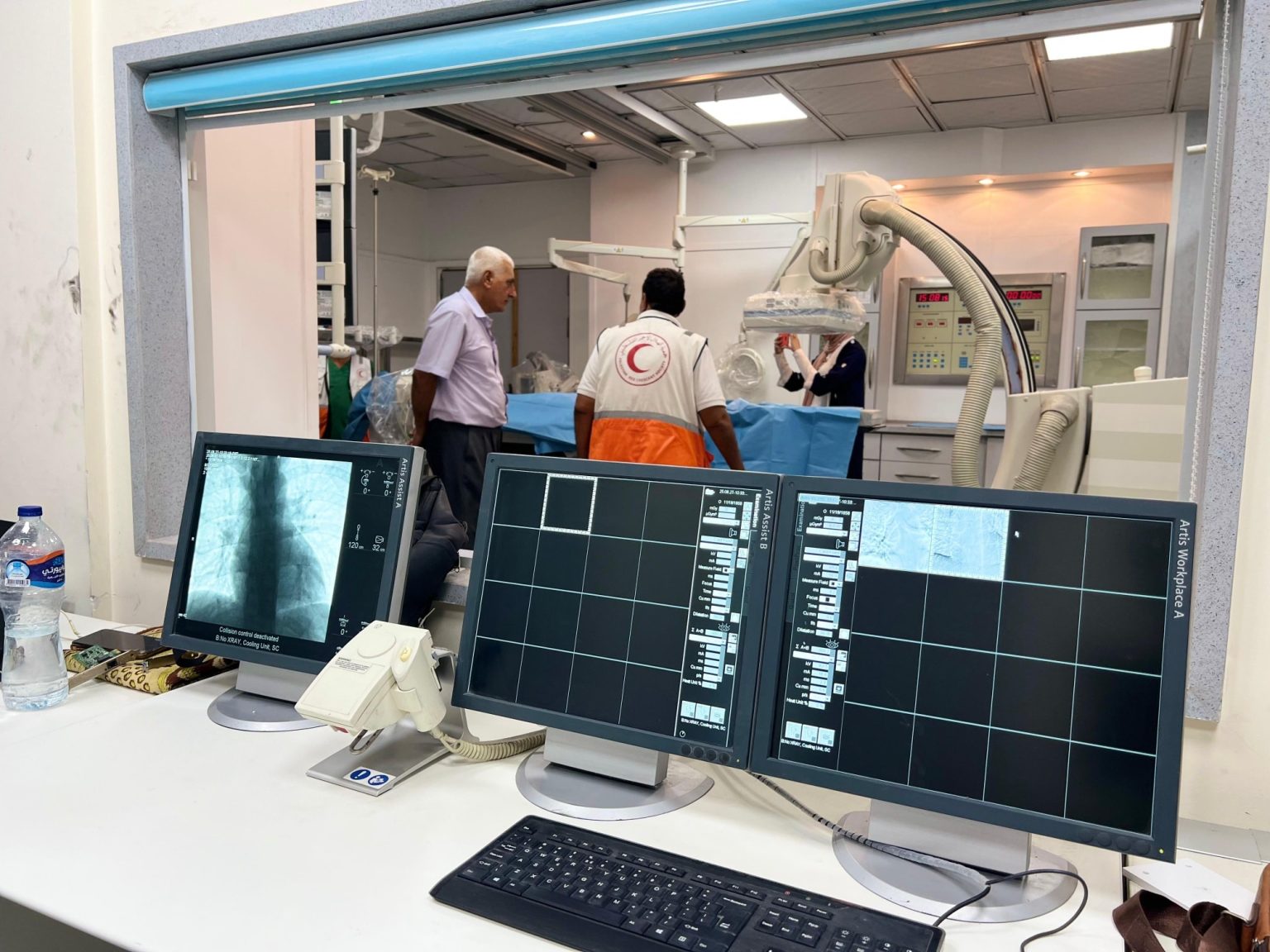
GAZA, (Palestine Foundation Information Center), Al-Quds Hospital, affiliated with the Palestinian Red Crescent Society, recorded a new achievement after the cardiac catheterization department exceeded the barrier of 1,000 cardiac catheterization operations in less than a year since its operation was resumed, to continue providing its services as the owner of the only catheterization device currently operating in the Gaza Strip, in light of the decline in the capabilities of the health sector due to the siege and shortage of medical supplies.
The hospital explained, in a press release, that these operations were not just numbers, but rather diagnostic and therapeutic interventions that contributed to saving the lives of hundreds of patients, and included diagnostic catheterization, stenting, and pacemaker implantation, in addition to receiving critical cases referred from intensive care units in the main hospitals in Gaza and the south of the Strip, which needed urgent interventions to save their lives.
The head of the cardiac catheterization department at Al-Quds Hospital, Dr. Ahmed Nassar, said, “Today we are performing case number 13 after operation number 1,000, and this achievement was achieved using the only catheterization device currently operating in the Gaza Strip.”
He added, “Despite the siege and scarcity of medical supplies, we were able to reach this number, and if capabilities were available, there would be no waiting lists, and we would have accomplished multiples of this number.”

Nassar pointed out that the department resumed its work on August 30, 2025 after the re-operation of Al-Quds Hospital, and has been able since then to perform more than 1,013 cardiac interventions, which varied between diagnostic catheterization, stenting, and pacemaker implantation, stressing that many of these cases were urgent interventions that contributed to saving the lives of patients.
Despite this achievement, challenges remain, as the department faces a severe shortage of stents, balloons, and medical wires, in addition to the difficulty of providing spare parts for the catheterization device, which limits its ability to receive more patients.
Nassar stressed that providing the necessary medical supplies would have allowed the department to perform approximately 3,000 operations annually, and end the waiting lists that currently include about 500 patients in need of diagnostic catheterization to determine their treatment path.