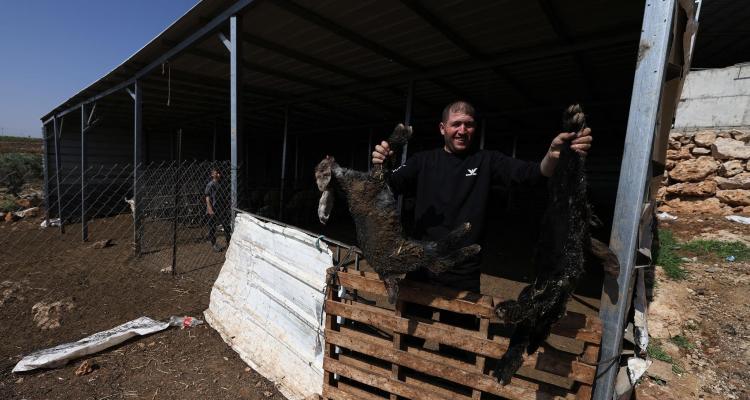
WEST BANK, (Palestine Foundation Information Center), Israeli settlement expansion is tightening its grip on pastures and agricultural land in the occupied West Bank, as attacks on Palestinian herders and restrictions on access to land and water threaten livelihoods and push more pastoral communities toward forced displacement.
A joint statement by the Palestinian Central Bureau of Statistics and the Environment Quality Authority, issued on Wednesday to mark Arab Environment Day, said pastoral and agricultural settlement outposts now dominate around 1.07 million dunums, or nearly 18% of the West Bank.
The statement, issued under the theme “Sustainability of natural pastures and strengthening resilience,” said West Bank pastures cover around 2,111 square kilometers, or about 37% of its area, with the eastern slopes accounting for 61% of total pastureland.
According to the data, 185 new Israeli settlement outposts were established between 2023 and 2025, including about 130 pastoral outposts and hilltop sites. Settlers seized around 300,000 additional dunums through these outposts in 2025 alone.
The number of pastoral outposts has reached 231 out of around 400 settlement outposts in the West Bank. During 2023–2025, settler attacks and restrictions on access to pastures and water sources displaced 118 Palestinian pastoral communities and groups.
The statement said Israeli control now covers about 42% of the West Bank, 71% of Area C and around 91% of the Jordan Valley, areas of major agricultural and pastoral importance.
Israeli military orders have allocated about 16,200 dunums for settler pastoral activities, while 70 agricultural and pastoral outposts have been legalized. In 2024, Israeli authorities issued land seizure, expropriation and “state land” orders affecting tens of thousands of dunums, in addition to orders changing the boundaries of nature reserves to seize about 20,000 dunums.
The loss of pastures forces Palestinian herding families to rely more heavily on purchased fodder, raising production costs and increasing economic pressure on rural communities. The impact also extends to the environment, as settlement roads, land-use changes and restricted access damage natural habitats and biodiversity.
The statement called for protecting and sustainably managing pastures, rehabilitating damaged areas, supporting pastoral communities and strengthening coordination with national and international institutions.
In Gaza, the situation is also severe. According to geospatial assessments by the UN Food and Agriculture Organization and UNOSAT, only 4,480 dunums of agricultural land were accessible and undamaged as of June 24, 2026, just 3% of Gaza’s total agricultural land.
Together, the figures show growing pressure on Palestinian agricultural and pastoral lands, threatening natural resources, livelihoods and food security in both the West Bank and Gaza.