By: Dr. Sabir Abu Maryam
Secretary-General, Palestine Foundation Pakistan
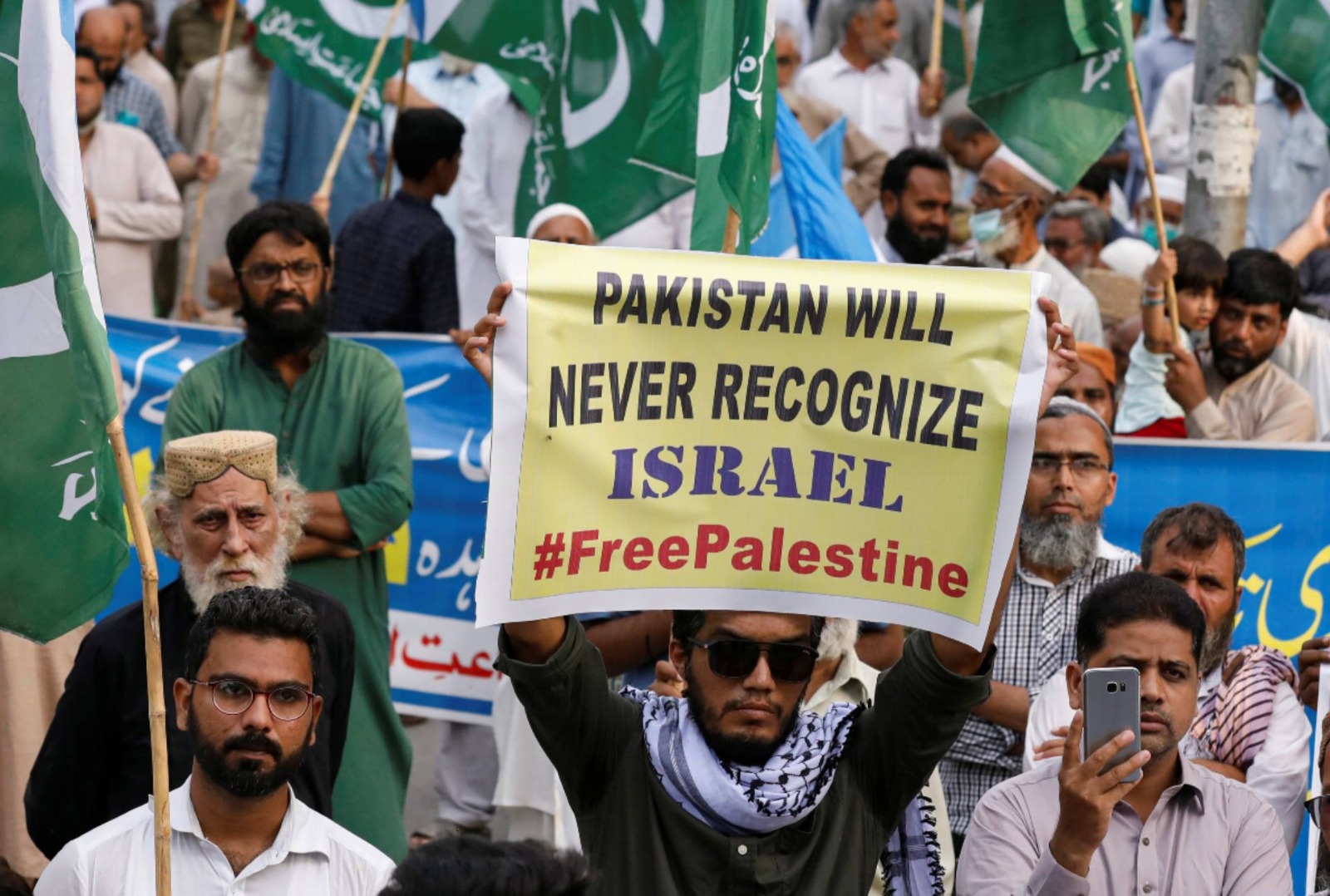
(Palestine Foundation Information Center), The global media and diplomatic circles in Pakistan are once again embroiled in an intense debate surrounding the Abraham Accords and the recognition of Israel. This discourse has been reignited by US President Donald Trump’s recent social media declaration, wherein he mandated demanded Muslim-majority nations, including Pakistan, Saudi Arabia, and Qatar to normalize relations with Israel. Crucially, Trump has tied any prospective security or nuclear deal with Iran to the prerequisite that Tehran, too, must normalize ties with Tel Aviv.
Through this mandate, the US administration has signaled to the Muslim world that the core issue of Palestinian sovereignty is being sidelined in favor of unconditional recognition of Israel.
What Washington and Tel Aviv failed to achieve strategically on the ground in the region since the onset of Operation Al-Aqsa Flood, they now seek to extract through the leverage of diplomatic negotiations with Iran.
Independent political analysts in the US observe that Washington faces a strategic deadlock against Iran’s regional influence, while Israel has struggled to decisively dismantle Hamas in Gaza and Hezbollah in Lebanon. In this context of operational frustration, Trump’s overture appears to be a calculated move to placate Israeli Prime Minister Benjamin Netanyahu.
Compounding this diplomatic pressure, US Senator Lindsey Graham, a close ally of the US President issued a veiled ultimatum to Pakistan, Saudi Arabia, and other Muslim states. Warning of future “difficulties” should these nations decline to sign the Abraham Accords, Graham’s rhetoric echoes Washington’s historical playbook of interventionism and regime-change politics, sending a chilling message to the leadership of these sovereign states.
While the pressure on Gulf nations intensifies, the developing situation has caused profound concern within Pakistan. However, a fundamental conceptual fallacy is emerging among Pakistani foreign policy experts and the Foreign Office: the tendency to anchor Pakistan’s state policy to the diplomatic decisions of Arab governments. Pakistan must realize that its stance on Israel is distinctly separate from that of the Arab world; it is entirely ideological.
A recurring narrative within Pakistani diplomatic corridors and mainstream media suggests that if Saudi Arabia normalizes ties with Israel, Pakistan will face diplomatic isolation or that Islamabad must follow the consensus of Arab states. This perspective is not only historically flawed but fundamentally compromises Pakistan’s status as a sovereign, independent state.
The conflict between Arab nations (such as the UAE, Bahrain, or Morocco) and Israel has historically been defined by territorial disputes, border security, and regional hegemony. Consequently, their diplomatic pivots are often dictated by ruling elite interests, economic incentives, and the pursuit of a US security umbrella.
Conversely, Pakistan’s refusal to recognize Israel does not stem from a geopolitical border dispute or transient strategic interests. Rather, it is an immutable ideological and principled commitment. Founded upon the foundational principles of Islamic statehood, Pakistan’s state policy cannot be made subservient to the foreign policy shifts of third countries.
Furthermore, the Pakistani Foreign Office’s conventional refrain, that Islamabad will not recognize Israel until an independent Palestinian state is established based on the pre-1967 borders, stands in direct contradiction to the foundational vision of the Father of the Nation, Quaid-e-Azam Muhammad Ali Jinnah. The current rhetoric maintained by the Foreign Office and certain liberal analysts inherently endorses the “Two-State Solution.” By implication, this suggests that if the Palestinian people are granted a fragmented enclave of land, Pakistan would view the existence of the Israeli state as legitimate.
This compromise is a stark negation of Jinnah’s explicit decrees. Jinnah consistently denounced the British and American plans for the partition of Palestine as unjust, cruel, and inhumane. He unequivocally declared that Israel is an “illegitimate child of Western imperialism” and described its creation as a dagger thrust into the heart of the Muslim world. He maintained that Pakistan could never recognize a state built upon the violent usurpation of another nation’s land. Jinnah’s stance was never a real estate negotiation dependent on land percentages; he rejected the entire moral and legal validity of the Zionist entity. Therefore, Pakistan’s diplomatic narrative must shift its focus away from the conditional establishment of a truncated Palestinian state and return to the core issue: the fundamental illegitimacy of the occupation.
The bond between the people of Pakistan and the Palestinian cause is not merely political; it is an unshakeable connection rooted in faith and universal human rights.
The Pakistani public views the ongoing atrocities in Gaza and the broader occupied territories as a collective wound. This deep affinity is backed by rigorous moral and rational arguments. No canon of international law or ethical framework justifies the mass displacement of an indigenous population to accommodate a settler-colonial project drawing people from across the globe.
Israel’s very foundation relies on a collapse of international morality. For Pakistanis, Al-Quds (Jerusalem) remains the first Qibla of Islam, and the liberation of this holy land is an article of faith. The public consensus holds that normalizing relations with a regime that commits systemic violence against innocent children on the land of the Prophets is an affront to humanity.
There is also a critical domestic strategic dimension: if Pakistan capitulates to external pressure or financial incentives to recognize Israel’s illegal occupation, it will irrevocably damage its own moral and legal standing on the Kashmir dispute. The core of both the Palestinian and Kashmiri crises is identical, the forced, illegal occupation of an indigenous population by an external power. Validating Israel’s occupation would effectively legitimize India’s illegal annexation of Jammu and Kashmir.
In conclusion, while the coercive diplomacy of American politicians like Donald Trump and Lindsey Graham presents a formidable challenge, Pakistan must not permit its foreign policy to be dictated by the shifting geopolitical alignments of Arab capitals.
Islamabad must abandon apologetic rhetoric and the pretense of the two-state solution. Instead, Pakistan must firmly state to the global community that its policy remains anchored in the vision of father of the nation Muhammad Ali Jinnah: for an apartheid, occupying entity, the word “recognition” does not exist in Pakistan’s diplomatic lexicon.